
Search Results for “{search_term_string}”

Seeds of Peace names Josh Thomas as next Executive Director

On behalf of the Board of Directors, it is our great pleasure to announce the appointment of Fr. Josh Thomas as Executive Director of Seeds of Peace!

Josh has served as interim Executive Director since February 2020, dividing his time between Seeds of Peace and Kids4Peace International, and serving as Board Chair of The Alliance for Middle East Peace.

He brings to us his years of experience working with nonprofit organizations in conflict regions and his first-hand knowledge of leadership development informed by decades of work in the fields of dialogue and social change.

Over the last five months, we have witnessed Josh successfully take on the challenges of managing Seeds of Peace during a pandemic while launching a strategic review of our organizational impact and vision. His clear ability to listen and lead across many spheres of thinking and translate learning into action give us further confidence in his leadership.

Josh is an Episcopal priest and a graduate of Dartmouth College and Union Theological Seminary. He has served congregations and campus chaplaincies in Atlanta, Boston, Seattle, and New Hampshire, and he taught courses in peacebuilding at Boston University School of Theology.

During his time at Kids4Peace International, Josh designed and managed projects funded by USAID and the US Institute of Peace which focused on empowering youth to be action-oriented, public leaders for peace.

In the coming months, under Josh’s leadership, we plan to integrate Kids4Peace programs into Seeds of Peace. We are excited about this opportunity to reach more youth and achieve even greater impact together.

We are honored to work with Josh as Seeds of Peace continues to develop courageous leaders who are creating more just and inclusive societies.

Steve Gruber
Board Chair

Janet Wallach
President Emeritus, Board Member

Shaiza Rizavi
Search Committee Chair, Board Member
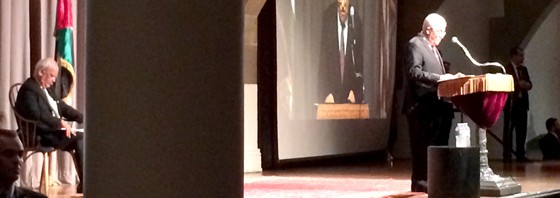
Palestinian President Mahmoud Abbas: Seeds of Peace “is the future”

NEW YORK | In a speech on the eve of the United Nations General Assembly meeting, Palestinian President Mahmoud Abbas outlined his vision for peace and pointed skeptics to Seeds of Peace.

“To those who say peace between Israelis and Palestinians is impossible, I say, let them visit America. I say, let them visit Maine,” he said to an audience at Cooper Union college on September 22.

“In Maine every summer, young Palestinians, Israelis, Americans, Arabs, and others meet in a camp called Seeds of Peace, founded in 1993. They build the very world I am calling for in Palestine.”

“It works. It is real. It is the future.”

Full remarks

President Bharucha, Mr. Clark, distinguished faculty and guests, religious leaders, dear students and members of the Cooper Union community, thank you for this opportunity to speak at one of the world’s most distinguished colleges.

From Cooper Union I would like to say: thank you America for extraordinary efforts that you have made to create peace in Palestine. And in particular to President Barack Obama and Secretary of State John Kerry, for their endless trips, back and forth, in search of peace.

What President Obama and Secretary Kerry did took courage. Just as it took courage for Abraham Lincoln to stand at this very podium to argue for the end of slavery.

I am honored today to stand in front of you at this podium, where eight men who were or became American Presidents have stood and announced their programs and platforms.

This great hall has been instrumental in furthering the Abolitionist Movement, the Women’s Suffrage Movement, American Labor Movement, the Civil Rights Movement, and the Native American Rights Movement. These walls have heard men and women speak far more eloquent than me; I ask their accommodation for the next half hour, to also hear me.

I come here today to convey to you the greetings of my people in Palestine who aspire for peace and justice. Palestine is a country in the heart of the Middle East. A country in the Middle East where Christians and Muslims live in harmony. A country in the Middle East, the birth place of Jesus Christ, in Bethlehem, where I pray with my follow Palestinian Christians three times every year. A country that hopes to live in peace and security side by side with its neighbor, the State of Israel.

I come today to pledge to create the new peaceful State of Palestine. I come here to ask you to rethink Palestine.

This may especially be seen by some as an odd and hard place for a faithful Muslim to talk peace. Here, almost in the shadow of Ground Zero, where thousands of innocent American men, women and children were also victimized on a quiet September day.

But today in Cooper Union, I stand on the same place where Abraham Lincoln stood over 150 years ago and condemned the scourge of slavery, to state, loud and clear, that we the Palestinian people condemn terrorism, we condemn what happened on 9/11, we condemn the treatment of Christians and non-Christians by ISIS. I am speaking on behalf of 99 percent of the Muslim peoples around the world. Here, today, nearly in the shadow of Ground Zero, I state to the world: the barbarians of ISIS and Al Qaeda who kill innocent people are not faithful Muslims. And to the children and families of the victims of 9/11, I say as a Palestinian Muslim, I am sorry for your pain. These murderers do not represent Islam, we all stand against them to defeat their evil plans.

At the same time we must work to end the Israeli occupation and establish a Palestinian state, for we cannot fight terror only by the gun.

Recently at the Vatican, Pope Francis, Shimon Peres, the former President of Israel, and I prayed together for peace. We prayed together because though we come from three different religious traditions, we all pray, in fact, to the same one God of Abraham.

Our holy book the Quran says: “O mankind! We created you from a single (pair) of a male and a female, and made you into nations and tribes, that you may know each other. Verily the most honored of you in the sight of Allah the most righteous of you.”

I am older than you. 79 years old to be exact. My life has been largely lived–for better or worse. So today, I come to tell you young people what I prayed for in the Vatican. I prayed for different world.

I prayed that day for an end to the occupation of my country Palestine, and my people. I prayed for a free and independent Palestine that will live side-by-side in peace, security, and prosperity with its neighbor, the State of Israel.

As you may know, Jews, Christians and Muslims have lived peacefully together in Palestine for centuries. So peace between religions runs through the heart of the most sacred City in the world, Jerusalem. Peace between the world’s religions runs through Jericho the Oldest City on Earth. Peace between the world’s religions runs through Palestine.

I prayed with the Pope that day for a Palestine and Israel that build bridges together instead of walls.

I made a prayer that someday I will be able to enforce the United Nations Convention on the Elimination of all forms of Discrimination against Women, which I have signed, and that we can make our new state of Palestine a model of women’s rights in the Arab world.

I also prayed that Israel will finally, after a long wait, live next to Palestine as a good neighbor and not as an occupier. So we Palestinians can continue to build our institutions for a modern and open state and society.

I made a prayer for an America that is a real friend of Israel, not a false friend. And just as real friends do not let friends drive drunk, so too a real friend of Israel would not let them engage in the widespread killing of women and children, including bombing United Nations schools and hospitals, such as we just saw in Gaza.

Just as real friends in America do not let friends break the law, a real friend of Israel would not let them advance 15,000 new illegal housing units while at the same time claiming to engage in peace talks.

Just as real friends in America don’t let their friends abuse their neighbor’s children, America as a real friend of Israel wouldn’t let them routinely arrest, beat and jail without charges Palestinian children, which has been well documented by both journalists and by independent human rights groups.

And so today, I come to ask you, the students of Cooper Union, I come indeed to ask all of the students of America and the world: Will you join this old man in his prayer? Will you help me to build a peaceful world? I am sure your answer is “yes, we will!”

Will you build this world I prayed for, and in fact, a better world than that, because, as the Christian Arab philosopher Khalil Gibran once said: “the future world of our children is so magical that an old man like me can never visit it, not even in my dreams.”

The people of Israel live today as our occupiers, and without a permanent vision of a peaceful coexistence with their very closest neighbors. This is not acceptable.

My people in Gaza live under siege by Israel, without freedom of travel, or of trade, with 80 percent of them now reliant on foreign aid, and in constant fear of being randomly bombed. They live locked in an open air prison. This is not acceptable.

To date, Israel maintains control of Gaza’s air space, territorial waters, electromagnetic sphere, population registry and the movement of all goods and people. The relatives of the very people in Gaza that Israel just killed even have to apply to Israel to obtain their death certificates. Is that a free people? This is not acceptable.

My people in the West Bank and East Jerusalem live under Israeli occupation, with segregated highways, behind huge walls, travelling through constant internal checkpoints, a large number of them with no running water, a large number of them still in refugee camps for decades, with no right to a fair trial and no right to post bail, often physically beaten and abused upon arrest, and with little hope for the future. Palestinians today have far fewer rights than African Americans in America had in the 1950s. This is not acceptable.

I ask you to rethink Palestine. You are smart. Study us carefully. Find the truth. Contrary to what is so often portrayed in your media, in the last decade we have done our part.

We tried for many months to begin serious negotiations with Israel. We said to the Prime Minister Netanyahu, since you openly state to the whole world that you support the two-state solution, why can’t we agree on a map for two states on the basis of 1967 borders? Despite many, many requests, we have never gotten a map.

I ask you to rethink Palestine. Help us stop the illegal stealing of our land. This week I will propose to the United Nations a new timetable for peace talks. The key is to agree on a map to delineate the borders of each country.

I say today to Prime Minister Netanyahu: end the occupation, make peace. A quarter century has passed since the Palestine Liberation Organization officially endorsed the two-state solution. In a historic decision, that has since been accepted by all the Arab states, Palestine recognized the State of Israel based on pre-1967 borders, conceding over 78 percent of historic Palestine.

Rather than accepting 78 percent of the land in question, the current Israeli government has chosen to use the peace process as a smoke screen for more colonization and oppression. We still wish to believe that our Israeli neighbors do not expect the Palestinian people to live under a system of apartheid. The desire of peace and freedom-loving nation for independence can’t be eliminated by force.

We are the only people on earth, who still live under occupation. This is not acceptable.

The fact is that the Arab League has presented a complete regional peace plan, the Arab Peace Initiative in 2002. This plan, which still stands, offers Israel full recognition and normalization of relations by 57 member countries of the Arab League and the Islamic Conference, in exchange for Israeli withdrawal to the 1967 border and a just and agreed solution to the refugee issue, based on UNGA Resolution 194. So our Nakbah can come to an end. If anyone ever again tells you that the Arab countries are the primary barrier to peace, that is simply false. And it has been this way for over a decade.

Rethink Palestine. Help us stop the illegal stealing of our land. Prime Minister Netanyahu, end the occupation, make peace. The Eighth Commandment says “Thou Shalt Not Steal.” America itself directly asked Israel to stop building illegal settlements on Palestinian land. But then Israel did the opposite: during the last nine months of negotiations sponsored by the United States, after being asked to freeze settlements, Israel advanced housing units for 55,000 new settlers in occupied territory, bringing to 600,000 the Israeli settlers population in the West Bank and East Jerusalem.

Isn’t stealing land covered by the Eighth Commandment? Under international law Israel has no right to take that land. Israel’s constant confiscation of our land is our most pressing and fundamental problem. It obstructs the achievement of a just and lasting peace with Palestine. This Israeli conduct reminds us of the wise words of late President Kennedy:

“We cannot negotiate with those who say, ‘What’s mine is mine and what’s yours is negotiable.’”

When Palestine exercised its long-overdue right to seek recognition of statehood before the United Nations in 2012, it was not in an attempt to bypass a negotiated peace. Instead it was to allow us to be a leader for peace and human rights in the Muslim world, mainly through access to multilateral treaties and international organizations. The worldwide vote to make us an observer state was in our favor by count of 138 to 9.

138 to 9 in our favor.

Only 9 countries in the entire world opposed our application; the dozens of other countries who all voted for us found that we were well-qualified to join the peaceful community of nations. These countries have all rethought Palestine, just as you must now do.

We ask that the international community stop hiding behind calls for “resumption of talks,” without holding the Israeli government accountable for its stealing of our land. The international community has the responsibility to protect our people living under the terror of settlers, an occupying army, and a painful siege.

The attitude of the international community toward the Israeli government must be related to holding it directly accountable to international law and human rights.

On behalf of the brave Palestinian people, in the tradition of Mahatma Gandhi, and Martin Luther King, and Nelson Mandela, I still come here to deliver a message of peace and justice to Israel and the rest of the world.

Security requires justice and an end of occupation. We cannot understand how the Israeli government can be so misguided as to fail to understand that the indiscriminate bombing of Gaza that kills hundreds of women and children only sows more hate.

As the President of the Palestinian people, I remain totally committed to the vision of a two-state solution, so we can live in peace with our neighbor, Israel. This is the reason I joined Pope Francis, together with President Peres, in our prayer for peace.

Now, I have told you about my world. The world of this old man. But you are young. In the language of youth, there is no such word as tired. In the vocabulary of youth, there is no such word as failure.

In Maine every summer, young Palestinians, Israelis, Americans, Arabs, and others meet in a camp called Seeds of Peace, founded in 1993. They build the very world I am calling for in Palestine. It works. It’s real. It’s the future. To those who say peace between Israelis and Palestinians is impossible, I say, let them visit America. I say, let them visit Maine.

In closing again, at 79, I do not know for certain if I will ever hold in my hand and taste the sweet fruit of peace. But I do know this for certain. I have held in my hand, and seen with my own eyes, the seeds of peace. The seeds of peace are the young Palestinians, Israelis, Americans and others all over the world who form peace groups on college campuses like J Street and Students For Justice in Palestine. Those are the seeds of peace.

You are the seeds of peace. Do not underestimate the power of your youth.

It was the young people who marched in Birmingham, Alabama, with Martin Luther King, who caused race relations in America to be rethought. It was the young people in America whose protests on college campuses against the Vietnam War forced that war to be rethought. It was the young people in America whose protests on college campuses against apartheid caused that injustice to finally end. And I say this to you: you have the power to convince the American people to rethink Palestine.

Wisdom may come from the old, but passion for justice is the province of the young. The old ask: what day will justice come? But for the young, the time for justice is always NOW. In the vocabulary of youth, the time for justice is always RIGHT NOW. And so it should be.

It was to the young, that Nelson Mandela, a great friend of Palestine, once said that South Africa could never be fully free until Palestine was free.

Now will each of you seeds of peace start tonight to build the world I prayed for with Pope Francis?

Will you seeds of peace create the world of tomorrow, where there will be no more Palestinians or Israelis killed?

Will you seeds of peace create a world that supports the 99 percent of peace loving Muslims, Jews, and Christians, and reject violent radical religion?

Will you seeds of peace rethink Palestine and ask others to rethink it?

Will you do that, for the sake of Palestinians and Israelis?

Of course you will. Because here at this magnificent college—the Cooper Union—where magical things are created, as at colleges across America, religious and ethnic diversity already exists. You have already created in your universities a model of the very world of interreligious coexistence and peace and love that the old people try to tell you is impossible in my country.

Despite all Israeli attempts to make our nation accept a reality of exile and apartheid, we continue our peaceful march toward freedom. Paraphrasing our late poet Mahmoud Darwish “standing here, staying here, permanent here, eternal here, and we have one goal, one, one: to be.” And I say, yes we will be.

So you already know how to build the road to future peace, and you know that it runs through Cooper Union, it runs through America and yes it runs right through Jerusalem and Palestine.

We have all made mistakes. But today, I say, let us move forward. Let us forgive not seven times, but as Jesus himself said, 70 times seven times.

Martin Luther King once said, “The arc of the moral Universe is long, but it bends toward justice.”

Today I say: the arc of fear is long, but it circles back to love. I intend to close that circle, and today I humbly ask you, the students of Cooper Union, of America, and of the world, to be part of that change. Rethink Palestine.

Riya: Speaking up, raising funds for India’s migrant workers

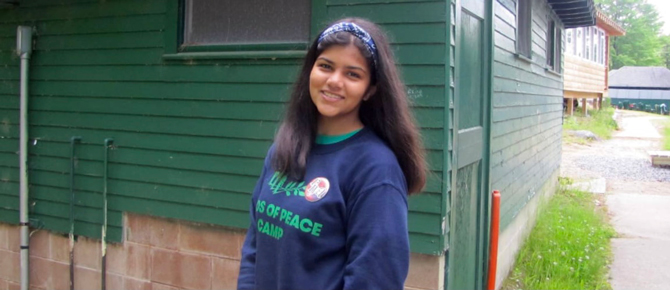
At a time when the sheer devastation of COVID-19 is paralyzing swaths of Indian society, Riya is channeling empathy into action.

“My experience with Seeds has taught me that we, the young people, have the capacity to lead the change to help people, and that is what I intend to do,” she said.

The 2019 Indian Seed is working to raise funds and awareness for migrant workers who she describes as “the real backbone of India.”

It is estimated more than 140 million people from rural India migrate seasonally to bigger cities in search of work, but COVID has taken an especially deep toll on this community. Not only does the virus spread quickly among the cramped conditions in which day laborers often live, but has dried up much of the work opportunities and their ability to support themselves.

“I decided to help this section of society in whatever way I could, rather than just sitting at home and feeling helpless and sorry for them,” Riya said.

She has partnered with a volunteer-run community kitchen in Delhi that provides migrant workers and daily wage earners, including those affected by COVID, with free meals. It takes about ₹20,000 a day to run the kitchen, and she is currently about a third of the way to her goal of ₹2,00,000 (or $2,857.)

Riya said that the pandemic has deeply impacted her family and friends, on an emotional level and in terms of loss of life. She has been encouraged, however, by evidence that “the spirit of humanity is still alive and kicking,” especially in the form of people around her—including many fellow Seeds—reaching out and stepping up in times of crisis.

“It is an amazing feeling to see the community around me, rallying together to find beds, medicine, and hospitals for people who need it, and provide other areas of support to people from all walks of life,” she said. “Of the many things I learned as a Seed, the most important thing is that young people like me can help other people and make a difference in the world. It is because of my ‘Seeds of Peace’ community that I decided to start this fundraiser—so we could help people together.”

Learn more or support Riya’s fundraiser ››

Seed Stories: Finding a home in the field

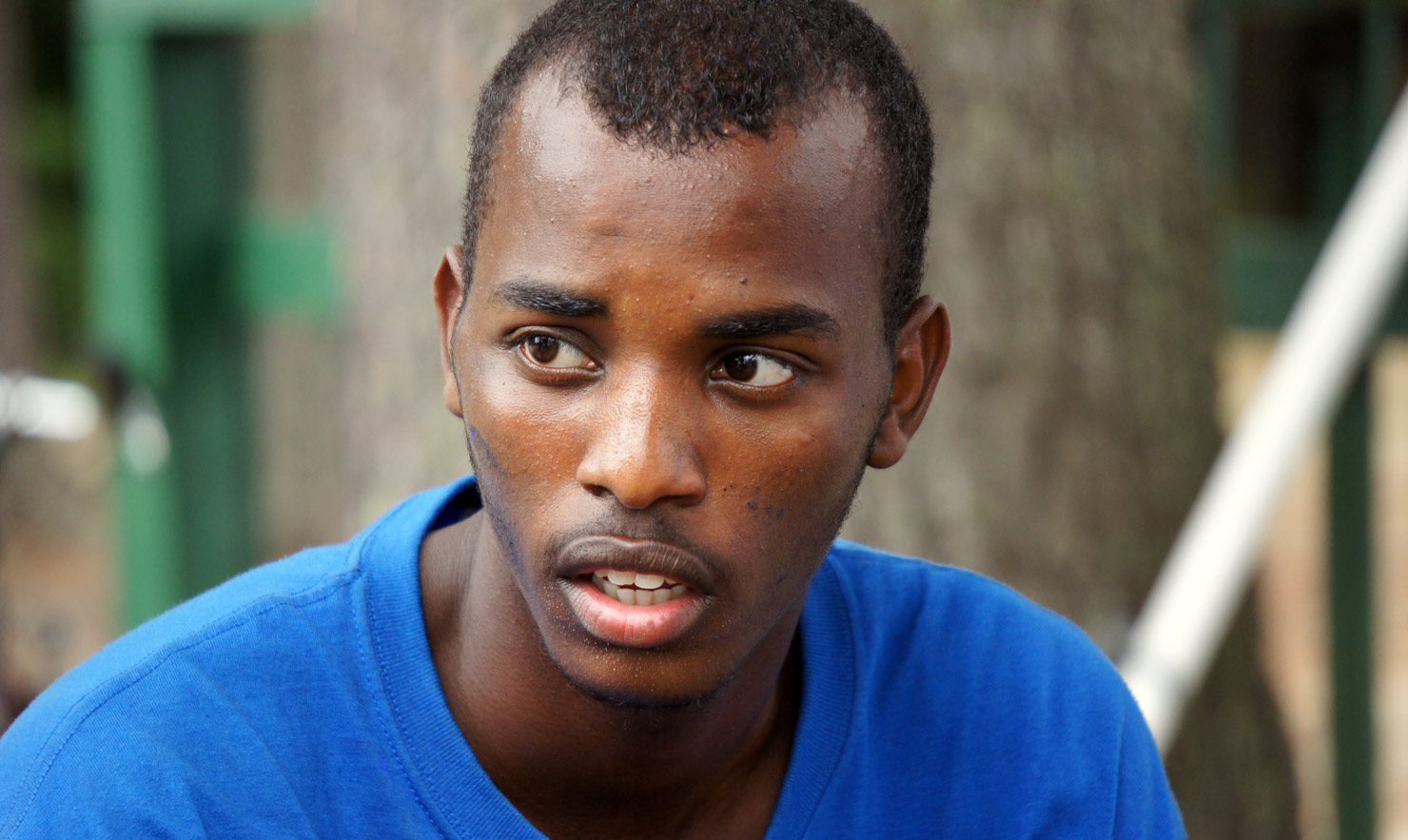
Twenty-five years ago, I was born in a refugee camp in Kenya after my parents fled the civil war in Somalia. My parents struggled to keep my brothers and I secure, fed, and sheltered.

Our struggle became even worse when my parents decided to divorce, divide the children they had together, and go their separate ways. I went with my father.

By the age of 6, I already had the responsibilities of an adult. I had to cook, clean, and look after my little brother while my father left to search for food. The shelter we lived in was slowly tearing apart. Every day, wild animals like hyenas and lions would dig, rip, and damage it, exposing us to the elements. Hope was slowly leaving our hearts.

But then, a miracle happened. After years of feeling hopeless, we learned that the United Nations had selected our family for resettlement to the United States. Friends and neighbors spoke highly of America and told us we were going to a place that was heaven on earth. We were extremely excited for the opportunities our new life was going to offer us. We had been given a second chance.

In September 2005, we were resettled to Syracuse, New York, one of the poorest cities in the nation, especially for black folks. We were nervous and unsure how to make use of the resources that were available. Paying monthly bills was a new idea to us. We did not know where to look for food and when we found it, our bodies rejected much of it. The only thing that tasted familiar was candy. It was a completely new world.

We were given a home in an area Syracuse people know as the Bricks. It was also known as the hood or the projects. We didn’t know what the “hood” was or what it meant to live in one, but we were confident that it was going to be better than the refugee camp we came from.

I was excited to go to school. Unable to speak the English language, I used basic senses to understand and communicate with my peers. After my first week of school, I was bullied by a classmate. At the time, I was naive and did not realize I was being bullied. I comprehended the situation as a way Americans communicate and thought that it was a weird way to make a new friend.

From the time I began school, to the time I went to college, I lost count of the number of times I was attacked. I soon learned that the people attacking me were affiliated with gangs. They had guns and were not afraid to use them. At night, I would hear gunshots near my house. In the morning, as I walked to the area where the bus picked me up for school, I would see a trail of blood on the pavement from someone who had been wounded.

As I began to understand English, I realized I was not safe from verbal attacks either. I was treated like a criminal based on my skin color. People called the cops on my friends and I, when we hadn’t done anything wrong. I learned to avoid looking like a Muslim whenever there was an attack on American soil. l was made to feel that coming to America as a refugee who seeks asylum is the worst thing you can be. People automatically concluded that you had come to take away their American Dream. All of the ignorant, negative stereotypes that were associated with coming from a refugee camp in Kenya were hurled in my direction. Once, a fellow classmate scraped cookie crumbs off of her desk and into her palm after eating a cookie and tried to hand me the crumbs, suggesting I should eat them. It was the most dehumanizing incident I’ve ever experienced in my short life, one I still struggle to forget.

This was not the America I was told about back in the refugee camp. I began to hate who I was and where I came from because of the way people treated me. As a result of these experiences, a small, negative voice developed in my mind, which gradually got louder. It was saying things such as ‘You are nothing. You deserve nothing. You are a burden to people; you are worthless.’ I could not turn it off. I was feeling mental pain that hurt more than physical pain. I didn’t know what it was but I wanted it to stop.

But then another miracle happened. I learned about Seeds of Peace. I didn’t know what it was, but I liked the word ‘peace’ in the organization’s name. My brothers told me it was a place where we could water-ski and play soccer every day. I went to the introductory meetings held after school. It sounded amazing and just what I had been yearning for and from the moment I set foot on the Camp’s grounds, I knew a journey of self-discovery and transformation had begun.

In the dialogue hut, I was given the space to unbottle all of the things I had bottled up over the years. I allowed myself to venture out of my comfort zone, to try new activities and to learn more about myself and others. Although I am normally a reserved and shy person, I found myself singing and dancing in front of people in an uninhibited way. I bonded with people from different socio-economic, racial, and religious backgrounds over bonfires and s’mores. I was made to feel that I was enough, and that my difference was beautiful. It was the happiest three weeks of my life.

There’s a saying at Seeds of Peace: out beyond ideas of right-doing and wrong-doing, there is a field. I’ll meet you there. I learned that people in this field look beyond labels of society. They use the “I” statement when they speak and not “they” or “them.” They delve into the most challenging topics fearlessly in the hope of growing past their comfort zone. They listen with their whole bodies even when they disagree with what is being said. They love with their whole hearts and help each other dismantle and heal from past experiences. This was an unreal experience. Unknowingly, it was what I had been searching for my whole life. It refurbished the hope that had been damaged by the outside world. Seeds of Peace became the place I call home.

Today, I work as a substitute teacher in the public schools of Syracuse and use every opportunity to mentor, educate, and empower students to become more than what the hood offers. I am on the board of directors for a non-profit that connects new Americans to the resources that help them transition into their new life. I am also on the board of a local non-profit credit union that helps fight off big banks that make poor communities poorer and works to keep the community’s money within the community. And I am working on a documentary that helps people understand what it means to be a refugee in America.

For as long as I walk this earth, I plan to keep what Seeds of Peace made me feel in my heart and use it as a hope for what this world can one day become. No matter where life takes me, I plan to live by the late Camp Director Wil Smith’s words and do “whatever I can, with whatever I have, wherever I am.”

Excerpt from remarks delivered at the 2019 Spring Benefit Dinner on April 30 in New York.

Nurturing the Seeds of Peace
Detroit Jewish News

BY ARTHUR M. HORWITZ | Empathy. Webster’s defines it quite simply: “Intellectual or emotional identification with another.” Yet its absence has been a primary obstacle to peacemaking between Israel and its neighbors.

Israel Prime Minister Ehud Barak’s jump-starting of the meandering Middle East peace process, literally hours after taking office last week, is rooted in the understanding that both Israelis and Palestinians have suffered over the years. By acknowledging the mutual pain, Barak has suddenly put a human face on the enemy.

Similar pronouncements from Yasser Arafat, the chairman of the Palestinian Authority, are also needed to achieve the “peace of the brave” to which they both refer.

Empathy.

Thousands of miles away from their homes, Israeli and Arab teenagers, mostly Palestinians, are learning and living the language of understanding. At a camp in Maine, outside of Portland, Seeds of Peace is providing these teens with a glimpse of the future—one that their generations will help shape.

A group of 165, including a delegation of Turkish and Greek Cypriots, are currently completing a three-and-a-half week session that has changed them from enemies to friends. And it all started with getting beyond their respective “facts” and fears while feeling the other person’s pain.

Seeds of Peace is the brainchild of veteran Hearst newsman John Wallach. Since its inception in 1993, more than 1,000 “seeds” have graduated from the camp, returning to their countries and communities as beacons of conflict resolution. Seeds of Peace is the only people-to-people program that has the blessings of the Israeli, Palestinian, Egyptian, Jordanian and Moroccan governments.

More than 4,000 teens are nominated each year by their governments to be among the 300-350 “seeds” who attend one of the camp’s two sessions. The camping experience is similar to many others on the one hand… pristine lake, sports, arts and crafts and bug juice.

On the other hand, it has daily conflict resolution sessions facilitated by trained staff and carefully planned integration of sports teams, bunks and other camp activities. The universal language of the camp is English.

A group from Detroit, headed by Seeds national board member Joel Jacob and including U.S. Rep. Joseph Knowllenberg, an important Seeds supporter on Capitol Hill, visited the camp last week. What they saw were the possibilities when fear and suspicion are overcome.

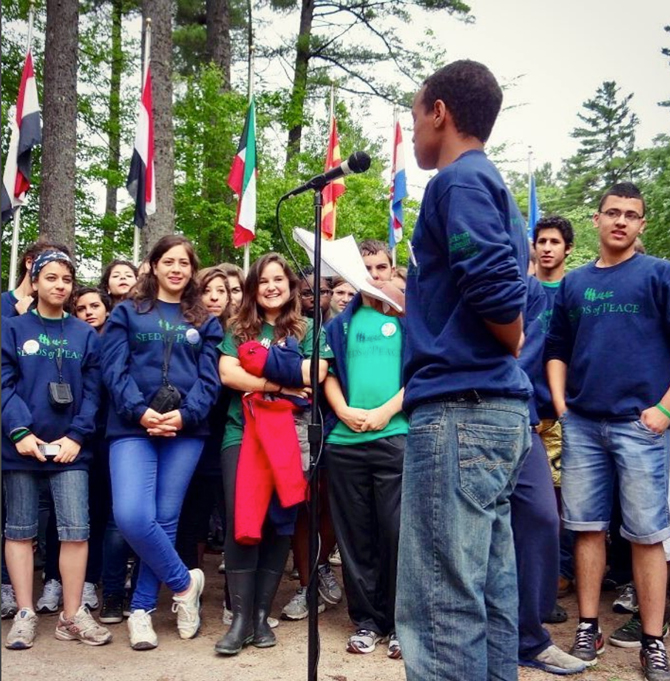
The teens stroll the campgrounds in identical, standard-issue green T-shirts. Girls are arm-in-arm with other girls. Boys throw their arms around other boys. Only after meeting them do you realize that they are Jewish girls holding hands with Palestinian girls; Palestinian boys throwing their arms around Jewish boys.

When this group of campers arrived at the camp less than three weeks ago, they were armed with anger, fear and their own set of “facts.” Also, many came following a final orientation from their host governments meant to reinforce their feelings of injustice.

“Freedom fighters” or “terrorists?” Six-million Holocaust victims or 10,000? “You mean I have to sleep in the same bunk with my enemy?”

Within a week, however, the campers begin to listen. And with listening comes empathy and humanity. A bomb in a market is not merely a strike against the Zionist entity. It is the maiming of the friend of a Jewish “seed” who was only looking to buy some food to feed her family.

A vigorous search by a soldier at a border crossing is not just a safety net for catching terrorists, but the humiliation of the grandmother of a Palestinian “seed.”

By sharing and hearing each other’s fears, the young people develop a remarkable bond. While the campers still engage in heated arguments about the final status of Jerusalem or the return of Palestinians from refugee camps, they disagree without being disagreeable and they remain friends.

The model created by Seeds of Peace provides a glimpse of how far the peace process can go. In his inaugural address last week, Israel’s Barak said he is “not only cognizant of the sufferings of my own people, but I also recognize the sufferings of the Palestinian people.”

It all starts with empathy.

Senator King Honors Wil Smith

In a statement submitted to the Congressional Record today, U.S. Senator Angus King paid tribute to the life of Wil Smith, a former associate dean at Bowdoin College in Brunswick, Maine, and a coach, mentor, and friend to countless people across the state. Wil lost a three year battle with colon cancer on Sunday morning. He was 46 years old.

Mr. President, I rise today on a sad occasion. Yesterday, Bowdoin College—indeed, the entire State of Maine—lost a truly great man. Wil Smith, who was a good friend to countless people in Maine, passed away yesterday at the age of 46 following a courageous three-year battle with cancer.

It is difficult to encapsulate in words the remarkable depth and breadth of someone like Wil. He grew up in Jacksonville, Florida, the youngest of ten children. His mother, Mildred, passed away when he was 15 years old. After high school, Wil briefly attended Florida A&M University before enlisting in the U.S. Navy and becoming an aviation electronics technician. He served in the first Gulf War and was later transferred to the Naval Air Station in Brunswick, Maine.

While stationed in Brunswick, Wil began coaching football at Brunswick Middle School. It wasn’t long after that when the coach of the Bowdoin College men’s basketball team spotted him and was impressed by his talent and natural ability to work with kids. He asked Wil if he had ever thought about attending college. After some convincing, Wil applied to and was accepted at Bowdoin.

It was also during this time that Wil became a father—and only months before his first semester began, he was granted full custody of his 11 month-old daughter, Olivia. To say the least, he was a nontraditional student in almost every sense. Matriculating at age 28, he was a decade older than most of his freshmen classmates. He was one of just three African-American students in his class. And he was the first single father in Bowdoin’s history to attend the college.

He worked tirelessly—carrying Olivia to class and then to basketball practice, taking evening shifts at the local Staples store, and volunteering at area high schools. He faced challenges unfathomable to most of his classmates at Bowdoin—struggling to balance a commitment to his daughter and his rigorous coursework. But Wil persevered—and he did so with a strength of conviction and determination that would come to define the influence he would have on students who would follow in his footsteps at Bowdoin.

Following graduation, Wil continued to devote his time and energy to his community, and in particular, to young people of nontraditional or underrepresented backgrounds. He continued to serve in the U.S. Navy Reserves, and joined the staff of Bowdoin College, serving as Director of Multicultural Student Programs. Driven to continue his education, he then enrolled in the University of Maine School of Law, where three years later, he would graduate with a law degree and once again return to Bowdoin.

At Bowdoin, Wil served as a beacon of light to so many students—many of whom, like him, toiled with the challenges of the transition to college. But as a gifted mentor and as someone who had the rare ability to genuinely connect with people, to understand them, and to relate to them, Wil inspired a newfound sense of hope in countless students, and his advice, unfailing support, and encouragement turned around the lives of hundreds and perhaps thousands of people.

And while students were away from Bowdoin during the summer, Wil dedicated his time to the Seeds of Peace International Camp in Otisfield, Maine. It was an endeavor that he joined in the summer of 1999, before he graduated from Bowdoin, and it was one he carried on until last summer. At the camp, he mentored children from across the world, and challenged them to look at and judge their peers not by their race, ethnicity, or differences—but by their thoughts and their merit. Will was truly a team player in this work, serving in numerous positions at Seeds of Peace over the years, from coach to counselor to associate director. But the title was always less important to Wil than knowing he was helping those he worked with at the camp. And true to the camp’s mission, Wil cultivated seeds of peace within the heart of every child he met—his reach and impact extending around the world.

That same spirit of mentorship drew him to the basketball courts of Catherine McAuley High School in South Portland, where he coached the girls’ varsity team for a decade, amassing nearly twice as many wins than losses and, in a testament to his talent as a coach, bringing home a prized State Championship in 2007. Through the game he loved, he taught young women about the power and virtue of leadership, character, and teamwork—the same traits he worked so hard to instill in students at Bowdoin, in young people at Seeds of Peace, or in anyone who came to him in search of help.

There is a hole in the heart of our community today. But while Wil’s loss is felt by countless people, his legacy will be carried on by the thousands who were fortunate enough to know him. Indeed, it is that legacy of caring, of hope, and of understanding which he has given to us and which we will give to future generations along with his story as proof that even the most unlikely of beginnings can yield remarkable outcomes. Today, the world is a lesser place for Wil’s loss, but we are all better for him having been in it.

My heart goes out to his daughter, Olivia; his partner, Maha Jaber, and her son, Nim; his family; and to all the people whose lives were touched by this extraordinary man’s unfaltering enthusiasm, caring, and generosity.

What We’re Reading: Opening minds on mental health

Odds are that each of us knows someone living with a mental illness, or live with one ourselves. But unfortunately, because of stigma, lack of resources, or awareness, we often go through these struggles alone, sometimes never receiving critical support, or even knowing that what we are experiencing can be helped.

While the severity varies greatly from person to person, mental illness affects one in five people, including the teenagers that come to Camp each summer. Researchers estimate that as many as 50 percent of youth ages 13-18 will deal with some sort of mental health issue, and half of all serious mental illnesses set in by age 14.

This May marks the 70th anniversary of Mental Health Month, an initiative started to reduce stigma and raise awareness of mental health issues. So we’re focusing on books and articles that include courageous personal stories that put us in the shoes of people dealing with mental illness and trauma, as well as decades of research to help us better understand the pathways to healing. The more we know about mental health and what it feels like to be depressed or anxious, to carry trauma, or have a chemical makeup that prohibits you from thriving, the more empathetic, supportive, and successful we’ll be when it comes to helping others, and ourselves.

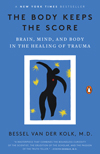
The Body Keeps the Score: Brain, Mind, and Body in the Healing of Trauma, Bessel van der Kolk
What does trauma do to our mind? What does trauma do to our brain (i.e. the physical organ that contains the mind)? What does trauma do to our bodies, and how do we heal? Based on work experience, lived experiences, and decades of studies, Dr. van der Kolk, a leading expert of trauma who has worked with clients ranging from veterans to sexual assault victims, explores how trauma imprints on our bodies, and how we can better understand and treat its detrimental effects. This book will be immediately useful and interesting to anyone who has experienced trauma, knows people who have experienced trauma, or works with people who have experienced trauma (hint: that means all of us). — Greg Barker, Manager of Facilitation Programs

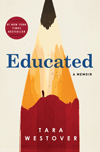
Educated, by Tara Westover
This harrowing memoir gives readers a strikingly intimate and firsthand look into the toll that mental illness can take on individuals and families. Raised in rural Idaho by an ultra-religious, survivalist family, Westover describes in detail years of neglect and abuse at the hands of a mentally ill father and sibling. Despite having never stepped in a classroom until she was 17, she eventually finds freedom through education. From Brigham Young University—where she hears about the Holocaust for the first time—to the elite halls of Harvard and Cambridge, she struggles to reckon with the world she was told about, and the one she’s discovering for herself. Westover’s story is a uniquely moving, complicated, and eye-opening that is at times uncomfortable to read, but utterly impossible to forget. — Dindy Weinstein, Director of Individual Philanthropy

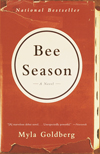
Bee Season, by Myla Goldberg
Myla Goldberg tells the story of a family of four growing distant from one another as they fight to find themselves and find connection with each other. The 9-year-old daughter, Eliza, strives to be seen as intelligent and accomplished as the rest of her family. Her brother Aaron rejects the family’s traditions in search of a higher spiritual understanding and sense of belonging. And while their father pressures them to fulfill his own dreams, their mother is struggling with a hidden life unknown to the family. Goldberg lyrically depicts the pain and pressure felt by each family member, exploring their deep inner selves and taking the reader along through layers of mental states and identity. Heart wrenching and beautifully written, Bee Season reveals how disparate our inner lives can be from our outward appearance, and the importance of human connection to care for and support each other. —Emily Umansky, Development Association

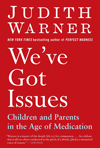
We’ve Got Issues, by Judith Warner
Journalist Judith Warner set out to write a book exploring the overmedication of American children. What she discovered in the course of her research, by spending time with families whose kids are dealing with a variety of mental and behavioral health issues and hearing their stories, is that, in fact, far too many children were not receiving the treatment they and their families so desperately needed. What they received instead was stigmatization and recrimination. Through listening to others’ stories and experiences, the author’s preconceived narrative was challenged, which fits very much in line with the work of Seeds of Peace! This book supported me at a time in my parenting journey when I needed empathy and understanding, not judgment. — Deb Levy, Director of Communications

Also don’t miss

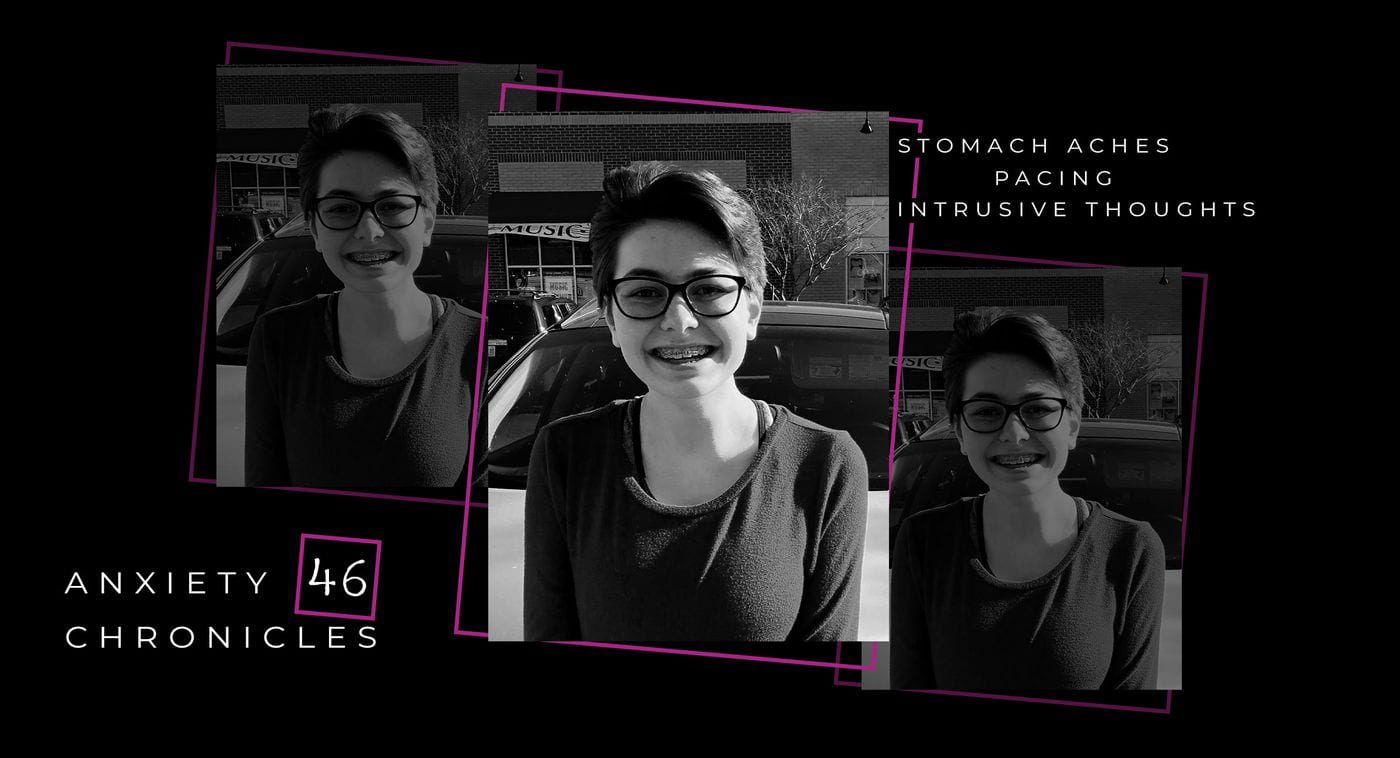
The Anxiety Chronicles, The Lily (The Washington Post)
Women are nearly twice as likely as men to develop an anxiety disorder, a serious medical condition that, as 15-year-old Ella Gross wrote recently, “is so much more than just being scared of public speaking.” For nearly a year this series has put a spotlight each week on a different woman’s journey with anxiety. They vary from teenagers to grandmothers and experience a wide range of symptoms and effects, though a common thread is that many began experiencing symptoms years—sometimes decades—before receiving help. By sharing their stories, these women are helping shine a light on one of the most commonly ignored, and commonly experienced, forms of mental health disorders in the United States.

Primal Fear: Can Monkeys Help Unlock the Secrets of Trauma? Luke Dittrich, New York Times Magazine
In the weeks after Hurricane Maria devastated Puerto Rico in 2017, a researcher began noticing unexpected patterns among one of its island’s monkeys: One, the monkeys seemed to be expanding their social networks, increasing the number of individuals that they had meaningful relationships with. Two, the monkeys appeared to become more tolerant of one another, despite living with radically diminished resources. “It was as if the hurricane had bonded even former foes against a common enemy and made the monkeys much more tolerant of life’s everyday frustrations, at least in the early days,” Dittrich wrote. Sound familiar? This fascinating article explores how researchers are seeing a rare opportunity in our genetic cousins to gain answers to long unanswered questions about the psychological effects that a disaster like Hurricane Maria has on humans.

Have any suggestions we should check out? Add them in the comments! And if you or someone you know needs information about mental health services, visit mentalhealth.gov or the World Health Organization.

Banner photo credit: Ella Gross/Lily/Washington Post

Ten Giving Tuesday #SeedsOfPeaceStories

On Giving Tuesday this year, we asked members of our community to share their #SeedsOfPeaceStory on social media.

Our goal was not just to spread awareness of our work, but also to celebrate the diverse voices of our family. And to be honest, we had no idea what to expect.

That day, hundreds of people shared poignant experiences, lessons learned, and moments of transformation—their reflections reaching far beyond our own social media following. To read this cascade of heartfelt testimonials was magical, and we were so happy to see the connections they fostered within our community. Hopefully, they even reconnected alumni to each other.

We’re happy to share just a few of these amazing journeys with you.

Rona, Israeli Seed

Over 24 years ago I heard about a summer peace camp in the US for kids my age. I thought it was a cool way to score a trip to the United States with other kids. I didn’t know it would be one of the most defining experiences of my life. I couldn’t imagine that I would make some of my best friends there, learn the most important life skills such as listening and being able to find common ground, even with the people I never thought I could.

I became a part of a living, breathing, constantly growing organism which is Seeds of Peace. That experience at 14 led to a second, a third, to different opportunities and even jobs over my teens and 20s.

Today, in my late 30s, I’m still proud of being a part of Seeds of Peace and I will do everything in my power to help it move forward and award many more kids (including my own!) to have this life-changing experience. This is my almost-quarter-century-long #seedsofpeacestory.

Syed, Pakistani Seed

In 2014, it was probably the best summer of my life. I interacted with more than a hundred people from all over the world. I played with an American, I dined with an Israeli, I swam with an Egyptian, I walked with a Palestinian, I danced with an Indian, I learned with a Jordanian, I shared the bunk with an Afghan.

Camp was a place where I was not treated by my national identity, but as a human being. I experienced diversity and coexistence, I heard people who came from different conflicts, I heard their different stories. It was an experience of a lifetime for me. My perspective of peace, war, and hate have all turned upside down into this idea that the world is a beautiful place to live.

Sophia, New York Seed

My #SeedsOfPeaceStory started only last July. Entering Camp for the first time, I had little idea of what would come next, and any preconceived notions I had coming in were quickly shattered. Quickly I fell into the routine of dialogue, group challenge, and other activities, and I found myself in a community as I had never experienced before.

At Seeds of Peace, I was free to express myself without limitation. The collective energy inspired me to do things I never would have thought I would do, like walking on a tightrope blindfolded. I made meaningful friendships and learned so much from a variety of perspectives I had never experienced before.

Overall, going to Camp was one of the best experiences of my whole life!

Luma, Jordanian Seed

My #SeedsofPeaceStory started more than 10 years ago in the summer of 2008. I was a 14-year-old shy, awkward kid that, for some reason, thought she knew more than enough about the politics in the region. I did not arrive at Pleasant Lake with an open mind—I went there to prove a point.

It took me two minutes after getting out of the bus to completely forget the point I was determined to make. I did not join Seeds of Peace with an open mind, but after the three weeks I spent in Camp, I left with an open mind, open heart, and an open soul.

Seeds shaped my life 10 years ago and continues to until this day. It shaped the way in which I think, I listen, and I speak. It opened my eyes to the world and helped me understand the power of dialogue. It made me wait for the other side’s perspective before formulating my own “point.”

Watching the news over the past 10 years, the only comfort is that “Out beyond ideas of wrongdoing and rightdoing there is a field,” and I’ve been there. And I’m so grateful for that opportunity.

Netal, Israeli Seed

Seeds of Peace has given me so much more than I could ever explain. It has given me family, friends, unconditional relationships that I would have never found in other places in my life. More than anything, it has given me the option to live my life differently. And for that, I’ll always be thankful.

Sarah, Maine Seed

Nervously clutching my inhaler outside the Infirmary on my first day of Camp in 2006, I had no idea how this Bunk 5 family and Seeds of Peace would change my life. From camper to counselor to facilitator, I have continued to rely on this community for strength and hope as the world works hard to make us doubt everything we know about the power of empathy and love to create change. They tried to bury us but they didn’t know we were Seeds (even though all of my clothing says “Seeds of Peace” on it … they really should be able to tell).

Krisha, Indian Seed

I knew I was excited and yet I could feel a knot in the pit of my stomach. I was very nervous. I was going back after three long years. It had been difficult keeping in touch with everybody. Would people remember me after all? What was I supposed to say? What would people think? Would I be able to be there for my campers? Could I be a good PS?

These loud, rapid-paced thoughts clogged my mind as the bus headed towards Camp. I could hear the energetic chants as the bus rolled in. I could sense the enthusiasm in the air as soon as I stepped out. Passing through the human tunnel, there I was, in the line-up pit, jumping and dancing and celebrating togetherness with a hundred beautiful people I was yet to know.

That evening, as I was strolling through Camp, I noticed a plaque in the trophy room that read, “This is where we belong.” I knew I was home.

Seeds of Peace has been a process of great essence and transformation for me. I am grateful to Seeds of Peace for creating a community where vulnerability does not feel so uncomfortable; where differences are accepted and individuality is celebrated.

I have been able to witness and foster my rawest self at Camp by opening my heart and mind to people, embracing fears and insecurities whilst challenging myself to overcome them, understanding who I am and what I believe in!

At Seeds of Peace, I have learnt to recognize my voice and give it power not by undermining the voices of others but by standing by it when needed, for myself or for others. For the friendships, love, opportunity, and sense of purpose, Seeds of Peace, I am thankful!

Ameer, Palestinian Seed

Thank you, Seeds of Peace, for letting me know people from Gaza, Nablus, Bethlehem, Hebron, Nazareth, Tira, Arraba, Kofor Qassem, Ramallah, and Jerusalem. I never imagined the barriers between us would be broken, that we would gather in one place and be a family.

People from Cairo, Amman, Los Angeles, New York, Washington, DC, Morocco, Maine, Somalia, Pakistan, India, and many more places are all my family, too, and mean a lot to me.

I spent three weeks with them in a journey of finding ourselves, sharing stories and becoming more open-minded. The experience changed me to a better person, a person who now has a real passion about something, about giving back to my community, and Palestinians in general.

Now I believe in the change I can make and how I can be the change.

Thank you, Seeds of Peace, for giving me the space to share my opinions and to represent Palestine.

Habeeba, Egyptian Seed

At 14 years old, I struggled a lot with dialogue at Camp. It wasn’t until the end of the program that I realized why it was so hard—I just wasn’t communicating.

Seeds of Peace taught me what it means to truly communicate with others. We, I, often take communication for granted—it’s hard, it’s challenging, to pour my heart out to you, to tell you the reasons I stay up at night, to allow my body to showcase my insecurities. And that’s what I was asked to do at Camp: to shed all my exterior armor, to let down my guard, and just be human—fragile, open, loving.

And I learned to listen. I shared parts of myself I never knew I could put into words, and I listened, intently, to others do the same. I learned to be empathetic, and warm, and welcoming—to stop myself from falling into the cycle of indifferent and apathetic communication, one that we all know too well.

At 16 years old, back at Camp as a PS, I learned to question—question everything I thought I knew about myself, everything I’ve been told, everything that I believed to be a constant.

This questioning has stayed with me until today, and has transformed the way I carry myself and view the world.

Abukar, Maine Seed

Long before I discovered my passion for journalism, I was interviewed by the BBC, thanks to Seeds of Peace. It was August of 2012 and I was a 17-year-old activist. I shared how an identity I once considered a burden—being a black immigrant, from a Muslim background—turned into a source of strength, even in the whitest state.

I don’t know how that experience has shaped what I do now, but this I know: Seeds of Peace has given me the opportunity to learn more about myself and the world around me, so that today I am able to do that for others. And for that I am grateful.

This is only a small handful of the more than 400 compelling experiences our community shared during Giving Tuesday. You can search the #SeedsOfPeaceStory hashtag on Facebook or Instagram to see more. And if you missed posting on Giving Tuesday, we’d still love to hear your own #SeedsOfPeaceStory!

Arabs, Israelis Hold Peace Reunion
Fox News

Israelis and Arabs attending a camp reunion in the woods of Maine are keeping an eye on the Gaza Strip, where a move is being made toward peace in the Middle East.

Badawi Qawasmi, a 26-year-old Palestinian, said Monday he hopes Israel’s withdrawal of 8,500 Jewish settlers from Gaza will lead to better lives in the impoverished, overcrowded area of 1.3 million Palestinians.

“I hope it’s just the first step,” said Qawasmi, who is among the former Seeds of Peace  campers, now in their 20s, who gathered for the first formal reunion in the camp’s 13-year history.

Seeds of Peace was established to bring together Israeli and Arab teenagers in search of common ground, a daunting task well before the historic evacuation of Gaza. The withdrawal marks the first time Israel will give up land captured during the 1967 Mideast War that is claimed by the Palestinians for their future state.

“I think it’s the worst thing that can happen to the region and the Palestinians because they’re not a player in what’s happening to them,” said Liav Hertsman, 25, a TV producer in Tel Aviv.

Still, the tranquility of the 67-acre camp was in stark contrast to the events in Gaza. Monday was the first day of a 48-hour grace period during which settlers can leave voluntarily without losing any of their government compensation.

On Wednesday, troops will begin dragging out any settlers still there.

Although the withdrawal was on the minds of the former campers, they also spoke about life back home, school and careers. The reunion was billed as a “Leadership Summit” where alumni can reconnect and recommit to promoting Israeli-Arab peace.

Standing near the shore of Pleasant Lake, two Israeli and two Egyptian men laughed as they talked about old times and caught up on each others’ lives. A sign stuck in the ground has arrows saying “Portland 45 miles,” “Jerusalem 6,000 kilometers.”

About half of the campers are Israelis, with an equal number of Palestinians, Egyptians and Jordanians, and a handful of Americans.

Former campers were attending workshop sessions on politics, the media, business and conflict resolution, in addition to traditional summer camp activities such as basketball, canoeing, water skiing or maneuvering the ropes course.

They are beginning their careers and finishing up their education, with a different outlook on life than in the 1990s when they were campers. Hertsman said attending Seeds of Peace in 1994 motivated her to get involved in world events.

“This is a chance to get back in touch where it all started,” said Hertsman, one of two alumni chosen to monitor the news during the camp and distribute articles.

Yaron Avni, a 24-year-old Israeli who spent time in the Israeli Army intelligence, said the Gaza pullout is a painful time in Israel’s history. Many of the settlers have known no other home.

“Still, it’s something we have to do and it’s for the best,” he said.

For Hani Alser, who attended Seeds of Peace in 1999, the withdrawal could have profound implications. Alser, 21, grew up in Gaza but hasn’t been back home for three years because of travel restrictions on the area since he began studying in Jordan.

He is optimistic that the pullout means he will finally be able to see his parents and the 1-year-old brother he’s never met.

“I hope I’ll be able to go home,” he said. “But I’m afraid this might take a long time, one or two years after the withdrawal, to see my parents.”

Read this article at Fox News »

Leslie named Director, Seeds meet Abbas | Newsletter

Leslie Adelson Lewin next Executive Director

Leslie Lewin

Special message from Janet Wallach: On behalf of the Board of Directors it is my privilege to announce that Leslie Adelson Lewin has been named Executive Director of Seeds of Peace.

Over the past 18 months, we performed an exhaustive search that included candidates from all over the world. In addition to a deep understanding of our mission, strong managerial skills, and the other qualities we were looking for in our next Executive Director, one of the characteristics that set Leslie apart from all the others is an unwavering commitment to each member of our Seeds of Peace family. We are thrilled that she has accepted this role. No one is better qualified to lead Seeds of Peace into the future. Read more »

Spotlight: Seeds in the news

Joseph (Joey) Katona, a 21-year old Seed, was named a ‘Hero Among Us’ by People Magazine. Joey has raised more than $60,000 for his fellow Seed, Palestinian Omar Dreidi, to attend college in America. The two first met at Seeds of Peace Camp. Read the article »

Palestinian Seed Khadrah AbuZant writes an op-ed in Ha’aretz urging Middle East leaders to make even greater efforts toward revitalizing the peace process, even in the wake of the war in Gaza and southern Israel that began in December 2008. AbuZant writes, “Although many of us are frustrated with this 60-year conflict, we must set aside time for healing before starting the peace process again. This time, greater efforts must be made toward creating a solution that will bring lasting peace. The process cannot simply be forced into motion: People must be willing for it to continue.” Read the article »

Noorzadeh Raja, a Pakistani Seed, recently published an article in The Daily Times of Pakistan about her experience at the Seeds of Peace Camp this year. She writes, “It was amazing to hear their [Indian] side of the story, and learn about how what they’ve been told differs from what our history books say. The first step to making peace is, no doubt, clearing all misconceptions, and our dialogue sessions certainly served this purpose. It was an enlightening experience.” Read the article »

The Times of India recently profiled an Indian Seed, Gaurav Bhawnani, and the life-changing experience he had at this summer’s Camp. Bhawnani said, “The camp was an eye-opener as it helped dispel a lot of misconceptions about the two countries. Now, some of my best friends are Pakistani. And our friendship is life-long.” Read the article »

American Seed, Cobi Blumenfeld-Gantz, has co-founded a unique program at the University of Pennsylvania called Dorm Room Diplomacy, which aims to cultivate mutual understanding between students at Penn and college students in the Middle East. To do this, Gantz helped form a partnership with the University of Jordan, among other schools, and are leveraging technologies such as Skype. Read more »

Field Seminar

Field seminar unites nearly 100 Israeli and Palestinian Seeds

To conclude summer programming in the Middle East, nearly 100 Palestinian and Israeli Seeds who graduated from the Seeds of Peace Camp in 2007 and 2008 participated in a Field Seminar from August 14-17. Read more »

Jon Preddy at the Summit

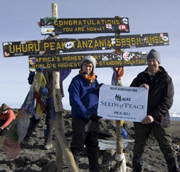
Teen climbs highest mountain in Africa to support Seeds of Peace

Jon Preddy, a remarkable young teenager from London, decided to climb Mt. Kilimanjaro—the highest mountain in Africa—as a way to raise awareness and funds for Seeds of Peace.
Read more »

President Mahmoud Abbas

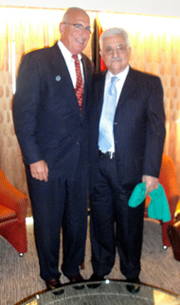
President Mahmoud Abbas meets with Seeds in New York

On September 24, 2009, Palestinian President Mahmoud Abbas met with Seeds of Peace to reaffirm his commitment to our conflict resolution and leadership programs for young people from throughout the Middle East. Read more »

Seeds lead community service projects during the holidays

Seeds of all ages led service projects in their home communities throughout the month of September. Read more »

Donate

To make a tax-deductible contribution to Seeds of Peace, click here.