
Search Results for “{search_term_string}”

11th Anniversary Benefit Dinner features Seeds

Seeds of Peace held its eleventh anniversary benefit on April 28, 2003, at Avery Fisher Hall at Lincoln Center.

By popular demand, we have been asked to post the speeches made by our Seeds of Peace alumni from the Middle East, India and Pakistan.

Tulsi, Indian

Mahatma Gandhi once said, “An eye for an eye only ends up making the whole world blind.”

Ladies and gentlemen, the world is imperfect and its people are blind to the basic principles of humanity and moral issues. Revenge, is the repercussion of power misused.

In the blink of an eye, I have seen the world fall through the abysmal pits of carnage, hatred, distrust and inequality. The world is a stage to unrest from WW1 and WW2 right through to the War against Terrorism and against Iraq, while peace, peace is just waiting in the wings.

Honestly, I had never actually met a Pakistani before, someone from the ‘other side’. All I saw of them were the 12 members of their cricket team who, God forbid, I wished India would beat every time they played!

I only had a stereotypical image of what they looked like. I imagined them either as soldiers at the border, armed, eagerly awaiting a war signal, or as strangers hidden behind veils (burkhas) – clad in black, conservative, extremist. But I was wrong and in ways I don’t understand, I have grown. I have learnt more than what a lifetime of scientific knowledge could teach me. I have learnt to discover and reject my vulnerability. I have learnt to suppress raw instincts. I have learnt, I have learnt to think before I label and segment people into human categories.

Today, I watch most of the world go mad, but I remain calm and optimistic.

The truth is, you can never really tell with life. You cannot hope to predict tomorrow and I am aware of that. What you can do, however, is prepare for it today. That is why I am standing here in front of you, so far away from home…to show you that we have already started preparing for the future.

During Camp, which was filled with a lot of introspection and self-reflection, I came to the conclusion that even though initially Camp seemed like the epitome of perfection, it wasn’t just fun and games and fantastic people. Delving deeper into what camp was really all about, I unearthed the fact that sometimes it was a downright painful experience. There were stories and arguments and all sorts of emotions at stake.

A bit like when you go shopping; the dress looks gorgeous from the brightly lit window, but when you go inside, its not really so glamorous. That camp. That summer of 2001, gave the seeds of ambition and hope within me, the right to germinate. That summer of 2001 taught me that the enemy had a face.

In retrospect, for a fleeting moment I thought I was looking at the world through the compound eyes of a house-fly, suffering from myopia. I realized that the story which I had was different from what a Pakistani had to tell me. But when it comes down to the truth, it is only the perspectives in totality which paint a comprehensive picture.

It wasn’t easy going home and spreading the Seeds of Peace message. But now I can assure you that there isn’t a single school in Bombay which doesn’t know about this organization.

I realized that we are merely puppets of the media. This has resulted in a gap. Larger than the physical gap that divides the two countries, it has led to a gap between understanding and empathy.

Today I stand before you as a proud Indian. Amal, a proud Pakistani. Yet, we have the same Seed of Peace sowed in our different soils. On March 13th, 1993, John Wallach had a dream to try to change this fragmented globe into a common brotherhood.

Today, on April 28th, 2003, over 2000 of us Seeds share that one man’s dream.

Amal, Pakistani

It is perhaps the greatest human desire to want to hold on to freedom and peace of mind and body. It is perhaps the highest degree of passion, which would prompt even a dying man to call out for peace. It is the most painful demand of the public and the utmost act of humanity to fulfill it.

The greatest realization I gained from Seeds of Peace was the fact that truth is solely a matter of perception played on by a theatre of evil we like to call history. My truth, my reality is not going to be an Indian’s truth … but I learnt to hear that truth, to take it in, to hold on to it and then defend it with my own. Seeds of Peace did not teach me to purge myself of negative emotion. It taught me the practical side to peace and I taught myself the art to perceive it that way.

The enemy had a face, a faith, a name and an identity.

Illusions built on the basis of bias came crumbling down and I came to see beyond what others had chosen to show to me and what others had thought I should be told. I matured, from a dreamer to a realist, from a child to a woman. I was allowed, for the first time, to embrace my own capability to think and question. It was as if I was allowed wings. Rusty wings of the mind given permission to freedom. I didn’t know I was trapped till I was actually flying. Actually doubting and questioning. And that is exactly what I did do.

I got back home and I questioned Seeds of Peace. I wondered whether the environment was too artificially created, I wondered whether it wasn’t just inevitable that kids staying by beautiful bunks by the lake would become friends. And I found my answer in the simplest analogies life has to offer. Like when you’re learning how to swim; you wear your floaters and these rubber tires around your waist and you hold on to the handles at the edges of that little synthetic pool to keep from slipping. But then, some time later you’re in the open see, with the wild, natural waves … but you know what it is you have to do and exactly how you have to do it.

That is what Seeds of Peace does to young people. Young people who go back home, have to deal with the ugliest faces of reality to survive as men and women of faith. leaders and teachers of substance. Camp is not a fool’s paradise; it is not the idealist’s greatest fantasy. I have sat and discussed wars and partition and history with Tulsi for hours, gone on and on arguing about details till I finally saw that I have to move beyond textbooks to search for solid solutions. Humanity can exist … humanity wants to exist if only I let it.

If tomorrow my child turns to me and tells me that war is a solution, it will be my fault. If tomorrow the world is still caught in this rat race of hate and injustice, it will be my fault. And if tomorrow another mother weeps on the unmarked grave of an innocent son, it will be my fault and I refuse to submit to that fate and that blame over and over and over again. I have been given a chance to change lives and there is no way I am throwing that away.

This journey has started, and now more than ever before it needs to continue. As long as I am alive, as long as there is passion and hope within me I will continue that journey. It is not a “favor” or an “act of morality.” It is simply demanded of me. Seeds of Peace is more than a summer camp in Maine. It enters your blood. It literally flows through your veins till all that remains is you and your obsession and everything else is forgotten.

I believe there is a reason in being born. There is a reason behind living, dying, breathing … and I am so happy I have found mine.

Ma’ayan, Israeli

I never thought terrible things can happen to me. I was the kind of person who thought that things like that can only happen to other people, to other families. Unfortunately, I was proved wrong.

I remember it was a few minutes after 6 o’clock at evening, I was watching TV, while my younger and only brother played with his friend in the other room. I remember thinking to myself how great it is I can finally sit down and do nothing, after studying so hard for the last couple of weeks, when suddenly, a tremendous explosion brutally cut my thoughts, and tore the silence apart. My building trembled so hard I thought it’ll brake down, and all the windows shattered, leaving with no protection from the outside. There was no mistake, I knew exactly what had happened. A bombing had occurred, right outside my house. I stood up, and started crying. I ran over to my brother and his friend, and was relieved to see they were both alright, but my emotions were still rising up inside of me. Even now, at this very moment, I can still hear the people screaming outside my window, the sound of the sirens, the TV reporting what has happened, and the voices inside my head trying to calm me down. I still remember approaching the window and seeing the exact same horrifying sites the TV was showing, while praying and wishing no one I know was there.

I always knew that sooner or later, something like this is bound to happen, since my house is across the street from the mall, where many people spend their time. The thoughts about how easily I, my brother or someone I know could have been there, haunt me to this very day. It was the first time, in my whole life, I felt so close, so physically and emotionally close to death.

Unfortunately, this kind of scene, is not a unique one in my country. Over the last 54 years Israel has existed, and especially throughout these last three years of the Intifada, my country and my people have endured hundreds of bombing attacks, like the one outside my house, and have known a great deal of loss.

As tragic as it may sound, loosing people has became an everyday thing for us, and we have been forced to accustom ourselves to living with death. This situation, in which fear, insecurity and hate are an inseparable part of daily life, has cast shadows over many Israeli’s hope, optimism, and faith in peace.
It took me hours after the bombing to pull myself together. I was feeling scared, angry, and mostly shocked, and I think that for one second there, I felt the absolute hopelessness Israelis feel, after being through a frightening experience like the one I’ve been through. But my experience was somewhat different, because of all the love and support I received from my Palestinian friends who called to check I was OK. It was those phone calls, those sweet words of caring, that gave me the strength not to surrender to feelings of revenge and despair, and convinced me even more than before I do not want that kind of a future for my children, or anybody’s children.

To be honest with you, I do not want peace on the paper. I want peace between people. I want trust, understanding, compassion and a feeling of security. I want little babies to be born to a world where they are taught to love, and not to hate. I don’t mislead myself by thinking non-seeds don’t want the same. But I do know that in the current situation, in which people don’t have many choices but the obvious choice of despair and hate, Seeds of Peace allows me, allows us to be true to ourselves, to what we believe in, and work for it.

That is why Tarek and I have been leading co-existence sessions between Palestinians and Israelis.

That is why I brought my best friend to a Seeds of Peace meeting, so she’ll see in her own eyes that Arabs are not as bad, as she thought the were.

That is why I spoke to students, to tell them about our organization, and to let them see there is another side to the reality they grew up with.

And that is why, ladies and gentleman, I stand here in front of you tonight, three years after my first summer in Seeds of Peace, to tell you my story, and to tell the world there is another way. Seeds of Peace has opened the door for me to a better future, and I just hope I will be able to do the same, for others.

Mohamad, Palestinian

Let me tell you a story. It was the middle of August of 2002. No Palestinians were allowed in Israel, when I lost any hope of being given a student visa to come to the United States and get advantage of the scholarship that I was awarded. After about a month of trying to get a permission to go from the Gaza Strip, where I lived, to Tel-Aviv where I had to be interviewed for my visa in the American Embassy there. I got a phone call from my American Seeds of Peace counselor from Jerusalem. “Mohammed” she said with a tone of excitement “We got you a VIP permission to enter Israel to the American Embassy for your interview”.

Well, two days later, I was in the heart of Tel-Aviv. I was probably the only Palestinian in Israel that day. When we got to the American Embassy there, we found out that we had to stay in a long line of Israelis waiting to be interviewed. We had to line up for about two hours. I was standing there, talking to my Seeds of Peace counselor who came with me, in English, when a young Israeli man stepped back on my foot. “Tslecha” he said. I knew very well that that word means “Excuse me” in Hebrew, but never I knew how to respond. I asked my American friend, but she didn’t know either. So, he thought that I was American. He was a nice guy, almost in my age. We kept chatting and joking for about half an hour in English. I didn’t mention that I was Palestinian and he didn’t ask. “Oh, Mohammed, when do you have to be back to Gaza?” my American counselor asked.

At that moment, I can tell that that guy was extremely shocked. It was like a giant iron door that was “boom” suddenly separating us. The guy started to avoid talking with us. he moved his spot in the line further away. A minute later, my friend decided to go to the ladies room leaving me with her back bag. That guy was staring at me, a Palestinian young man from the Gaza Strip, in the American Embassy, in Tel-Aviv, with a huge back bag. I could tell you how scared that guy was. He left the whole Embassy right away. I have never ever seen that guy after that moment.

I was asking myself “why, why was that guy so terrified that he even missed his interview? Did he think that all the Palestinians were suicide bombers? That I was going to blow myself up there and kill him?” Unfortunately, that what happens when we let the media control our minds and thoughts.

I had two advantages that that young man didn’t have. Firstly, I knew very well that he was Israeli but he never knew that I was Palestinian during our conversation. Look how different his reactions were before and after discovering my identity. His human nature attracted him to enjoy a conversation with me, and I didn’t really care who he was. All I knew about him was that he was a young man from Israel with whom I can enjoy a conversation.

The other advantage was that I am a seed of peace, and he was just a random young man living in the region. I wonder how different that guy’s attitude would have been if he was a seed of peace, just like me. He would have realized that it is possible to have a Palestinian friend. He would have hoped that the line was much longer so that he can enjoy a longer conversation with me. He would have realized that most of the Palestinians are as affable as he was. Don’t blame him, I don’t blame him for what he did, I just feel sad for him. He just wasn’t given the opportunity, the atmosphere where he can develop independent thoughts and understanding of the logical reality and get rid of his close-mindedness and stereotypes that he has grown up with.

He didn’t have the ability to question those stereotypes even after an enjoyable half-hour conversation between us. He wasn’t taught how to understand people’s gestures and feelings, he couldn’t read their thoughts, couldn’t make a wise judgment and without saying it, he categorized me as “ a terrorist”. Simply, that was the big difference between us, a seeds of peace versus a typical teenager living in the region.

When we are thoughtless in our acts and our silences to different people, we stifle the ability to grow and connect with them … like that young man did that August day. More than anything else, Seeds of Peace enhances our pride in being who we are: thinking adults and compassionate human beings.

Tarek, Arab-Israeli

“Do you really have Jewish friends”? That was the reaction of my classmate to the stories I brought home from Seeds of Peace camp three years ago. Although we are citizens of Israel, and the closest neighbor to my Arab village “Jatt” is a Jewish kibbutz, no one in my school had ever made close connections with any Israeli Jews. In fact they didn’t even imagine it was possible, until they met my friends from seeds of peace.

My classmates and I are Palestinian citizens of Israel. We are loyal to our country, Israel, and at the same time to our Palestinian tradition and identity. Due to this, we are a double minority, often viewed with suspicion by both sides of the conflict, and faced with a crisis of determining who we really are. But at Seeds of Peace, I spoke with both Palestinians and Israeli Jews as an equal human being. That gave me the chance to build my own identity and to make friendships with people on both sides who understood and respected me for who I am.

Equality, understanding and friendship between Jews and Arabs are things my classmates, and unfortunately most of the more than 1 million Palestinian citizens of Israel, have never experienced. Showing my community this vision of a better reality was my mission. But my stories from seeds of peace weren’t enough – or maybe they were too much – for my classmates to believe. They needed to see what I had to tell with their own eyes in order to believe my Jewish friends are real, and our honest friendship is true.

The easy part was proving my friends are real, I organized a meeting between my skeptical classmates and Jewish friends – like Ma’ayan – from Seeds of Peace. We had long conversations about all of the buried topics my classmates have always wanted to discuss with the other side. The cult was that both sides were surprised, on the one hand, the Jewish Seeds were confused when they found out that the four male representatives of my classmates were all called with the so well known name “Mohammed”. On the other hand, my classmates left that meeting telling me, “Some of those Jewish friends of those Jewish friends of yours understood us better than Arabs do.” This sentence made me realize Seeds of peace and I made the change years of government negotiations never could.

More than a year afterwards, it became clear not only that my Jewish friends are real, but that they are real friends.

On January 30th, 2002, my beloved father, Dr. Dawood Arow, was killed by a hit-and-run driver. He was crossing the street to buy flowers for our family. I was so shocked, I didn’t call anyone, I didn’t talk to anyone. My father was one of the first doctors in my village, and he was the kind of doctor who cared deeply for his patients, and knew them all as individuals. It did not surprise me to see thousands of them gathered in my village for his funeral. What did shock me, the only good shock in this time of tragedy for my family, was seeing my friends from seeds of peace, Jewish and Arabs, standing there among the mourning crowd. They didn’t just come that day either – my friends from seeds of peace came to visit my family and console us throughout the whole period of mourning we had. Them being there showed everyone and especially me, they are the kind of people, the kind of friends, who cared for me and didn’t stand a side watching when I faced my hardest times.

Since then, Seeds of Peace means being there for friends at the hardest times. A few months ago, a Jewish friend of mine from Haifa named Liav, lost her father suddenly and unexpectedly. You can be sure that I was there at the funeral, and at her home during the days of the shiv’ah mourning ritual. I believe that Liav, her family and friends will always remember that, and know that this Arab friend is for real, and will be by her side when it matters most, just as my friends were there for me.

Bios of the Seeds of Peace alumni

Tulsi is a 16-year-old Indian from Bombay who was part of the first delegation to Seeds of Peace from Southeast Asia in the summer of 2001. She is currently in her first year of secondary school in the scientific stream. Tulsi has continued to be active in Seeds of Peace upon returning home. She recently wrote an article about her experience at camp published on a news website, and took part in the first Seeds of Peace Press Conference in India. She has also kept in touch with both her Indian and Pakistani friends via video projects and email communication.

Amal is a 17-year old high school student from Lahore, Pakistan. Amal attended Seeds Of Peace in 2001 as part of the first Pakistani Delegation. Since returning home, she has been in constant touch with her fellow Seeds through the internet and home visits. Amal attended the Seeds of Peace Conference on Uprooting Hatred and Terror in November 2001, and was involved in the India-Pakistan video exchange project. Apart from attending local conferences and peace gatherings, she has spoken actively about Seeds Of Peace at a number of large meetings, including a very well attended inter-faith church gathering in Lahore. She directed an award-winning documentary on violence against women, and has published her own anthology of poetry.

Ma’ayan is a 17-year old Israeli high school senior from the city of Kfar Saba in Israel. She first attended Seeds of Peace in the summer of 2000 and returned in the summers of 2001 and 2002. She is involved in the Advanced Coexistence program at the Seeds of Peace Center in Jerusalem, which has led to numerous presentations promoting coexistence at Jewish and Arab schools around Israel. Currently, she is working with as a “Coexistence Intern” helping design programs and learning the skills of facilitating Arab-Jewish dialogue.

Mohamad is a 17-year old Palestinian from Gaza City. He attended elementary and middle school while living in Gaza but through the Seeds of Peace Education Program, received a scholarship to finish his high school education at Deerfield Academy in Massachusetts. Currently, Mohamad is a senior at Deerfield Academy and will be graduating this spring and next year plans to attend college in the US. Mohamad first attended the Seeds of Peace Camp during session one of 2000. Since then, he has been an active participant in many Seeds of Peace activities, presentations and follow-up programs.

Tarek is a 17-year old high school senior from the Arab village of Jatt, in Israel. He first attended Seeds of Peace in the summer of 2000 and was selected to return as a Peer Support camper in the summers of 2001 and 2002. Tarek participated in the November 2001 Seeds of Peace Conference on Uprooting Hatred and Terror in New York City and has been featured in the media including an appearance on MSNBC last summer. He completed the Advanced Coexistence program of biweekly Arab-Jewish dialogue meetings at the Seeds of Peace Center in Jerusalem, and is now working as a “Coexistence Intern” in this year’s program.
Middle East
Hope Magazine

At a summer camp in Maine, the children of bitter enemies live with the people they’ve been taught to fear. It’s no love-fest, but it might be a volatile region’s best chance for building lasting peace.

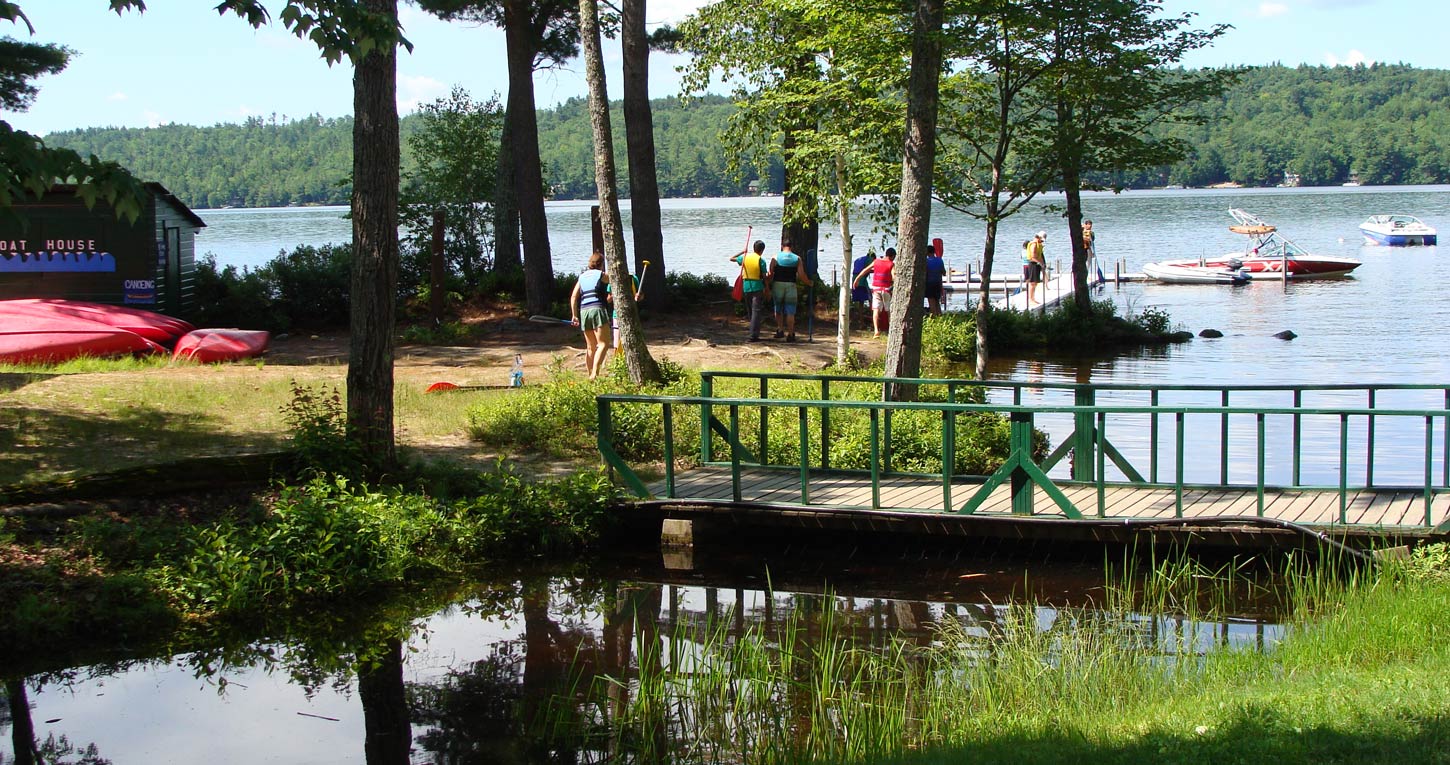
BY BILL MAYHER | Like roadside ice cream stands or country churches, summer camps in Maine have a reassuring orthodoxy all their own. Visit one and you’ll probably find a line of cabins strung out along a lake. There will be a main lodge and a jumble of lesser structures, each with its own blend of rumpled plumpness speaking of light construction and heavy winter snows. On your visit, you’re almost certain to hear the shriek of whistles from the swimming dock, the sound of distant shouting as a well-hit ball arcs deep to left, dusty footfalls clumping closer and then suddenly tripping on a well-worn root by the dining lodge, as a thousand teenage feet have tripped a thousand times before. At summer camps, what you’ll mostly hear is laughter, and in the spaces between the laughter, the plaintive song of a white throated sparrow from the woody margins, the uncertain plunk of tennis balls, and the snap of a wet towel with its answering yelp of pain. In the long inhale and exhale of summer days by a sandy-bottom lake, what you’ll surely find among the grassy spaces and dappled shade of camps is a special mix of away from home safety and risk that helps kids grow right.

Not surprisingly then, when it came time to find a place for the children of Arabs and Jews—bitter enemies who have been killing each other for generations—to attempt the painful and uncertain work of making peace among themselves, a summer camp in Maine seemed like a natural place to locate. To make peace, these kids need distance from their homelands. They need neutral ground. The cultural, political, and personal walls that separate them are incomprehensibly high. There is, in the words of contemporary historian Mohamed Haikal, such “fury and revulsion” between them, that most of the teenagers chosen by their countries to attend a camp called Seeds of Peace in Otisfield, Maine, have never met a single one of their opposite number. For this reason alone, they need time to talk together; they need time to listen. Most of the 162 campers at Seeds of Peace have traveled from Egypt, Israel, Palestine, Jordan, Morocco, Tunisia and even Qatar to eat American camp chow and sleep in open cabins with people they have been taught their whole lives to hate. For taking these risks, they deserve a chance at reconciliation and friendship. At Seeds of Peace, they’ll get it.

On a dazzling July morning, Seeds of Peace founder John Wallach opens this year’s session with a challenge to the teenagers around him on the grass. “Today this is the only place in the world where Israelis and Arabs can come together on neutral ground and try to be friends,” he says. “Because of this, I would ask one thing of each of you. No matter what else you do in your time here, make one friend from the other side.”

In laying down his challenge—regardless of how idyllic the setting, or how eager the kids—Wallach is saying that building friendships between enemies is, after all, no easy thing.

John Wallach left a high-powered journalism career to launch the Seeds of Peace International Camp in 1993. Wallach had been a White House correspondent for thirty years. He had broken the story of the CIA mining Nicaraguan harbors, and he had covered the Middle East. He won the National Press Club Award and the Overseas Press Club Award for uncovering the “arms for hostages” story that led to the Iran-Contra scandal. When few people had thought such a thing was possible, he had written, with his wife Janet Wallach, a biography of the elusive Yasser Arafat.

But Wallach didn’t feel satisfied being, in his words, a “fly on the wall of history.” Perhaps he felt a sense of personal destiny because his parents had escaped the Holocaust. Perhaps he has always had an instinct for seeing beyond superficial differences because Catholic priests had guided his parents through the Pyrenees to safety. Whatever the reasons, in 1985, when the Cold War thaw was merely a trickle, Wallach initiated a program in what he called “citizen diplomacy” at the Chautauqua Institute in Upstate New York to bring together ordinary Russians and Americans to search for common ground. For this work, Wallach received the Medal of Friendship, the former Soviet Union’s highest civilian award, from then president Mikhail Gorbachev in 1991.

At news of the World Trade Center bombing in New York City, in February 1993, Wallach again heard the call to action. A month later, an idea came to him: because the adults of the world had so clearly failed at peacemaking in the Middle East, he would skip the present generation of leaders and go straight to the next. He would bring together young people who had been born amid the violence and searing hatreds of the region, and allow them to explore their mutual humanity.

“I spent my whole life with the powerful,” Wallach recalled in an interview with Susan Rayfield in the Maine Sunday Telegram. “I can’t tell you how many times I’ve been on Air Force One, or with the White House pool, or world leaders. I had a lot of power as a journalist. I’ve learned that the answer to life is not the poohbahs, it’s the basics. The coming home to Maine. To what is human in all of us, that ties us together as human beings.”

Wallach needed staff, kids, and a facility to realize his vision. He found his first staffer, Executive Director Barbara “Bobbie” Gottschalk, in Washington, D.C. Gottschalk’s book group had invited Wallach and his wife to discuss their book on Arafat and afterwards, he shared his vision for Seeds of Peace. Gottschalk was so intrigued, she left a secure job as a clinical social worker to join him.

To find kids for his camp, Wallach approached the Middle East’s major players, each of whom he personally knew: Yasser Arafat, the Chairman of the Palestine Liberation Organization; Yitzhak Rabin, the Prime Minister of Israel; and Hosni Mubarak, the President of Egypt. “Trust me with your children,” Wallach asked each of the beleaguered men. “Give me the next generation. Give them a chance to escape the poison.” His years of journalistic engagement and fairness were to have an unforeseen payoff: all three leaders answered Wallach’s plea, an acquiescence little short of miraculous.

Serendipity intervened when Wallach found that a Camp Powhatan in Otisfield, Maine, would let him use its facility after the camp’s regular session ended. Touring the camp, Wallach met Tim Wilson, Powhatan’s co-director, whom he immediately recognized as a Maine-camp classic with his own dazzling bag of tricks for keeping things lively and yet under control at the same time. An inner-city teacher and football coach around the steel mills of Pittsburgh, Wilson is as good at the up-in-front-of-everybody bluster that keeps things cooking as he is at the quiet arm-around-the-shoulder-buck-up that helps an exhausted and melancholy adolescent get through another day. So in the summer of 1993 with a camp facility and a core staff in place, Wallach had assembled the basics of what would become Seeds of Peace.

In four short years, the camp has won awards including a 1997 Peace Prize from the United Nations Education, Science and Cultural Organization (UNESCO), and drawn accolades from world leaders. Kofi Annan, Secretary General of the United Nations, wrote in a letter to Seeds of Peace this year, “There is no more important initiative than bringing together young people who have seen the ravages of war to learn the art of peace.” In her speeches, Secretary of State Madeleine Albright has mentioned Seeds of Peace as a bright spot on an otherwise dark Middle East horizon. Yasser Arafat has said, “Seeds of Peace represents the hope and the aim which we are working to realize, namely just peace in the land of peace.” Before he was assassinated, Israeli Prime Minister Yitzhak Rabin noted after meeting with campers, “Witnessing young Arabs and Israelis together gives me great hope that soon all Arabs and Israelis can live normal lives side-by-side.”

The new arrivals, all between ages thirteen and eighteen, plunge into the usual sports and games, ready to fulfill the camp’s mission to make peace among themselves. That is, until all the hard work begins. Staff assign campers to Co-Existence groups, where the most intense, and arguably the most important, work of the camp occurs. Here, campers learn to listen to the histories and feelings of age-old enemies and begin to move toward accommodation and ultimately, empathy. Led by pairs of trained facilitators, these groups of about fourteen campers meet daily in a cycle of three sessions, and then move on together to a new pair of facilitators who, using a variety of techniques including oral history, role playing and role reversal, art, and drama, teach effective listening and negotiating skills. The group work is at first designed to create a safe space between participants. The facilitators then direct the group toward more difficult issues.

In one group, facilitators Linda Carol Pierce and Janis Astor de Valle delve into intense racial tensions in Brooklyn, New York. Their role-play, in which a black camper from Bedford Stuyvesant runs into a white camper from Bensonhurst, starts out as friendly banter. Suddenly, it veers into a dramatic shouting match recapitulating incidents of muggings and mob murder that continue to divide their neighborhoods to this day. As the actors shout at each other, “You people,” this, and “You people,” that, campers see graphically that bone-deep prejudice is not confined to the Middle East.

Following the role-play, Pierce and deValle ask individuals in the group to share with a partner a personal story of prejudice each has suffered, and then have that partner report the story to the entire group—a well known technique that builds listening skills among the youngsters and, as they tell each other’s stories, helps put them into each other’s shoes. An Arab girl tells of being snubbed on the internet by members of her chat group when they discovered she was from Jordan. She relates how one of them shot back, “Isn’t that where people with bombs come from?” and refused to acknowledge her further, letting her twist in cyberspace a new style victim of a very old disease.

In another group, campers who already have represented the opposition’s side in a mock Middle East negotiating session are now allowed to present their own points of view in debating who should have control over Jerusalem. But before the teenagers begin, the facilitators ask them to assemble pictures from colored toothpicks in a tabletop exercise that serves as a metaphor for issues of personal and collective space. The kids’ individual designs—stick figures of people, houses, stars, and suns—soon expand to cover the entire table. The facilitators then start with the questions. “Were there borders there for you?” one facilitator asks. “There were borders on the table. Whoever was stronger took more space,” a camper replies. “The quick and the strong get it all,” adds another. “Let’s relate this to Jerusalem,” the facilitator then suggests, giving the kids fresh angles of approach to discuss this contentious and emotional issue. The debate that ensues is often spirited, often heated, but it is also respectful because both sides have established the need to honor each other’s “space.”

Through the process of working with different facilitators—each with different strategies—campers cannot avoid getting down to the most stubborn problems that divide them. There is too much bad blood, too much history to let campers play at peace like they play at tennis. This camp, by Wallach’s own design, is no feel-good paradise; rather it is a camp that compels them to look their enemy in the eye and in doing so, beginning to know their enemy’s heart. When the kids get down to it in the groups, Wallach says, “It doesn’t take them very long to realize that they don’t like each other very much.”

As they hash out their deep-seated differences, the kids at Seeds of Peace also spend plenty of time on the playing field—a few individual events, but mostly team sports that put individuals from opposing political factions on the same team: baseball, tennis, lacrosse, soccer, swimming, volleyball, relay races, basketball. The theory is that in the heat of competition, young people will become teammates and forget the elemental differences that brought them here.

Nowhere is this more apparent than in the Color Games, a competitive crescendo in the final days of the camp. Guided by the skilled (and wily) hand of Tim Wilson, the camp is divided into two teams: Greens and Blues. Tee shirts are donned, separate cheers invented. The teams are then turned loose to relentlessly compete against each other across the entire spectrum of camp sports and activities. Every camper has to contribute, the efforts of each essential to the whole. It is raucous, loud, dusty, and hilarious: transcendent partisanship forging white-hot loyalties—if only for the moment.

As the Color Games rush toward the final events, in the age-old tradition of a summer camp, it becomes increasingly impossible for the participants to assess with any precision what it might actually take to win. The totals for each team remain maddeningly close until, in the final event, one team surges to capture the crown only to discover that, in fact, there is no actual prize for the hard fought victory except the opportunity to give an enthusiastic cheer for the losing team and to jump in the lake first.

At this moment, the Color Games become a metaphor for sharing the victory equally between “winners” and “losers.” After days of running their guts out and shouting over the tree-tops, the campers begin to understand that most elusive of truths: People on each side of a conflict must be truly satisfied if there is to be peace; victory can and must be a shared thing.

Perhaps Egyptian camper Silvana Naguib said it best in a film made at the camp several years ago: “The first step we have to make right now is not only to want for your own people…You have to really, really want, really desire for the others. If you are an Israeli, you have to want for the Palestinians to feel happy and feel safe and feel comfortable. If you’re a Palestinian you want the same thing [for the Israelis]. All the people in the country have to really want everyone else to be happy.”

On July 30, 1997, a double suicide bombing by radical Palestinians tears through a Jerusalem marketplace called Mahane Yehuda, killing fourteen Israelis and wounding more than 150 others. The horror of the attack is captured by Serge Schmemann writing in The New York Times: “Witness after witness recited the same litany of flame, flesh and horror. They described bodies covered with fruits and shoes; a man sitting on his motorbike dead; limbs flying.”

Reports of the bombing rip through Seeds of Peace as well. When the news breaks, John Wallach addresses the camp as a whole. Special groups are formed with facilitators to help campers ride out the emotional storm. In the first hours, a deep sense of mourning and sympathy pervades the camp. In the next few days, as the initial shock wears off, the work in Co-Existence groups takes on a harder edge; it become more difficult to maintain safe space and good listening. At this point, says facilitator Cindy Cohen, “It’s almost impossible for kids to [acknowledge] the suffering of the other side without feeling it as an attack.”

In the groups, tension is palpable and harsh phrases fly: “Palestine does not exist!” “Israel has no culture!” “You people always bring up the Holocaust to justify everything you have done to us.” Historical interpretations are shot like missiles; it is raining verbal SCUDS. Of this phase Wallach says, “You could leave a Co-Existence Group and feel pretty discouraged by the depths of anger you see there. But it’s all part of the process of peacemaking. It is the beginning of wisdom.”

At first it’s hard to see much in the way of either peacemaking or wisdom happening. It just looks like bickering. But then, through the sluiceways of talk, one suddenly glimpses—washing along amid the hard, gray slag of ancient enmities—bright nuggets of reconciliation: “I can understand your fears.” “Everyone has the same sort of pain…We share that.” “We hear history repeats itself, and that’s really scary.” “If we can’t compromise here, how can we expect two whole countries to compromise?” Finally in one combative session, a particularly hard-line Israeli boy turns and looks into the eyes of the Palestinian youth next to him—a boy who was jailed at the age of eight during the Intifada, and who saw his uncle killed by Israeli soldiers. The Israeli boy says, “I can’t guarantee that my government won’t kill your people, but I can guarantee that I won’t.”

In the days ahead, the kids will be allowed to exhaust themselves in passionate arguments—no matter how futile. Eventually they will reach the point when they look across the abyss that divides them and finally see other human beings. It is the tradition of this camp that, amid the games and cheering and fireside songs, amid the long, hot days of talk, trust will be built on the simple idea that if each side listens attentively enough to the other, each will at long last realize there is no alternative to peace.

Wallach’s charge to make one friend from the other side seemed like a modest goal in the first, euphoric days of camp. In the darker days following the bombing, it seems nearly unreachable. This is the point when a paradox embedded in the way Seeds of Peace works becomes clear: The pain of the journey is the very thing that insures both its validity and its durability. Without hardening-off at camp, the tender shoots of reconciliation nourished there won’t be hardy enough to survive transplanting to the rocky, unyielding soil of their homelands.

Role-playing and other group work gives the campers a sense of how to cope with the re-entry process. But when the teens return home, they will still face formidable obstacles to keeping in touch with new friends from the other side—especially since the suicide bombing has led Israel to impose even stricter control over border checkpoints. A Palestinian camper explains that he had to stand in line for four hours to apply for a pass into Jerusalem. He then had to wait about a month for the pass to be processed. After his request was approved, he had to stand in line for another four or five hours to cross into Jerusalem to visit his friend who lived only twelve kilometers away. And that was before the bombings. Luckily, there is e-mail to keep kids communicating with camp friends, and Wallach and executive director Gottschalk—who maintains contact with all of the kids—have developed other techniques for helping them stay in touch. A full-time coordinator in the Middle East works at establishing events for alumni, who also write feature articles for the organization’s quarterly newspaper, The Olive Branch. Two years ago, King Hussein of Jordan welcomed 200 campers to a Seeds of Peace reunion in Jordan and symbolically donned a Seeds of Peace necktie.

Towards the end of camp, evidence of friendship is everywhere—in arms casually twined around another, in easy banter and teasing. Hazem Zaanon from Gaza and Noa Epstein from just outside Jerusalem are hoarse from cheering and flushed with excitement about the Color Games. Hazem says that he got to know Noa at their lunch table when they “just began to talk, first about Palestine and Israel, but then about everything. We became friends because everyone listened to the other’s part,” explains Hazem. “We became easy in this. We listened and respected each other without yelling and screaming.” Noa agrees: “Camp is wonderful for me. I wouldn’t have made a Palestinian friend back home.” She then speaks of the “easy” luxury of time with her friend, “not in Co-Existence groups, but eating lunch and playing ball games. Things that require friendship.” Of course each of them knows it will be hard to keep in touch when “they face reality back home.” But, Noa adds, “I think we have taken a step toward a new reality.”

Whether this new reality is to be born in the region may end up being a matter of sheer numbers. When this year’s campers return home, there will be 800 Seeds of Peace graduates in the region; next year close to 1,000.

Seeds of Peace honours King Hussein
Jordan Times

AMMAN | In tribute to the late King Hussein, U.S. President Bill Clinton, former President George Bush, U.N. Secretary General Kofi Annan, Israeli Prime Minister-elect Ehud Barak and U.S. Middle East envoy Dennis Ross honoured the memory of the King at an evening organised by the “Seeds of Peace” in New York.

In his video remarks, Clinton addressed the dinner gathering on Thursday saying, “the ideals that King Hussein lived by were embodied in the Seeds of Peace … He wore the Seeds of Peace tie the day we signed the Wye Accords and the last time he landed his plane in his beloved Jordan.”

U.N. Secretary General Kofi Annan, who the same evening was presented with the 1999 Seeds of Peace Award, noted that “we meet tonight still grieving for the loss of His Majesty King Hussein, who received this award two years ago … the peace we continue to build must be for him.”

Her Majesty Queen Noor, who received the Seeds of Peace sculpture honoring the legacy of King Hussein, thanked the dignitaries and celebrants for their moving tributes, adding that in the 47 years King Hussein reigned, he dedicated “all his heart, soul, and physical energy to peace, willing to sacrifice his life for the cause.” Queen Noor said King Hussein was constantly in search of partnerships, which he felt he found in the Seeds of Peace.

Seeds of Peace is a summer camp in the United States for 12 to 14-year-old children from countries throughout the Middle East and North Africa.

At the camp, Arab and Israeli children interact by participating in a variety of activities that range from team sports to theatrical plays and co-existence seminars.

The children also travel to Washington where they stay for a week during which they meet with the U.S. president, the vice-president, members of Congress and the Supreme Court.

The programme’s main goal is to introduce Arab and Israeli children to each other in the hope that their camping experience forges lasting bonds of friendship and understanding between them.

Since 1993, Seeds of Peace has brought teenagers from the Middle East, Bosnia and other troubled regions to its conflict resolution and co-existence camp.

The organisation plans to launch a programme for Greek and Turkish youth from Cyprus this summer.

King Hussein once said, “children are capable of achieving great things … give them a chance.”

Ambassador and Mrs. Hassan Abu Ni’mah, Ambassador and Mrs. Marwan Muasher, HRH Princess Raiyah Bint Al Hussein and Prince Zeid Bin Raad attended the Seeds of Peace dinner with the Queen.

Common Mideast ground
The New York Daily News

BY AMY SACKS | They grew up only miles apart, but Koby Sadan and Fadi Elsalameen never dreamed they could ever be friends.

Yesterday, Elsalameen, who is Palestinian, and Sadan, an Israeli, stood side by side at a Palm Sunday service at Manhattan’s Marble Collegiate Church. There, they shared their childhood experiences of mutual hatred for each other’s nationalities and expressed their dreams for peace in the Middle East.

“I grew up to believe the Israelis hated us, [and that] the only reason they came to Palestine was to kick us out,” said Elsalameen, 18, who is studying political science at Earlham College in Indiana.

Sadan, 21, had similar sentiments. “From the age of zero, I learned there are Arabs in the world who hate us, and it is their life mission to take us away from our life and from our country,” he said. Sadan, who lives in Tel Aviv, recently finished serving in the Israeli Army and is applying to U.S. colleges.

After completing their education, both men hope to return home and become leaders. As the current leaders of their respective homelands continue to search for a lasting peace, the two friends strive to be role models and stress dialogue as the only way for Palestinians and Israelis to understand each other.

“The way to fight the animosity present in the Middle East is to wage a war on animosity,” Sadan said. “In a war you need soldiers—we are the soldiers. The more soldiers you have, the more chance you have to win the war.”

Elsalameen and Sadan visited the church through the nonprofit Seeds of Peace, which helps teenagers from regions of conflict throughout the world to learn the skills to live in peace. Each attended the one-month summer camp program in Maine, where they learned—through sports, dialogue and conflict resolution—to coexist.

“By being with friends like Fadi who are also Arabs, I learned to see the beauty of the Arab people,” Sadan said.

Sadan and Elsalameen also agree that these days it is difficult for Jews and Arabs to sit at the same table without a mediator.”Seeds of Peace is the only place where Palestinians and Israelis are treating each other like people,” Elsalameen said. “At the end of camp, you learn to see it from the other side—it helped us become friends.”

Unique camp brings teens together
Chavurah

BY DORIS ABRAMSON | Sunday, December 14, was a sunny but very cold day. Inside the Washington, Conn. home of Pat and Dick Abrams it couldn’t be warmer.

The room was filled with about 40 Jews, Christians and Muslims attending a gathering for an international project called “Seeds of Peace.” The program, now going into its fifth year, brings 13- to 15-year-olds from opposing sides of the conflict in the Middle East and the Balkans to a summer camp in Maine where they get to know one another in a relaxed and supportive environment. The aim is a simple one: to build friendships between teenagers who have been taught all their lives to hate and distrust one another, and to use these new friendships to foster communication, negotiation, and interchange so that they can better understand each other’s perspectives on the important issues that divide them.

Conflict Resolution

The program emphasizes the importance of developing non-violent mechanisms for resolving conflicts through education, discussion and emotional growth with competitive and co-operative activities. Young Palestinians, who were accustomed to throwing rocks at their adversaries, are coached in new skills of throwing an American baseball and football. Stones that they used to hurl when they were at home are used here to establish footholds in the steep climbing wall where an Israeli is taught to hold the rope for a Palestinian and vice versa. They play tennis and soccer together. They paint their own peace posters. They were given the monumental job of writing their own Peace Treaty which John Wallach, the founder, plans to present to the heads of the concerned governments.

“Seeds of Peace” has brought together over 300 male and female teenagers from Israel, the West Bank, Egypt, Jordan, Morocco, Serbia and Bosnia-Herzegovina. No government funds are used, only tax-deductible charitable contributions. They don’t want government interference. Campers are selected in a competitive process; the only prerequisite is that they must have a working knowledge of English. Each candidate is recommended by his or her school and then asked to write on the subject, “Why I Want to Make Peace with the Enemy.” In Israel, Jordan and Morocco, the essays are judged by the Ministry of Education. In Egypt, the West Bank, Serbia and Bosnia-Herzegovina, they are judged by a mixed panel of officials and private citizens. The final step of the selection is a personal interview. Candidates are awarded extra points if they demonstrate skill in speaking English. Points are also awarded to children from refugee camps or other underprivileged backgrounds.

Conducted under the supervision of professional American, Middle Eastern and Balkan facilitators, the conflict resolution sessions focus on teaching tools of making peace—listening skills, empathy, respect, effective negotiating skills, self confidence and hope.

Sad Stories

A two-day orientation and seminar takes place at the John F. Kennedy Shul at Harvard with the Director of the Centre for Social and Economic Policy in the Middle East. Each of them is asked to speak about the ‘bad things that have happened to the good people they know.’ One after another, the youngsters tell tales of friends or relatives who have been killed in the Arab-Israeli or Bosnian conflict. The stories were harrowing, even producing tears among the participants and the invited audience. Shouq Tarawneh from Amman, Jordan was one of the campers who spoke very eloquently to us. She has been to the summer camp for three consecutive summers, living and sleeping in wooden bunks with the first Israelis she ever met. An extraordinary young woman, she is a senior at Gunnery and is now applying to several top colleges in the States. She told us she was taught to hate Jews. They are the enemy. After completing her stint at the camp, everything changed for her. When she went home, she conducted seminars at the schools in her area and used the format she learned at camp. She truly feels she has made an impact. That’s what “Seeds of Peace” is all about.

Common Ground

Hiba Darwish, a tenth grader from Beit-Jala, just outside Bethlehem, told us how she invited her Israeli friend home for supper. Her mother liked the girl and told her she could invite her again. She tells her friends at home all about her experiences and tries to change their attitudes towards Israelis. She said it isn’t always easy. Roy Cohen, an Israeli from Ashdod, in the ninth grade, is a delightful young man with a wonderful sense of humor. He told us how they went on hikes and played competitive sports and participated in the camp-wide ‘color war.’ The teams pitted against each other, one wearing black t-shirts and the other red. He said that there were no gold, silver or bronze medals for the winners. Instead, the victorious team gets to jump in the lake first. The losers have to wait their turn. He recalled discovering how much he had in common with his Egyptian, Jordanian, Moroccan, Palestinian, Qatari and Tunisian fellow campers. He told us that when the terrorist attack took place in Jerusalem’s Mahaneh Yehuda market, their new Arab friends comforted them—a thing one never imagined could be possible.

Roy told the story of how angry he got when he and a few friends were pasting posters for a scouts ceremony. “A man asked, “Why aren’t you pasting posters that say ‘Kill the Arabs?’ I told him, ‘Because I just hate that kind of horrible poster.’ My friends did not argue with him; they just told him that, ‘The scouts are not political.’ I told my friends that was the stupidest answer I ever heard. And they understood one of the differences between us. I’ll stand up and argue against prejudice. But my friends, who have never met the other side, won’t argue on behalf of the Arabs.”

Future Leaders

Everyone at this gathering was so moved by these marvelous kids. They are the future. John Wallach believes that these youngsters have such extraordinary qualities that some are bound to rise to positions of leadership in their respective countries. When they do, they will have trusted friends in high places in other countries, and will be able to talk with each other.

Wallach quoted Isaiah. “The wolf shall live with the lamb and the leopard shall lie down with the kid, the calf with the lion and the fatling together, and the little child shall lead them.” Perhaps that is the most important lesson of all: after all these years, the emotional and moral power of children can still be harnessed to point the way for adults. To paraphrase Warren Christopher, who said, by reaching across communities, these children are resolving a conflict that for too long has divided their peoples. It is their spirit, their lives, their dreams, their future. Let us not betray them.

John Wallach, president and founder of “Seeds of Peace” left a high-powered journalism career to launch this program. He had been a White House correspondent for thirty years. He broke the story of the CIA mining Nicaraguan harbors and covered the Middle East. He won the National Press Club Award and the Overseas Press Club Award for uncovering the “arms for hostages” story that led to the Iran-Contra scandal.

Personal Destiny

He didn’t feel satisfied being, in his words, a “fly on the wall.” Perhaps he felt a sense of personal destiny because his parents had escaped the Holocaust. Perhaps he has always had an instinct for seeing beyond superficial differences because Catholic priests had guided his parents through the Pyrenees to safety. He instituted a program he called “Citizen Diplomacy” at the Chantauqua Institute to bring together ordinary Russians and Americans to search for common ground. For this work, Wallach received the Medal of Friendship, the former Soviet Union’s highest civilian award, from then president Mikhail Gorbachev in 1991. He is also the Executive Director of the Eli Wiesel Foundation for Humanity.

Amgad Naguib from Cairo wrote the following anthem:

People of peace, rejoice, rejoice,
For we have united into one voice
A voice of peace and hate of war
United hands have built a bridge
between two shores …

We on the shores
Have torn down the wall
We stand hand in hand
As we watch the bricks fall
We learn from the past
And fear not what’s ahead
I know I’ll not walk alone
But with a friend instead …

Article appeared in Chavurah (Jewish Federation of Greater Waterbury and Northwestern Connecticut).

VIDEO: Israeli & Palestinian Seeds meet post war | Newsletter

Israeli and Palestinian Seeds meet for the first time since war in Gaza

Seeds

Since January, Seeds of Peace programs have focused on intensive uni-national programs, where Israeli Seeds were able to talk with other Israeli Seeds about the conflict, and Palestinians did the same.

The event in Netanya was the first time the two sides were brought together to discuss the war in Gaza and southern Israel. It provided Seeds with a significant opportunity to talk together about their experiences of the war, work through their anger and disappointment, and ultimately renew their connections with each other and their commitment to search for understanding.

The dialogue sessions were led by 14 Israeli and Palestinian professional facilitators, all but one of whom were trained by Seeds of Peace through the facilitation program. They were supervised on-site by Facilitation Course instructors Danny Metzl and Farhat Agbariyah. Senior Advisor and Director of Alumni Relations Tim Wilson’s inspirational talk helped to recall to the Seeds the transformational experience they had all gone through at camp and his presence did much to encourage Seeds, staff and volunteers to make the most of the opportunity provided by the seminar.

SeedsInterspersed with the dialogue sessions were several rounds of team-building activities, including some spirited and uniquely Seeds of Peace field sports like “Steal the Bacon,” as well as a lively “talent show” of skits and music put on by the Seeds. Another important feature of the event was the presence of several adult Delegation Leaders whose help in conducting events was invaluable. View a short video about the Delegation Leaders program produced by Seed alumni Fatma Elshobokshy.
Middle East programming

Group PhotoThe day began with a tour of the city and a trip to the Museum in Taibe. The Seeds then traveled to a Seed’s home, for a presentation and discussion led by Managing Director and Chief Administrator in Israel, Eyal Ronder, a Ministry of Education official, Rauf Daood, and the head of the Taibe Education Department. A delicious dinner was shared after the successful and exhilarating discussion.
Group PhotoOn January 11-12, 2009 schools participating in the Model Schools Initiative in Jenin, Bena na’eem (outside of Hebron), Jerusalem and the UNRWA school in Walla Jay (close to Bethlehem) received a visit by Seeds of Peace representatives. The representatives met with principals and teachers at the schools to discuss implementations of techniques, learned at a June workshop in Jenin, current needs and further steps to be taken.
On February 14-16, 2009, the Israel-Middle East Model United Nations simulation was held. Topics discussed at the simulation included Col. Muammar Kaddafi, the African Union, and the human crisis in Somalia.

South Asia programming

Mr. King’s path represents a tribute to ideals of equality and peace projected by his father. These ideals are values key to Seeds of Peace. On February 18, Seeds attended a jazz concert performed by Herbie Hancock, Chaka Khan and Dee Dee Bridgewater, along with the support of the Thelonious Monk Institute of Jazz. On February 19, the group met with Mr. King for a discussion at the Mani Bhavan (the Gandhi Museum). Mr. King was provided with Seeds of Peace literature and a copy of the Seeds of Peace magazine publication, the Olive Branch.

On February 15, Pakistani Seeds and educators gathered for a Sports Gala. The four hour event consisted of enjoyable badminton, table tennis, basketball and card games. Winners and runners-up of the games received trophies. All of those in attendance received SOP wristbands.

Seeds of Peace partners with the American School in London

Seeds Graduates in LondonThe week’s events were led by Director of Global Programming, Paul Mailhot, as well as Facilitation Training program instructors, Danny Metzel and Farhat Agbariyah. 16 Israeli and Palestinian Seeds worked with ASL kindergarten through high school students regarding conflict resolution tactics. Throughout the week, facilitators were involved in approximately 40 classes.


Additionally, the facilitators ran a panel discussion and question and answer session with parents, teachers and students, speaking of issues ranging from the Seeds of Peace organization to living in conflict in the Middle East. A meeting was held with parents in the International Community Committee. The week ended with a tour of the Houses of Parliament and tea with Lady Hameed.

For the week, Seeds were assigned ASL host families and ASL High School student buddies. This provided both Seeds and ASL members with an opportunity to establish a relationship, making the visit more memorable and meaningful. The visit was an overall success, allowing students, Seeds and parents alike the opportunity to share experiences and knowledge about conflict resolution, peace and decision-making.

Donate

To make a tax-deductible contribution to Seeds of Peace, click here.

Leslie Adelson Lewin appointed next Executive Director of Seeds of Peace

NEW YORK | It is my pleasure to share with you some exciting news. On behalf of the Board of Directors it is my privilege to announce that Leslie Adelson Lewin has been named Executive Director of Seeds of Peace.

Over the past 18 months, we performed an exhaustive search that included candidates from all over the world. Leslie was the only person who possessed the unique combination a deep understanding of the mission, strong managerial skills, and an unwavering commitment to the Seeds themselves. We are thrilled that she has accepted this role. No one is better qualified to lead Seeds of Peace into the future.

My late husband and the founder of Seeds of Peace, John Wallach, hand-picked Leslie over 10 years ago to be a counselor at Camp. Those who had the privilege of knowing John remember him as a charismatic, vibrant and inspirational leader.

John saw many of these same qualities in Leslie.

He asked Leslie to join Seeds of Peace because her passion, commitment and intellect were apparent to him right away. Until his death in 2002, Leslie worked by John’s side in Maine, New York and Washington, D.C., to help Seeds of Peace grow into an internationally recognized organization impacting the lives of over 4,000 young people around the world.

Since his passing, Leslie’s commitment to Seeds of Peace and John’s legacy have grown. Leslie became the Director of Camp where she developed programming to make the first, crucial step to becoming a Seed—being a camper—as challenging, effective and fun as possible.

As our earliest Seeds now come together as young professionals in media, government, business, nonprofit, medicine and education, Leslie will use the relationships she has cultivated with these Seeds over the course of 12 years to guide the development of powerful Graduate programming.

Please join me in congratulating Leslie as we embark together on this new and exciting chapter at Seeds of Peace.

Thank you for continuing to be our partner in peace.

Sincerely,

Janet Wallach
Janet Wallach
President Emeritus

Settling Differences: First time Israelis and Palestinians are meeting on a regular basis in the West Bank
The Jerusalem Post

BY LAUREN GELFOND FELDINGER | JERUSALEM At least once a month, Palestinian lawyer Abed Eriqat, 29, passes through the one exit out of Abu Dis where there is no security barrier, gritting his teeth at the soldiers manning the checkpoint on the road where most of his life he had traveled freely to neighboring Jerusalem.

To help him get through the wait and then interrogation, moments that he describes as the most humiliating and hopeless of his life, he sometimes uses an unusual tactic: remembering meetings with Israelis, even settlers, as a source of hope.

“I still think it’s an international crime that Israel settles the West Bank. But I’ll meet a settler as a neighbor. It’s an opportunity to expand my point of view and to help Israelis understand how I think.”

In search of Israelis for dialogue, Eriqat posted an ad on the list server of Israel’s Bohemian Mideast Rainbow gatherings list last year. “I wanted to see which Israelis are really interested to know and commit to speaking to a Palestinian. If you believe in peace, why not speak with Palestinians about everything, to know the two sides of the story?”

As the days and weeks passed, only one Israeli would respond—a woman in next-door Ma’aleh Adumim.

As Eriqat clicked open this e-mail, his eyes widened. “You are living on my land,” he muttered to himself.

While Ma’aleh Adumim is generally described by Israelis as a suburb of Jerusalem built on unpopulated lands that in biblical times stretched between the Judah and Benjamin tribes, Israel’s third-largest Jewish settlement in the West Bank is considered by many Abu Dis residents as stolen Palestinian land that would have been used for their own community’s natural growth.

But the next week, Eriqat traveled through the checkpoint and made his way from east to west Jerusalem to meet Leah Lublin, “the settler.”

PALESTINIANS often tell Lublin, 53, that they cannot have normalization with settlers. Eriqat, too, rushed to tell her the same at their first meeting.

“I’m not a settler,” she explains. “I don’t consider myself Left or Right. I’m apolitical. I’m just someone who wants to live in peace in the country that I love. I moved to Ma’aleh Adumim to be close to my ailing father.”

In the mid- and late 1990s, though, Lublin did go to gatherings of Kach, a movement now outlawed by Israel as a Jewish terror organization. “I was a militant right-winger; I hated Palestinians because I didn’t know them and I feared them,” she says.

But in the gatherings, Lublin and her husband found that they could not find common ground with Kach members: “It was negative energy. We didn’t fit in.”

By 2001, Lublin fell into a state of despair. “The intifada was a very dark period. My kids were traveling on buses. We were calling each other all the time after suicide bombings. My teenage daughter had a boyfriend who was killed. My second daughter had a youth counselor who was also killed. It was really painful. The suicide bombers would do their thing; then we were dishing it back, pounding their communities, and I didn’t see any end in sight or that any of these solutions were going to work.”

In 2002, as she was flipping through The Jerusalem Post, an article about the Interfaith Encounter Association caught her eye, and in a moment of impulse she picked up the phone to call its director, Yehuda Stolov. A modern Orthodox Jew who founded the IEA’s dialogue groups shortly after the second intifada broke out in 2001, Stolov traces his non-political, interfaith relations-building approach to Jewish sources: Rabbi Avraham Yitzhak Hakohen Kook’s teachings about universalism and the teachings of the Merkaz Harav Yeshiva, where he studied for six years. He also told Lublin about research in recent years, such as that of Dr. Ben Mollov of Bar-Ilan University, which found that non-political interfaith meetings, where people get to know each other, help lessen prejudice and the risk of participating in or supporting violence towards “the other.”

Inspired by her conversations with Stolov, Lublin headed out that weekend to the Tantur Ecumenical Institute on the border between Jerusalem and Bethlehem for her first interfaith retreat run by IEA. “I went with all these preconceived notions of Palestinians. Seeing 25 young Arabs, I thought, ‘Oh no, they are going to blow the place up or follow me home and stab me,'” she says.

“Up until that point, I had thought that we Jews were the only victims; but that weekend, I realized they were also victims, that many innocent Palestinians were also killed in this conflict, and that we were both in pain. That weekend I also got friendly with an artist from Ramallah. He picked up a fistful of soil and ran it through his fingers, saying ‘I love this land.’ And I said, ‘You know, I love it, too.’ It was a wonderful revelation that they could love this land as much as we do and that they are going to stay, and we are going to have to find a way to live together and to get over the fear of each other,” she says.

“When [the Palestinians] left [the retreat] they told us, ‘Don’t take buses.’ I said Tfilat Haderech [the traveler’s prayer] for them. I was [no longer] just worried about Jews—I also started worrying about them every time the IDF went into Nablus. We had become compassionate toward each other.”

After that, Lublin began attending any interfaith events that were not political. “When I went once to a left-wing meeting, I found it angry and insular; the political arena is not for me. These [interfaith] meetings are happy gatherings. When I see Muslims, Christians and Jews studying religious texts together or socializing together, I feel this is the kind of world I’d like to help create for my children and grandchildren, where there’s tolerance and respect for one another. I believe that if a lot of people get involved [in dialogue], the politics will simply fall into place.”

Lublin told her friends about her new-found beliefs and activities. “They were shocked,” she says. “Some said ‘Don’t tell me’ or ‘Grassroots movements won’t help.’ One couple stopped inviting us to their home.”

Six years after becoming the coordinator of the IEA’s interfaith groups in Jerusalem, she thought to herself: “I can do more; we are preaching to the converted.”

So when she saw Eriqat’s note on the Rainbow list, she rushed to respond.

At the YMCA in Jerusalem, Lublin and Eriqat sat over coffee and chatted about family, work and life in their communities. And when Lublin suggested they start a group from neighboring Palestinian Abu Dis and Israeli Ma’aleh Adumim to study common themes in Islam and Judaism under the umbrella of the IEA, Eriqat was surprised.

“Religion?” he said. “It seems to be what divides us.”

ERIQAT SOON opened up to the idea of gatherings that weren’t political or exclusively social; and he and Lublin joked that meetings where Jews made chicken soup for Palestinians and Palestinians made knafe pastry for Israelis could not be the end goal.

Though the IEA was having 4,000 participants a year meeting for non-political interfaith dialogue, despite incursions or terror attacks, this would be the first group where Palestinians and Israelis from neighboring Muslim and Jewish communities in the West Bank would meet on a regular basis.

Eriqat’s openness was an unusual result of the Palestinian uprising. His father, appointed in the early 1990s by Yasser Arafat as chief assistant of east Jerusalem governance, was a leader in the local Fatah movement and had been jailed two times by Israel because of his Fatah ties. The younger Eriqat, as a child, threw rocks as a symbol of resistance against occupation. Arabic-language TV stations in Israel and the West Bank would interview his 12-year-old sister as the youngest Palestinian jailed for throwing rocks at Israeli soldiers, he says.

Eriqat’s father, a couple of years after being released from prison, where he learned Hebrew, decided to try a new tactic. He signed his son up for a Seeds of Peace summer camp in the US, shocking family and friends. “My mother cried. I said no, I was afraid,” explained the younger Eriqat. The family thought it was a big mistake. Not one of his friends encouraged him. “But my father said, ‘You will find Abed [Eriqat] a new man afterwards, and I want to invest in the peace process.'”

Since his camp days as a teen, Eriqat has indeed joined and sponsored dozens of events with Israeli groups. Last year he launched an organization that introduces Palestinians to meditation as a tool to “make peace internally and circulate this [peace] into Palestine,” he says, calling these his new tools of resistance.

But this would be his first interfaith venture with Jews that would focus exclusively on religion and exclude politics. And unlike meetings with Peace Now and other left-wing Jewish activists, the Israeli Jews he would meet through the IEA have diverse political affiliations and are primarily religious. He also considered them settlers.

Convincing the neighbors on both sides of the checkpoint to participate in such a meeting continues to be a challenge.

Through Israeli eyes, Abu Dis is generally considered a hotbed for extremists. Three suicide bombers during the intifada came from the village, and Al-Quds University was known for supporting groups affiliated with Hamas and Islamic Jihad. The campus was also home to the Abu-Jihad Museum honoring Palestinian “martyrs” and had just celebrated a week-long event honoring the life of the late Palestinian engineer of the suicide bomb, Yahya Ayyash.

So when Lublin told her neighbors and posted an ad repeatedly on a local e-mail site inviting Ma’aleh Adumim residents to her home for meetings with Abu Dis residents, four people did sign on. But reaction from most went from cool to hostile.

Nearly a dozen e-mails from Ma’aleh Adumim residents over the first months accused her of ruining the neighborhood or opening it up to terror. Though it has been mostly quiet in the last months, Lublin still occasionally hears an antagonistic remark.

A short drive away into Palestinian territory, Eriqat also suffers the searing looks of some neighbors. The building and expansion of Ma’aleh Adumim, including the accompanying checkpoints, security barrier route and the stalled E-1 plan, infuriate Palestinians, who argue that building in occupied territory under Israeli rule not only breaks international and Israeli law and agreements but also interferes with Palestinian freedom of movement, civil rights, natural growth and plans to build a Palestinian state on contiguous land in the West Bank.

Yet some of Eriqat’s neighbors, like him, were curious.

“SO CRAZY. So weird. So scary,” were the first thoughts of Majdi Abed, 33, when, as a physics major at Al-Quds University in Abu Dis last year, he heard about the interfaith meetings in Ma’aleh Adumim.

“‘In a settlement?’ I thought. Settlers are so extreme in their thoughts, even in their actions. And you need a permit [from Israel] to travel each time, and the checkpoints are so scary. The whole thing makes me go crazy and feel so scared, so bad,” he says. “But I said yes—to see the place, to see what kind of people live there. What do they believe? What do they believe about us?”

Some of Abed’s friends in Jenin, where he was born and now teaches general science, were also potentially interested in the idea of meeting Jews and discussing each other’s religion in an intimate, home environment. But, he says, “They all refuse the meeting place, Ma’aleh Adumim—a settlement.”

Abed and Eriqat’s first meeting with MA residents was at a Hanukka party at Lublin’s home, replete with traditional holiday jelly doughnuts, potato latkes, candle-lighting, songs, and stories about the miracle of the oil and the ancient Jewish Maccabees who resisted the Greek Hellenists who tried to convert them.

“Hanukka was so wonderful. It was the first time I was invited as a human being—not a worker—into a Jewish home,” says Abed. “It was very intimate. Everyone was very friendly. Even the cakes were so wonderful.”

In the following months as the group was formally established, they were able to gather a small group of Israelis and Palestinians to join meetings for celebrating Jewish and Muslim holidays and discussing topics such as women’s roles in religion, religious sects, war, prayer, rituals and ethics in the respective religions.

Abed, who now drives three hours each way when he can for meetings, had worked with Jews in the past but had little knowledge of their traditions and beliefs, he says. “Such meetings give a precious cultural, political and historical understanding to the nature of the conflict. It also empowers my knowledge of Islam and helps us introduce Islam to other nations and wipe out bad stereotypes of Islam.”

Are Jewish stereotypes also changed? “Exactly,” he replies. “When you hear about [Jewish] history, culture and religion from [Jewish people] themselves, it leads to understanding about a lot of things—like how they feel about the Holy Land.”

“Abed is a teacher and he is so special,” says Lublin. “I can imagine that in his own casual way, he will teach his children and students not to hate.”

Still, the Palestinians face hurdles and, sometimes, mixed emotions.

TO CROSS the border between the Palestinian West Bank, under Palestinian civil rule, and the Jewish West Bank, under Israeli civil and military rule, Palestinians must get permits from the IDF to enter Israel. The process of applying two weeks in advance of each meeting includes taking time off work during business hours to pick the permits up at the IDF’s District Coordinating Office and waiting sometimes up to a full workday for them to be turned over, the participants say. Sometimes permits are denied without explanation.

For those times when the Palestinians receive approval and the permits are issued as planned, they also worry about being interrogated at the checkpoint at the entrance to Ma’aleh Adumim by security guards, surprised to see a group of Palestinians who are not day laborers.

“The police sometimes call me [from the entrance],” says Lublin. “They ask, ‘Did you invite these people? What are their names?’ I told the head of security once, ‘Why don’t you come on over and check us out? We are studying the Torah and the Koran together.'”

The experiences of getting permits and going through checkpoints, coupled with memories of the intifadas, where his family home was twice destroyed by the IDF and classmates killed, says Abed, creates a painful contradiction for him.

“It’s an eternal, complicated feeling of pain, with contradictions inside of me, to be in my friend’s house and to be in a settlement.”

Also, he adds, “I don’t tell [Palestinians] where the group meets anymore; they will have a negative impression of me.”

Jewish participants struggle with their own complications.

Of her first meetings, Esther Frumkin, 48, of Ma’aleh Adumim, says she learned new information every time, found observing and talking to Palestinians a new and interesting experience, and discovered that the Palestinians also have a great love for their own religion and interest in and respect for Judaism.

“But I also found myself disturbed because I started to see a lot of things, like news items, in a new light once I personally knew people who were affected by those events. I couldn’t stay as detached,” she says. “I have told my family. But they are all skeptical, including my children. I was surprised and distressed to see how much anti-Arab feeling they have unconsciously absorbed from their environment. I don’t tell a lot of people that I go to the meetings. I guess I feel embarrassed, and I don’t want to draw any attacks from people who don’t approve.”

SITTING IN the Aroma Cafe on Mount Scopus in a pressed Oxford shirt after the first dozen or so interfaith meetings in Ma’aleh Adumim, Eriqat pauses and plays with his silver wedding band when asked about normalization with Israelis.

“I have family and friends who are not satisfied with my work. They call me ‘normalization man.’ Sometimes this makes me angry. This stereotype could have destroyed my relations with my wife. People were telling her that I ‘work with the enemy.'”

Eriqat’s picture was once plastered across the Al-Quds University campus, charging: “Israelis kill Palestinians, and Palestinians shake hands with Israelis” after he arranged a dialogue between Al-Quds University and Tel Aviv University students, he says.

“It was very hard. The posters were everywhere. I was scared. I picked up the phone and called [Al-Quds University president] Sari Nusseibeh. He said, ‘If you do not believe in what you do, then stop your project. If you do believe, then continue on in what you believe.'”

Nusseibeh’s practical advice helped refocus his commitment, Eriqat says. “After that, I started many new projects. But I also made some enemies.”

Enemies notwithstanding and despite the mixed feelings he has about crossing the checkpoint to spend time in a Jewish settlement, his relations with the Jews he met at the Ma’aleh Adumim interfaith meetings are so strong that he invited them to his wedding earlier this year.

The former Palestinian intifada activist who once threw rocks and the former right-wing militant describe each other as the dearest of friends.

Beyond the surprising friendships Eriqat has discovered, he sees the meetings as a real source for change.

“[In Ma’aleh Adumim] I feel hopeful; I see it as an opportunity,” he says. “I want to show that Palestinians are regular people, nice people, and not terrorists. I want to show Israelis how the checkpoints, the wall and occupation influence us, because the media does not show this reality. When you say ‘Israeli,’ Palestinians think soldiers; occupation. They don’t know anything else, so how can they change their minds? But if they could sit with an Israeli, they would change their minds 100 percent. They would be able to see an Israeli as a human being. I want Palestinians to see that not all Israelis are enemies. And I don’t want Palestinians to be terrorists. This is a great opportunity. We forget nationality and find many things in common,” he says.

Ultimately, can such dialogues between Palestinians and Israelis influence politics and security by influencing people to support different ideas, different choices and different leaders?

“I hope,” says Eriqat. “I hope, I hope, I hope.”

Featured Go-Getter: Ben Losman
Make Mama Proud

Ben Losman

• Communications Manager and Facilitation Trainer
• Ashoka’s Youth Venture, UnLtd India, and Seeds of Peace
• BS, Robert H. Smith School of Business at the University of Maryland, Marketing and International Business, 2006
• Current City: Mumbai, India

BY LEON LINDSTROM | Let’s straighten this out: you went to a business school—as an undergrad—so you could go into the NGO world? You’re not the first person to decide on management education as a tool for public service, but did you really settle on that plan as a high-schooler?

Ben LosmanI can’t claim credit for such sage foresightchalk it up to advice from my dad. In high school, I had no idea what I wanted my career path to look like. I found it unfair and constricting that we had to choose so early. My social conscience was strong but vague; I knew I wanted to do “good,” but didn’t know how. Volunteering had always been a big part of my life, and with that, I’d come to see that good intentions aren’t enough to make real impact. My dad is an entrepreneur. His advice: “get a good head for business on your shoulders so you can enter the non-profit sector and actually be competent and effective.” As a suburban high school hippie who, at the time, saw all corporations as part of the evil empire, this made sense to me.
Do you have a sense for what your undergrad background did for you, relative to, say, what the liberal-arts universities of some of the other folks on this site did for their graduates?

My business education was solid, but textbookit didn’t push me to think too far outside of the box. Now that I’ve been working for a few years, I realize that the main focus of instruction should have been on creative problem solving.

Institutionally, there was little attempt to spark a social conscience within the student bodythere were plenty of student clubs that volunteered in the local community, but there was no academic discourse on the role business plays in social change. In my eyes, this was a wasted opportunity.

And here’s where I have to make a disclaimerUMD has made huge strides since I graduated, particularly through a partnership with Ashoka U, a program that seeks to transform the campus into an ecosystem that fosters changemaking.

My business undergrad gave me a prestigious diploma, a textbook understanding of business, and some good connections. But the classes that were the most important to my intellectual development were a) Dissecting Shakespeare’s Use of Language and b) Advanced African Drumming.

The first job out of college: occasionally rewarding, usually frustrating. How was yours?

Mostly frustrating. The organization was divided by annoying internal politics, my work often seemed pointless (I had tight deadlines for deliverables that were of no value to clients), and it dawned on me that much of what we did as an environmental organization was greenwashing. The culture stifled new ideas from junior staff. I shouldn’t have put in eight months there, but someone had told me that it’d look bad on my resume to leave my first full-time job before working the better part of a year. And I had become close with other junior staff. Plus, all my other friends were unhappy with their respective jobs, so it seemed natural to commiserate when we got together to watch The Wire. But that all ended one glorious day—the day I found out I’d been accepted as a counselor at Seeds of Peace.

Tell us about Seeds of Peace and where that’s taken you.

Seeds of Peace brings together young people from across international conflict lines to experience cross-cultural dialogue and coexistence. The flagship program is its summer camp in Maine; teenagers from the Middle East (Israel, Palestine, Egypt, and Jordan) and South Asia (India, Pakistan, and Afghanistan) come together to spend the summer living with the people that, in many cases, they’ve been taught to distrust or hate. They play sports and make art together, sleep in the same cabins, and complain about the food together. Part of every day is dedicated to small-group dialogue focused on their respective conflicts, which is facilitated by experts in mediation.

My first summer with Seeds of Peace shook me to the core. I grew up in a liberal American Jewish household; before camp, I was confident that I understood the conflicts in the Middle East and South Asiaand that I held progressive viewpoints. The intense conversations and interactions I had with the campers quickly made me realize that I had no grasp of the reality on the ground. As the campers began to examine their own identities and develop intimate cross-conflict relationships, my respect for these young people grew into something that continues to guide me in my career and life path.

After my first summer at Seeds, I began working for Ashoka’s Youth Venture, an organization that enables young people to lead their own projects and initiatives for social change, at Ashoka’s headquarters in DC. At the core of this approach is the belief that young people can and will create systemic change when provided the opportunity and support. I saw parallels to Seeds of Peace and began working on a partnership.

In 2008, I returned to Seeds camp and ran “I, Changemaker,” a workshop series with the South Asians based on the concept of youth social entrepreneurship as a means towards peacebuilding. Together, the Indians and Pakistanis examined the social issues they all face in their respective communities and explored ways in which they could unite and make change happen. Throughout the course of the series, the Seeds mapped out their own social ventures, several of which had team members from both sides of the border.

After camp, I moved to Bombay to work with Ashoka’s Youth Venture India. In addition to the Seeds partnership, I took on responsibilities within Youth Venture’s marketing, strategy, and programming. I’ve never learned so much so quicklynot only from the team I worked with, but from the young people we support.

As I began working with Seeds alumni on the ground in Bombay, I realized that few of them actually planned on launching the social ventures they had designed over the summer. They had been too far removed from their home communities when making their detailed plans—they lacked the community groundwork that is critical for developing a social venture.

This was a key learning for me when Seeds of Peace invited me back to lead the program for the returning campers in 2009. Instead of focusing exclusively on planning social ventures, my team and I expanded the concept of changemaking to something much broader. The campers set goals for making change happen at camp (a supportive environment with all resources available), within themselves (to grow into the people they want to become), and in their home communities. They returned home with measurable, achievable goalssomething accessible and personally meaningful to them. Now I’m back in Bombay again working with Ashoka’s Youth Venture India, Seeds of Peace, and another organization called UnLtd India. Youth Venture enables young people to take their first steps into the world of leading social change; UnLtd supports people who have already taken that step and now are ready to scale and sustain. The close relationship between Youth Venture and UnLtd has given birth to a pipeline of Venturers who, in looking to scale their projects, go on to become UnLtd investees.

You seem to have worked for Seeds of Peace in a few capacities—and taken advantage of some opportunities to connect to work with other organizations as well. Was there a master plan here, or did it just happen?

As the last weeks of my first summer at Seeds drew to a close, I began to panic. Camp had made me realize that I could—and needed to—love my work, create impact, and be a part of something bigger than myself. I had no idea how I could find another job that excited and fulfilled me year-round. So I sat down with one of my friends, a former Seeds counselor who had been at the same point a few years ahead of me. She helped me broadly identify my interest areas—which were (and still are) youth empowerment, conflict resolution, environmental sustainability, and social entrepreneurship (which, though I didn’t know what it meant, sounded cool).

The next step was to explore, connect to, and contact as many organizations and companies working in these areas as possible. I started asking other Seeds staff for guidance; it was amazing to be surrounded by so many brilliant, passionate people with similar interests—having access to their networks opened my eyes to amazing work around the world that I might not otherwise have known about. Ultimately, I found Youth Venture when I moved back to the DC area. That led to the partnership with Seeds, which led to the opening at Youth Venture India, which led to the position at UnLtd India.

The short answer to the question is that I had no master plan, just a gut drive to explore and learn from inspirational people and situations. Because I was embedded in networks of perpetual idea-generators and I stayed flexible, I was able to find opportunities to dive head-first into things that piqued my passion.

In your various escapades, what have you come across that has impressed you?

The central belief of Ashoka is that everyone can be a changemaker; you simply have to give yourself permission to make change happen and then act upon it. I’ve had the privilege of meeting people who arrived at and acted upon this self-belief years ago; these are the social entrepreneurs who are now creating systemic social change across the world, whether by making Tanzania safe from mines using sniffer rats (Bart Weejens of Apopo) or revolutionizing care for the patients in Calcutta’s state-run mental institutions (Ratna Ray of Anjali).

But for me, it’s sometimes more impressive to witness the birth of the self-belief that enables people to lead change. That’s one of the main reasons I work with young people.

Bombay is a city deeply divided along class, communalist, and political lines. Youth Venture reaches out to young people from all over the city and has created a community of changemakers—young people who are taking action within their own spheres of influence. So at any given YV workshop, you’ll see a cross-section of the city—young leaders from the slums working alongside students from prestigious universities and people who never finished grade school because they had to bring in money to feed their family. The fact that each Venturer is making change happen within his/her own community acts as a social equalizer. This is the only venue I’ve seen for people to come together across this city’s divisions and connect to each other as equals.

Equally as amazing are the Youth Venturers we support in Songadh, a rural tribal area in Gujurat. Their Ventures are focused on fulfilling the basic needs of their villages, and what they’ve accomplished is incredible. Many of them have mobilized their community members and negotiated with the government to electrify their villages, build dams to harvest rainwater, and create roads where there were none before—often creating jobs for their fellow villagers in the process. Youth Venture offered resources and knowledge, but more than anything, these young people just needed to know that someone believed in their capacity to lead change—that was the spark that enabled them to take action.

What have you become good at?

Challenging the work we do by asking uncomfortable questions—are we imposing change on the groups we work with, or are we enabling them to unlock their own agency for making change? Are we treating the people we work with as beneficiaries, or are we setting up sustainable systems so that, eventually, these people can take the reins?

I’ve also become fascinated by groups and group dynamics. I’m developing my skills as a facilitator.

Looking down the road, what are you working toward?

I feel like I’ve found my path. Within Bombay, I want to create more spaces for people to come together across social divisions through dialogue, music, and sports.

Ultimately, I think an MBA will give me the foundation I need to support young changemakers—much of it comes from common sense and networks, but I want to have the technical knowledge to help people scale and sustain their initiatives at my fingertips.

Do you have any lessons for folks that getting out of school and either thinking about what to do or trying to do it?

When recruiting new Youth Venturers, we ask young people two major questions: (1) What burns you about society? and (2) Do you have the courage to stand up and do something about it?

Start with the first question. Identify your passions and interests (it helps to do this with someone who knows you well); create a broad list of topics and issues that you can read and say to yourself, “I’d be excited to dedicate myself to at least one of these things.” Then start exploring the work that’s being done to address those issues. Using your issues as anchor points, cast a wide net—ask friends, family, professors, etc. for leads, ideas, and connections. Search for organizations and companies doing interesting work (idealist.org is my go-to starting point). Don’t filter the results by geography; you might find amazing work in a place to which you’d never move—use this as a stepping stone to discover new ideas and connections.

That’s the hard part. Once you start finding people doing work that excites you, reach out to them and strike up a conversation, even if they’re not offering any immediate job openings. Stay flexible, curious, and eager to get in over your head.

Once you choose to dedicate yourself to something, there will inevitably be days you question your choice. If you experience too many of these days in a row (if your work is making you compromise yourself and what you value), find something better, pack up, and leave—don’t rationalize away your gut instinct. At the same time, though, genuine challenges are often potential opportunities for you to grow. Clear your head, talk to someone you respect, and decide whether you’re facing a compromise of self or a challenge to be tackled.

Are you makin’ mama proud?

Just asked her over gChat, her response: “smiley face heart exclamation point.” I think that’s a yes.

Afghan Seed Ventures project provides Internet training to Kabul students

KABUL | The Internet Training Course, a Seed Ventures project developed and led by Shapoor, a 2009 Afghan Seed, launched at the Ghulam Haidar Khan High School in Kabul on Saturday, March 17. Over 250 teachers, participants in an Afghanistan Ministry of Education training seminar at the high school, were present to witness the launch.

Access to the Internet is rare in Afghanistan and its general absence from learning environments leaves a void in students’ ability to access information about other countries and cultures. Many schools in Kabul lack both computers and pertinent curricula.

“The students in our schools are limited with what they read in textbooks,” said Shapoor. He aims to combat the knowledge deficit by providing over 300 Kabul public school students with workshops over the course of the next six months during which they will learn how to use the Internet as an educational resource—as a way “to learn, search and communicate.”

In addition to increasing technological awareness and facility among Kabul youth, the Internet Training Course will also provide substantial leadership opportunities; while the first workshop will be conducted by a professional, subsequent workshops will turn one session’s students into the next session’s teachers.

Shapoor purchased three computers and accompanying equipment for the Internet Training Project with funding that he was awarded after a Seed Ventures competition in which he had to demonstrate the potential impact and fiscal responsibility of his plan in a written application as well as in front of a panel. Sayed Taheri and Nasradin Afzali, two of the panel members who approved the funding for Shapoor’s project, attended the launch.

Seed Ventures, a program partnership between Seeds of Peace and Ashoka’s Youth Venture, provides social entrepreneurial training to Afghan, Indian, and Pakistani Seeds, giving them the tools and resources needed to develop innovative, effective approaches to societal issues.

Ghulam Haidar Khan High School Principal Asadullah Kohistani introduced Seed of Peace to the training seminar participants in the audience, commending the work the organization has done in support of education in Afghanistan, and thanked Shapoor for implementing such an important project at the school.

Afghan officials are currently considering ways in which new technology can be incorporated into the national curriculum, and The Internet Training Project, Khohistani said, was laying important groundwork.

“I think this is a great start for introducing the new technology into Afghan schools,” said Wali Arian, Director of Afghan Programs for Seeds of Peace. “The project was introduced to more than 250 teachers … and I am sure they will take this subject seriously for their own schools as well.”

Shapoor agreed. “I hope one day all schools in Afghanistan will have this subject as part of their educational curriculum.”

Learn more about South Asia Seed Ventures »