

Search Results for “{search_term_string}”

He has stake in Mideast peace
Cleveland Plain Dealer

BY ELIZABETH AUSTER | WASHINGTON The last time the United States won a war against Iraq, Aaron Miller knew exactly what he hoped would happen next.

So the lanky, long-haired son of a prominent Cleveland family helped draft a memo to his then-boss, former Secretary of State James Baker. The first Persian Gulf War, Miller argued, had rearranged the political furniture in the Mideast, offering a chance at last for a major breakthrough in the Arab-Israeli conflict. Getting a breakthrough wouldn’t be easy, but it was worth a try. Baker agreed, and over the next seven months, dashed off to the Mideast eight times, Miller recalls. By October, Baker had his breakthrough: a landmark peace conference in Madrid.

Plenty has changed since then in the Middle East, much of it lately for the worse. But the 54-year-old Miller, who has spent his entire professional life trying to figure out ways to bring peace to the region, has been thinking a lot about that memo as he watches the news from Iraq. “In the wake of this war, there will come a similar moment,” he predicted last week at his home in suburban Washington. “The United States will be involved in Israeli-Palestinian negotiations before this year is up.”

If his prediction is right, however, Miller will have some major adjusting to do. For the first time in a quarter-century, he will have to watch a high-stakes round of Middle East diplomacy from the sidelines. Earlier this year, he decided to leave the State Department to become president of Seeds of Peace, a nonprofit group that teaches Israeli and Arab teenagers the art of coexistence.

Miller, who once expected to retire from the State Department, said he never considered leaving until the death last summer of John Wallach, a friend who founded Seeds of Peace after the World Trade Center bombing in 1993. Wallach, who had asked Miller to take over the group before he died, had been a neighbor of Miller’s. Miller’s wife, Lindsay, had long been active in the group. Still, Miller said, it was a tough decision because he never imagined surrendering the central role he had played for more than a decade in U.S. efforts to broker an Arab-Israeli peace.

During the Clinton administration, Miller was deputy to special Mideast coordinator Dennis Ross. When the Bush administration disbanded Ross’ office in 2001, Miller stayed on as a senior adviser for Arab-Israeli negotiations. Even during the past few years, which he calls the low point of his 24-year career at the State Department, Miller says he never gave up hope that prospects for peace would improve despite suicide attacks in the Middle East and the Bush administration’s relatively low-key approach to pursuing the peace process.

“Had John not died,” he says, “I would have stayed because it would only have been a matter of time before the [Bush] administration would have had a moment to engage in this diplomacy. And I would have been part of that moment.”

Indeed, unlike many critics of the Bush administration’s approach to the Arab-Israeli conflict, Miller takes pains to note that new administrations typically take time before jumping into high-stakes diplomacy in the region. And the Bush White House, he adds, “inherited probably the worst situation” of any recent administration.

Miller, who traces his stubborn optimism about the Middle East to his formidable parents—Forest City Enterprises Co-Chairman Sam Miller and the late Ruth Ratner Miller, a prominent Cleveland philanthropist and community leader—is legendary in diplomatic circles for his faith that a peace agreement eventually will be achieved. “His attitude was always that this was too important to give up on,” says his former boss, Ross, who is now director of the Washington Institute for Near East Policy.

Gerald Linderman, a former professor of Miller’s at the University of Michigan who has kept in touch with him, says he wouldn’t be surprised “if there is another chapter in his life” that involves a return to government diplomacy. Nor does Miller rule it out. When he finally decided to leave the State Department after three months of agonizing last year, he says, he made a four-year commitment to Seeds of Peace.

His thinking, he says, was that he might have more impact on Mideast peace in the short term by running such a group because he had concluded that no permanent peace agreement is likely for years in the wake of the Clinton administration’s failure to push the process forward quickly. In the meantime, he said, a group like Seeds—which runs a center in Jerusalem as well as a summer camp in Maine—could work with young Palestinians and Israelis to make sure they don’t become so embittered by recent violence that they are unable to make peace succeed in the future.

“I came to understand,” he said, “that the real game may well be the next generation. What’s really at stake here is the possibility of losing an entire young generation to hopelessness and despair.”

Even if the Bush administration is able to restart talks in the coming months and move closer toward a peace pact, Miller argues, no agreement will survive without support from young Palestinians and Israelis who are growing up increasingly polarized. Though Seeds cannot solve the problem with its modest $5.5 million annual budget, Miller says, it can at least chip away at the problem as he looks for ways to expand its programs. Just last week, he said, he got word that the first President Bush has agreed to serve on the organization’s honorary advisory board, joining former President Clinton.

And Miller, who became accustomed to traveling during his years trying to defuse tensions in the Mideast, says he is on the road again constantly in his new role—raising money, trying to garner publicity and drumming up political support from the many governments that agree to send their teenagers to Seeds’ programs. In just the past several months, he says, he has been to Israel, Egypt and Jordan.

His contacts in such countries and his sensitivities to the political dynamics of the region have been invaluable, says Janet Wallach, an author and the widow of Seeds’ founder. “This was John’s great hope,” she says of Miller’s decision to take over the organization. “The reason John was so eager for Aaron to do this was that Aaron not only had the knowledge and understanding of all the nuances of Middle East diplomacy, but he also had the passion for Seeds of Peace.”

Miller, who will address the City Club on Friday, says he has barely had time to miss his old job since leaving it in January. But that doesn’t mean he won’t if the peace process perks up. “Of course I’ll miss it,” he says. “You cannot do this for this many years and not have it kind of course through your veins.”

There is at least one thing he won’t miss, though—the last-minute calls ordering him to get on a plane back to the Middle East, like the one that prompted the letter from former Secretary of State Madeleine Albright that hangs on the wall of Miller’s study at his sprawling home in Chevy Chase, Md. The letter, addressed to Miller’s wife, Lindsay, apologizes for the time in 1998 that the couple had to cancel at the last minute a 25th anniversary trip to Hawaii. It took almost five more years for Miller and his wife to take that trip. They finally took it in December, after he made his big decision.
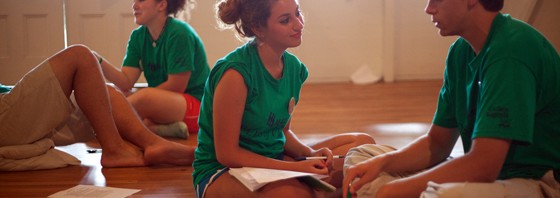

15 Minutes: Aaron David Miller
Social Innovation Review (Stanford Graduate School of Business)

Read this as a PDF »

In 2003, Aaron David Miller left his State Department post as a top Middle East peace negotiator and adviser to six secretaries of state to take the helm at Seeds of Peace, a nonprofit that brings together teenagers whose societies are in conflict. Seeds attempts, over the course of a summer at an unusual camp in Maine and through follow-up programming in conflict regions, to transform them into eventual leaders capable of seeking reconciliation. Since 1993, Seeds of Peace has developed a network of nearly 3,000 potential leaders from 25 nations.

You have spent your career focused on the most seemingly intractable issues facing mankind. What have you learned about the pursuit of peace, and how does it help you guide your organization?

The Arab-Israeli conflict can be resolved. What led me to resign from the State Department was my conviction that it has become a generational conflict. We are in great danger of losing an entire generation of young Arabs, Israelis, and Palestinians to a kind of hopelessness and despair that has characterized the situation over the last four years. I left the State Department not because I’d lost faith in what I call transactional diplomacy, which is the business of diplomats that I did for 25 years. But that is not enough. Transactional diplomacy has to be married to something else, and that something else is what I describe as transformational diplomacy—creating personal relationships between future leaders.

You really believe in achieving peace one personone teenagerat a time?

While saving the world one person at a time is not the most ideal way to proceed, it’s critical if we’re ever going to move beyond peace as the purview of diplomats to the kind of reconciliation and peacemaking that needs to be shared by broader constituencies. Contacts and relationships must be forged between young leaders who will emerge as journalists, attorneys, legislators, sports figures, scientists. This is the stuff of which relationships between nations are built. If there’s a sense of sharing a common destiny and there are practical ways of cooperating, people see they’re part of the same structure. One person’s floor really is another person’s ceiling.

Can you truly be nonpolitical with so much politics involved?

We’re a nonpolitical organization in the sense that we don’t take positions on discrete issues. I was asked to take a position on the Iraq war, and I wasn’t going to because I’ve got George Bush Sr. and Bill Clinton on my advisory committee. We need the support of Democrats and Republicans in this country. We need the support of Labour prime ministers and Likud prime ministers in Israel. So it involves a degree of diplomacy and very careful management. It’s a nonprofit where there are all kinds of minefields.

Minefields?

We brought [Israeli Labour leader] Shimon Peres and [Palestinian university president] Sari Nusseibeh to Detroit, where we have a very large and very active friends committee. On the part of the Arab-American community, there were demonstrations against Peres outside the Ritz- Carlton where this event was held. I brought Queen Noor to Orlando, where we have another support group. There was great unhappiness among some elements in the Jewish community over things she had written in her book about her husband [King Hussein of Jordan]. So we’re constantly sitting on top of a political volcano. It goes off occasionally.

How do you keep the volcano from blowing?

I focus on the compelling nature of this work. I believe that only the forces of individuals through their own sense of courage and purpose can defeat the forces of history. And if we abandon the field to those impersonal forces of history, we have abandoned the future. If Israelis and Palestinians, 14, 15, 16 years old, who have lost friends and relatives to this conflict, can make the physical and psychological journey to living with one another and developing mutual respect—and sometimes even affection—for one another, it seems to me no obstacle is insurmountable, and I’m not going to indulge myself in thinking otherwise.

What enables you to achieve success with these teenagers?

We’ve created an environment which provides four basic freedoms that these kids simply cannot get at home – freedom of association without stigma, which is absolutely critical to building any kind of trust; freedom of movement, which they do not have at home; freedom to think critically and independently, tough to do while caught up in these conflicts; and freedom from fear of mortal harm. Their parents cannot guarantee them 24 hours of absolute security. For three and a half weeks, we can.

That creates big changes in them?

This environment sets the stage for a phenomenal transformation. That first night, you’ll find Israelis and Palestinians who won’t sleep. Not because they are homesick, which they are, or have jet lag, which they do, but because they’re terrified that during the course of the night physical harm will come to them from the other side. At the end of three and a half weeks, they are in mourning over perhaps never seeing each other again or being unable to have contact.

Specifically, what do you do to foster this change?

It happens because of the combination of the abnormal—90 minutes every day with facilitators who use all kinds of techniques—with the normal. We used to call them coexistence sessions. We now call them dialogue sessions. Coexistence implies simply allowing the other side to be. Real reconciliation is more than that. They’re really detoxification sessions in which hatred and poison from years of conflict come out.

Do they really change their outlook, ceasing all antagonism?

Can we claim the Israelis and Palestinians have resolved their conflict? No. Can we claim that the Arabs and Israelis will never again think ill thoughts of one another? No. But we can claim this: For the first time in their lives, they hear the narrative of the so-called other—the enemy—not from a rabbi or an imam or a priest or a politician or a journalist or a parent. They hear the story of the so-called other from a friend, a peer whose humanity and decency they simply can no longer deny. One Palestinian said to me, during the worst of the confrontation in summer 2002, “I come for one reason, to hear and be heard.” So with this transformative experience—and a decade of follow-up that we do—you end up creating authentic leaders who not only understand the needs and requirements of their own constituency, but they truly appreciate the requirements of the other. That is the essence of conflict resolution. It’s also the essence of leadership.

What makes for an effective leader of a nonprofit? What makes you effective?

You have to believe in it and convey that passion. And because I come from a world that is the opposite of nongovernmental organizations, it may well be that people pay more attention. I mean, why would somebody who was an adviser to six secretaries of state want to work with young people? The reason is that being part of something bigger than yourself, particularly on historic issues, is an honor and a privilege.

What did you learn at the bargaining table that enables you to do this?

It’s the way I define my own life: “The perfect should not be allowed to become the enemy of the good.” That phrase should be emblazoned over the portal of every negotiating room and boardroom in the world. The insistence on the pursuit of 100 percent in conflicts will get you nothing. Or worse than nothing. Life is all about finding a balance between the real and the ideal. The negotiation of real peace will not be the property of the margins; it will not be the property of the right or left. It will be at the center, where Seeds is.

What is the biggest challenge you face?

Other than managing politics? Fundraising. We accept money from corporate sponsors and foundations, but most comes from individuals and event-driven development, which is not the most effective way to marshal resources.

Why is it a challenge? Because of the time involved?

No. Because of what we try to do. Hamas is running 5,000 young people each summer through their camps. They’re not coexistence camps. We’re running 500. Those numbers don’t make any sense There is no greater challenge that this country faces than the challenge that is brewing in South Asia and the Arabic and Muslim world, and it’s a generational challenge. Except for resources, there’s no reason why Seeds couldn’t bring 5,000 each summer to two or three camps and have a significant multiplier effect by doing follow-up in the regions.

What’s the greatest difficulty in setting the budget?

The unpredictability of what we’re able to raise against what we’re spending. And making sure the budgets are real and that we can raise resources to cover it. This is the problem with any nonprofit—the need for some sort of financial cushion so chasing dollars isn’t the single most important act in the organization. We’re also putting a lot of resources now into evaluation.

So you go back later and see whether your program works?

Exactly. Zogby International has looked at a portion of our young people from camp sessions in 2003. The degree to which their attitudes—even in these circumstances—have been constant is encouraging. We are now doing a long-term study so we can see over a decade what a difference this program has made.

Why did you commission those studies? Can data bolster fundraising?

There had never been an effort to measure success and that was unacceptable. We need independent, credible evaluation to determine whether our program is working. Yes, of course it’s driven by our donors, foundations, corporate sponsors who want to know. And they have a right to know. The fact that you’re a nonprofit doesn’t free you from the kinds of standards all other credible organizations have to measure themselves by, and be measured by others. We also want to know whether programs work. We can adjust or modify them if they’re not.

What’s the structure of your organization?

I have a diverse board of 25 committed people and a smaller executive committee. Both help with fundraising. We’re now doing a strategic plan, and that brings up many issues.

Such as?

A second camp. Should we concentrate on one conflict or continue to deal with two or three? Is event-driven development the best way to go? Should the focus of our activities be in the regions [where conflict occurs] or in the United States? I feel the region is where success or failure lies. Historically, we started with the camp in Maine.

So there’s tension over deviating from your original mission?

Remember, this organization was created in 1993 by a Hearst journalist, John Wallach. Forty-five of the first Seeds grads—Israeli, Palestinian, and Egyptian teens—were on the White House lawn on Sept. 13, 1993 [when Yasser Arafat and Yitzhak Rabin signed the Oslo Accords]. In 2000, everything broke down. We’ve got to go to regional or even uninational approaches, not as a substitute for dialogue, but to empower these young people within their communities so they don’t become delegitimized.

So you have to manage a transition?

Some small nonprofits never survive the deaths of their charismatic founders. That whole process of transition—how you move from an entrepreneurial phase of a nonprofit with a founder beloved by all to the institutional phase, there’s dislocation in that.

How do all these changesenlarging operations, disagreements internally, a polarized worldaffect your organization and outlook?

It is all infinitely more complicated. But it is also incredibly exciting and challenging. The opportunities to present a very compelling mission and a model for how to deal with these conflicts have expanded exponentially. I went down to talk to the ExxonMobil corporate board last month for possible support. They understand not only from the corporate public relations perspective but from also the global reality and substance that organizations like this one are worth supporting. So I believe political circumstances have broadened potential constituencies.

So you feel more hopeful?

I think 2005 will bring a break in the Israel-Palestinian stalemate. But if you ask me when you can see anything remotely resembling peaceful normal relations between nations, I think it will be a couple of decades. That’s right about the time our oldest graduates will be coming into their own.

Seeds of Peace to host Action Summit

Seeds of Peace empowers leaders of the next generation: 30 of them to meet this week

NEW YORK | From September 16-20, 2006, Seeds of Peace program graduates will convene to develop concrete strategies to strengthen channels of communication and cooperation between Arabs and Israelis and to increase the impact of these initiatives in their communities.

The Seeds of Peace Action Summit will bring together thirty Israeli, Palestinian, Egyptian, and Jordanian Seeds graduates whose involvement with Seeds of Peace stretches over a decade. The Seeds of Peace graduates now hold positions such as foreign policy adviser to President Abbas, senior advisor to Kofi Annan, assistant to a member of the Knesset, as well as senior posts at the World Bank, at the United Nations and in TV and radio broadcasting. The Action Summit participants will gather in New York to work towards a different future for themselves, their countries, and the Middle East at large.

The Action Summit, occurring immediately prior to the gathering of world leaders at the United Nations General Assembly and at the Clinton Global Initiative, will focus on being more effective advocates for peace, developing technology to facilitate cross-border cooperation, and interacting with key figures who can help them implement their initiatives.

“These oldest Seeds’ graduates are coming together with renewed urgency to ensure that the lessons they have learned through Seeds of Peace take root in their communities and lead ultimately to better understanding,” said Janet Wallach, president of Seeds of Peace. “Their efforts following the summit will provide an essential foundation for their continued development as the region’s future leaders.”

Seeds of Peace empowers leaders of the next generation. Since 1993, Seeds of Peace has graduated over 3,000 teenagers and young adults from several regions of conflict and has reached several thousand more in their communities through initiatives such as the Seeds of Peace Camp in Maine, numerous regional workshops, educational and professional courses, and adult educator programs, as well as the extensive Seeds network. Participants develop empathy, respect, and confidence, and gain critical leadership, negotiation and conflict resolution skills. Many are now in positions of influence such as foreign advisor to President Abbas, or assistant to a member of the Knesset, as well as senior posts at the World Bank, the United Nations and TV and radio broadcasting.

Founded by the late John Wallach, former Hearst correspondent and author, Seeds of Peace is internationally recognized for its unique model of long-term engagement with its participants, its official support by the government leadership of its participating delegations, and its ability to operate continuously to bring youth from regions of conflict together to empower them to become the next generation of leaders.

Seeds of Peace announces new program initiatives developed at Action Summit

Organization also makes $1.2 million commitment at the Clinton Global Initiative to launch conflict resolution institute

NEW YORK | Seeds of Peace announced a number of new initiatives today that were a direct result of the Action Summit held earlier this month at the Manhattanville College in New York. Thirty Israeli, Palestinian, Egyptian, and Jordanian Seeds graduates, whose involvement with Seeds of Peace stretches over a decade, spent four days together developing programs and networking initiatives to enable and foster more communication and cooperation between Arabs and Israelis as well as to increase the impact and effectiveness of Seeds of Peace in the Middle East and world communities at large.

“We are pleased with the very clear and tight action plan the Seeds generated,” said Janet Wallach, president of Seeds of Peace. “These programs will be implemented by the Seeds themselves and will offer tremendous opportunities to enhance their leadership skills and to engage each other and their communities personally and professionally.”

Recognizing the need for programs that engage and empower Seeds now involved in professional careers, summit participants developed a series of initiatives to increase the potential of economic cooperation and professional networking opportunities between each other. Highlights include:

Connecting Israeli and Palestinian Schools

Israeli and Palestinian Seeds who received training in professional dialogue facilitation through an Seeds of Peace-sponsored conflict mediation course will engage students in Israeli and Palestinian schools in Jerusalem through regular dialogue sessions and recreational activities. This will enable the Seeds to practice their facilitation skills while also contributing to community outreach projects.

Business Forum

Israeli and Palestinian Seeds will provide local business professionals in both communities with the opportunity to network and engage each other in the service of economic cooperation. Speakers will be invited to address specific topics of interest to both the business community and the Seeds.

Professional Development Seminars

Creating groups of Arab and Israeli Seeds who share professional interests, educational sessions will be held on subjects such as law, education, business, and religion.

Political Educational Seminars

Israeli, Palestinian, Egyptian, and Jordanian Seeds will design a seminar series in each of their countries to gain in depth understanding of their own political systems, historical peace treaties and critical issues concerning the Arab-Israeli conflict. The culmination of the program will be a multinational event that enables the group to share their learnings and capture their findings in a joint document.

Community Outreach

In order to multiply the impact of Seeds of Peace in the societies of our alumni, Israeli and Arab Seeds will conduct extensive outreach programs to engage their families, friends, and community members. Specific programs include school and college presentations parent dialogue groups, and partnerships with local businesses, and community service organizations.

Mentorship Program

To create strong linkages between Seeds aged 14 to 27, older and younger Seeds will be paired together through a mentorship program emphasizing community involvement.

In addition to the new program initiatives derived from the Action Summit, Seeds of Peace was a participant in the Clinton Global Initiative where they announced the launch of the John P. Wallach Institute for Conflict Resolution, a $1.2 million initiative to provide advanced negotiation and mediation training to university-aged Israeli and Palestinian Seeds. The institute’s mission will be to empower an emerging generation of Israeli and Palestinian youth to lead their communities toward peace. Program curriculum will cover human rights, gender issues, religion and democracy, and program participants will do outreach work using Seeds’ communication technologies to expand their reach.

About Seeds of Peace

Seeds of Peace empowers leaders of the next generation. Since 1993, Seeds of Peace has graduated over 3,000 teenagers and young adults from several regions of conflict and has reached several thousand more in their communities through initiatives such as the International Camp in Maine, numerous regional workshops, educational and professional courses, and adult educator programs, as well as the extensive Seeds network. Participants develop empathy, respect, and confidence, and gain critical leadership, negotiation and conflict resolution skills. Many are now in positions of influence such as on the team of advisors to President Abbas, assistant to a member of the Knesset, or working at the World Bank, the United Nations and in TV and radio broadcasting.

Founded by the late John Wallach, former Hearst correspondent and author, Seeds of Peace is internationally recognized for its unique model of long-term engagement with its youth participants, its official support and endorsement by the government leadership of its participating delegations, and its ability to operate continuously to bring youth from regions of conflict together to commit to a model of coexistence and a path to peace.

Contact: Amgad Naguib, GolinHarris

Spenta Kutar & Shahrzad Zaidi
My Hero

Recently, My Hero had the opportunity to interview two Seeds of Peace alumnae. Spenta Kutar, age 16 is from India and Shahrzad Zaidi, age 17, from Pakistan.

Each student is on the “opposite” side of a feud that has been going on between the two nations for years, which has resulted in a nuclear arms race.

MH: What early experiences in your life influenced you to become personally active in the quest for peace? How did you get involved with Seeds of Peace?

Spenta: Both countries, India and Pakistan spend so much time, energy and money in fighting each other that both countries don’t seem to care much about their internal development—if India was not fighting with Pakistan, these resources could instead be used to fight hunger, poverty, illiteracy and many other problems that plague my country. Knowing this I wanted to contribute in my own way towards securing peace between our countries.

Shahrzad: Seeing other people living with an undeserved feeling of insecurity and animosity for the enemies with whom they had so much in common influenced me to become personally active in the quest for peace. I got involved with SOP through school.

MH: What was your initial reaction to being among the “enemies”? Were you apprehensive or nervous?

Spenta: Yes, I was apprehensive about meeting them but I was also dreadfully excited…it is not everyday that an Indian meets a Pakistani!

Shahrzad: I was really excited to meet them as I had never met an Indian before. However, the first day I was a little apprehensive if they would meet me as a “seed” or an “enemy”.

MH: How did the experience of SOP change your idea of how peace could be attained? How did it change your idea of your own role in the process?

Spenta: Through SOP I realized that the one thing peace requires is mutual understanding. It is not necessary to agree with the other sides’ point of view but to accept and respect their beliefs. That is the first step towards peace. I became aware of the ‘power of one’. I realized that I could make a difference, and in my own small way contribute towards the easing of tensions between India and Pakistan.

Shahrzad: I learned that convincing the “preconceived enemy” to believe the way I do is not the solution. To attain peace it is important to “accept” their viewpoint. Also, it is important to listen to different perspectives and make an informed evaluation because our ideas are based on what has been drummed into our heads and the biased books/media.

MH: What advice would you give to kids who are interested in contributing to a peaceful world?

Spenta: Don’t ever lose hope.

Shahrzad: They have to believe that individuals can make a difference. It is important to hear the enemy’s point of view before making judgments. Kids are mostly influenced by their peers, therefore, their ideas can make other children think on those lines.

MH: What is your perspective on the current conflict between the U.S. and Iraq?

Spenta: Though Saddam Hussein needed to be ousted from power, the US should have gone through the UN instead.

Shahrzad: Saddam Hussein’s tyrannical rule was well known during the Gulf War. Why did the Americans and their coalition partners leave the job unfinished then when they had a total mandate and a unanimous global support to complete the job? I feel that the U.S. is setting a precedent for the stronger nations to go after weaker nations and take a pre-emptive strike on those whom they perceive to be a treat. My fear (as a Pakistani) is, if India perceives Pakistan as a threat, will it attack us? Moreover, world over Saddam Hussein is known to be a vicious, tyrannical and barbaric man, but that should not be a license for the mighty powers to wage war without the world backing.

MH: What are your personal goals now for your education, career, family etc.? Has SOP changed any of those goals?

Spenta: SOP has made a lasting impact on me. It has broadened my horizons and made me much more concerned and aware of the problems facing the world and the need to remove them.

Shahrzad: My short-term goal is to get into a good university on scholarship. On the professional side, I want to go into Investment Banking or actuarial sciences. On the social side, I want to be a good human being, accommodate others needs and be sympathetic in sharing. SOP has helped me focus more on my goals.

Read Susannah Abbey’s interview on My Hero Project »

If Our Leaders Can’t Do It
Ha’aretz

TULKAREM | December 27, 2008, will be remembered by Palestinians as the beginning of the massacre in the Gaza Strip. To many Israelis it was the day the Israel Defense Forces began its response to Qassam rocket attacks from Gaza. Despite these differences, I believe everyone can agree it was a day that pushed us back several steps on the road to peace. Now is the time to think about how we can regain the ground that was lost.

Although many of us are frustrated with this 60-year conflict, we must set aside time for healing before starting the peace process again. This time, greater efforts must be made toward creating a solution that will bring lasting peace. The process cannot simply be forced into motion: People must be willing for it to continue.

The healing process will not be quick. There will be long-term psychological repercussions among the Gazan population, such as post-traumatic stress disorder and “survivor’s guilt.” Children will require special care to ensure that they have an emotionally stable future. As it is they who will provide the next generation of Palestinian leaders, it is imperative that we not forget them.

It’s time to employ the measures needed for reconciliation. First and foremost must be the rebuilding of Gaza’s infrastructure and economy. This should be an international effort, but wouldn’t it enhance the process of reconciliation if Israelis were at the forefront? Israeli public support for the rebuilding would allow Palestinians to distinguish between their perceptions of Israel’s military and government (and the actions they take) and those of its sympathetic citizens.

When healing, engagement and reconciliation have taken place, the next step is to reach an accord. If governments cannot reach an agreement during negotiations, then it’s up to the public to press the issue or to take matters into their own hands.

Various organizations, at both the grassroots and international levels, have worked for years to push their leaders toward peace – but none with more diligence or intensity than youth peace groups. These proactive youth have met on a personal basis, by living together, playing sports and games together, learning empowerment techniques, holding mock UN sessions and participating in serious dialogue. They have learned how to listen compassionately, speak frankly and respect one another’s rights to exist without fear. They have put their differences aside and made peace with those whom they once considered their enemy.

Youth peace groups are a prime source of ideas for how to move toward full political reconciliation; they should be empowered.

The inspired young alumnae of programs like Seeds of Peace could bring their vast experience and innovation to the table. The female participants in similar programs like Creativity for Peace could be the nurturers of healing and understanding. The members of organizations like Combatants for Peace could bring the strength and stamina needed to get through the tough times ahead. Those who have participated in cross-cultural or religious-tolerance programs like the Sulha Peace Project could show us the importance of solidarity.

Even now, during this time of transition, these dedicated young peace seekers are making a difference. I recently learned that Shetha, one of my sisters in Creativity for Peace, who lives in Gaza, was critically wounded, and her sisters and cousins killed, in a missile attack on their house during Operation Cast Lead. Eyal Ronder, managing director of Seeds of Peace in Tel Aviv, helped me get an emergency travel permit so I could visit her in an Israeli hospital. During that visit, I believe I managed to cheer her up as well as ease the sorrow and sense of outrage I felt at the time.

After hearing Shetha’s tragic story, many of the people in my peace-friends network also decided to visit her—even those who didn’t know her—and they held a candlelight vigil at the hospital, dedicated to her and her slain family members.

The ongoing conflict and the recent tragedy in Gaza have robbed children of their hope for a better future. Even worse, they have stolen the humanity of young and old alike, on both sides. Although youthful innocence can never be regained, hope and humanity can be restored to both peoples. Hope and humanity must be won back because, after all, worse things can always follow even the worst that we have seen. There is no time to lose.

Khadrah Jean Jaser AbuZant, 19, was the Palestinian winner of the Simcha Bahiri Youth Essay Contest. She lives in Tul Karm, in the West Bank, and is a third-year psychology student at An-Najah National University. She is active in Seeds of Peace.

Read Khadrah AbuZant’s opinion piece at Ha’aretz »

Seeds of Peace grads work towards understanding
Moscow-Pullman Daily News (Idaho)

BY RUTH SNOW | Hassan Halta and Elie Shteinberg hated each other before their participation in Seeds of Peace.

They never had met, or even heard the other’s name, but the Palestinian and Israeli youth knew the other was an enemy.

The two Seeds of Peace graduates met for the first time Monday morning when they woke up in the same Moscow hotel room and started to prepare for a panel discussion at the University of Idaho’s Borah Symposium. More than 350 people attended Monday’s forum at the UI Student Union Building, the first of four scheduled this week.

Seeds of Peace promotes peace by enabling children of war to break the cycle of violence during a summer camp environment. Since the organization started in 1993, 1,600 youth have completed the program.

Co-founder Barbara Gottschalk said the type of meeting between Halta and Shteinberg is unheard of in the Middle East. Most Palestinian and Israeli youth assume the other is a faceless enemy, not a human being.

Halta, 20, recalled the 1996 summer camp when he met an Israeli, his new bunkmate.

“I had never met an Israeli before,” he said.

The boys started talking with each other and, in time, Halta said he forgot the other boy was Israeli. “I started to see a human face,” he said. He soon realized the boy and other Israelis were not responsible for the region’s conflict.

The conflict, which has escalated in the past few months, is due to an unwillingness on the part of the older generation of both countries to work together to find a reasonable solution, Halta said.

Shteinberg, 18, said when he first sat down and talked with the “enemy” at a Seeds of Peace summer camp in 1999, he realized they had watched the same movies, listened to the same music and played the same games.

“I was amazed,” he said.

Even after the camp concluded, he and a few of the Palestinian youth remained friends.

“We’ve gotten to the point in our relationships that politics just don’t matter,” he said. “I really feel like I’ve got a true friend on the other side.”

Gottschalk said it’s easy to blame and threaten people when angry, rather than listen to the other side’s reasoning.

“Enemies are made, they are manufactured for certain reasons,” Gottschalk said.

Shteinberg said peace in the region will begin when residents of both countries can start saying they have friends on the other side.

Since the escalation of violence in the two countries, Shteinberg said he and his Palestinian friends worry each time a violent act occurs.

“For us, any person who is injured or dies can be a friend,” he said. “It’s really hard for me to look at the news and see what happens.”

For peace ever to become a reality, regular citizens – not government officials – must realize the other side consists of human beings, not faceless enemies, Halta said.

It is hard to know what long-term results the organization may have in the region, but Gottschalk said peace likely will occur through the youth.

Shteinberg and Halta agreed the older generation is responsible for the continuing conflict, but their generation must be willing to find lasting solutions.

“It’s easy to say the old guys messed up, but we have to fix that,” Shteinberg said. “Obviously, today’s leaders are not going to live forever and that is good.”

Seeds of Peace
Worldpress.org

Every summer in Maine, a group of teenagers from the Middle East and South Asia gathers at the Seeds of Peace summer camp to experience something they can’t find back home: an environment where they can openly and peacefully engage in dialogue with kids they might, under different circumstances, consider enemies.

Founded in 1993 by journalist John Wallach, Seeds of Peace prides itself in “empowering young leaders from regions of conflict with the leadership skills to advance reconciliation and coexistence.” Kids who enter the program (or “Seeds,” as they’re called) are given the opportunity to forge relationships that ultimately alter their worldview, connecting to cultures that previously seemed diametrically at odds with their own.

The program began in 1993 with 46 teenagers (14-16 years old) from Israel, Palestine and Egypt attending the summer camp. Since then, more than 4,300 young people have gone through the program, and the organization has expanded to include Seeds from Jordan, the Balkans, Turkey, Cyprus, India, Pakistan, Afghanistan—although the majority still come from the Middle East. The program has also come to include year-round regional conferences, workshops, educational initiatives and dialogue meetings, allowing the Seeds to advance communication and peacemaking years after that initial encounter at summer camp.

Executive Director Leslie Adelson Lewin told Worldpress.org that these ongoing initiatives are part of what distinguishes Seeds of Peace from other conflict-resolution organizations. “While camp is clearly the entry point, it is also the foundation of what we see as a much longer-term program and experience,” she said. “Not every kid has to be involved in Seeds of Peace for their entire life, but I feel pretty confident that the experience they’ve had impacts them and stays with them throughout their life.”

The summer camp balances activities that give kids the chance to be kids, with a more serious curriculum designed to stimulate important dialogue and begin building relationships that, in many cases, will end up lasting a lifetime. “For many of our Israelis and Palestinians,” Adelson Lewin said, “coming to camp is the first time they’re really meeting ‘the other.’ It’s the first time an Israeli is having any kind of real interaction with a Palestinian, and vise verse. They’re not just having interaction; they’re having a pretty substantive opportunity to get to know these people as people, and to hear the other side of the story, which is pretty impossible to do when you’re at home, in your own schools, in your own government, in your own media.”

To someone living in the United States—where war is not something experienced on your home turf on a regular basis—it is hard to imagine what the gravity of this first encounter might be like. Amer Kamal is a Palestinian Seed who grew up in East Jerusalem. He told Worldpress.org about the nerves he felt going to camp in 1997, recalling the shock he felt when he learned that he wouldn’t have his own room and would have to bunk with the other kids. “On both sides of me there were Israelis,” Kamal said. “I didn’t feel safe. I was worried about my stuff, even. I kept my stuff in the bag; I didn’t unpack.”

For the first week Kamal kept to himself, didn’t talk to the Israelis in his room. “I would go hang out with the Palestinians, or the Jordanians or the Egyptians.” This lasted until, during one of the bunk activities, he started talking to an Israeli. “He was a swimmer, and I was a swimmer. He liked basketball, and I liked basketball, too. Then the situation changed.” He no longer saw him through the lens of nationality. “He was now my roommate, who likes basketball and swimming.”

Kamal grew up during the first intifada and witnessed the Al Aqsa Massacre in 1990. Apart from the limited interaction he had with Israelis when he would cross the Green Line, which separates East and West Jerusalem, the Israelis he’d encountered were soldiers. “I’d seen people dying on their hands,” he said. “That was basically Israel for me.” So seeing an Israeli as someone who likes basketball and swimming—seeing him as a friend—was no small leap. These initial connections make it easier to do the harder work that inevitably follows.

Eldad Levy is an Israeli Seed from Haifa who first attended camp in 1998. He has since gone back as peer support, then a full-time counselor, and is now directing the Israeli regional program full time. He, too, found it “stunning” to realize that “there are young, smart, funny people on the other side.” He told Worldpress.org that Seeds of Peace “has become the most important tool I have to think with,” the experience that has shaped the way he views things more than anything else. But both as a camper and a counselor he has seen how difficult it can be for kids to break through that initial wall.

During one of the dialogue sessions (which are led by professional facilitators) at Levy’s first camp, one girl took a while to open up. After she was eventually able to share her thoughts, she closed back up again and was too upset to talk to anyone. Levy wanted to engage her but couldn’t. “When you’re 15 years old,” he said, “you don’t normally have someone telling you they don’t want to talk to you because of your political views. It’s not something that happens to 15-year-olds.” He and the girl eventually worked through that friction and connected, but emotions can be high when confronting sensitive issues head on.

“The most important thing I learned,” Levy said, “was the ability to not get upset, to control my emotions, while hearing something that I completely disagree with—realizing that the person I’m listening to is coming from a completely different social, cultural, political background, and that that person might respect me, might even love me, but is simply disagreeing with me.” He learned not to turn away “from that painful thing that you are hearing.”

Kamal echoed the same sentiment. The goal is not to agree with the other person, he said. The important part is “that the other side understand where I’m coming from and why I’m saying this, and that I understand where they’re coming from and why they believe in what they believe in.” It doesn’t happen overnight, but when Seeds learn how to listen and understand each other, he said, “those two things are life-changing … the starting point of it all. If you can reach that stage, then you’re able to talk about a peace process.”

Both Kamal and Levy have close friends with whom they disagree to this day, friends with whom they continue to engage in dialogue. “We both want the best for our people,” Kamal said. “We both are nationalistic, and we both are passionate about our cause and our rights, but we respect each other, and we choose a civilized way to talk to each other. That, I think, is what Seeds of Peace is able to give, and what other organizations or politicians haven’t been able to do.”

Kamal and Levy also both talk about how the organization is able to “incorporate the wall,” using very similar language independently of each other. As Levy put it, “We’re not a peace organization in the sense that we’re encouraging kids to be peace activists, or to abandon all the values of their nationalism and culture.” He stressed that, as an Israeli, there are Israelis with whom he disagrees. Political disagreement is natural. It’s the manner in which you have that conversation, built on mutual respect, that makes the difference.

That is not to say that Seeds do not experience doubt along the path. Around 2000, when the second intifada started, at a Seeds of Peace workshop in Ramallah, Kamal watched Israeli tanks roll into town. “Seeing the tanks in front of my eyes, seeing the helicopters, the Apaches, the F-16 fighters coming over and bombing,” he said, “it was the first time I’d seen my country really under attack.” He saw much of the development and progress achieved in the West Bank in the 1990s being turned to rubble. In a situation like that, anyone’s peaceful character gets put to the test.

In the late 1990s, a lot of people in Israel and Palestine were rallying around the peace process. It was much easier for someone to speak out in favor of reconciliation with the other side. Today is much different. Society on both sides is violently charged, with open hands clenched into fists. “When you have the F-16 fighters bombing continuously, and you wake up and read the news and more people are dead, you cannot come out and be loudly supporting peace,” Kamal said. “It’s tense now. People are full of anger, hatred. Before, I was always okay going to West Jerusalem, but now I’m scared to enter it because I don’t feel safe. I’m afraid if I speak Arabic, someone will jump me and start beating me. People believed in the peace process, but now they’ve seen that it didn’t take them anywhere and they’re angry. To take them back to the peace process would be very difficult.”

Levy agrees that today the spirit in the air is far more hostile than in the late 1990s. “I think both Israeli and Palestinian societies are going through a sad process of radicalization, going to extremes and polarization,” he said. “I have nothing but respect for anyone who goes through Seeds of Peace, because I know what they go through at school.” In 1998 kids told him he was wasting his time. “Kids today get it way worse. They have to legitimize themselves much more. Therefore they come to the program with bigger baggage. They come filled with more tension.”

For those who go through the program, though, the impact can be so penetrative that it becomes a part of who they are. Although every Seed has a different experience, Levy said, “no one can disregard their Seeds of Peace experience. It’s impossible to treat as something negligible.” And now that many of the Seeds are grown and making their way in the world, the organization can see that broadened perception take effect. “The Seeds of Peace mission statement includes the word ‘leadership’ a lot,” Adelson Lewin said. “I think now, 18 years in, we can really see the 30-plus-year-olds becoming leaders in their respective fields.”

As a case in point, “A former camper of mine is a pretty well-known anchor on Israeli television right now,” Adelson Lewin said. “He was always interested in media. He studied media. He talks a lot about how he covered the Gaza war, for example, a couple years ago, and how his language and what he wanted to report on and how he approached the situation was different than his colleagues because he had a different outlook on who the people living in Gaza were. His experience and relationships with people living in Gaza played out on a professional level in how he chose to report and the words he chose to use when covering a story like that.”

Tomer Perry, an Israeli Seed from Jerusalem, told Worldpress.org about how his Seeds experience lives inside the DNA of his professional path as well. Perry first went to camp in 1996, returned as a counselor, and has participated in several follow-up programs and leadership summits over the last 15 years. “I’ve learned so much about the limits of the reality as it was told to me in school and as it was told in the news I had heard all my life,” he said. “I have learned the limits not only of the news we read, but of the way we read it—the limits of our perspectives.” Perry is currently living in Stanford, pursuing his PhD in political theory, and he said his Seeds experience is so entangled with his life and his studies that he couldn’t separate it if he tried.

This vision got set in motion when Wallach, the founder of Seeds of Peace, was working as a journalist in the Middle East. “As an American he could go back and forth between Israeli and Palestinian communities,” Adelson Lewin said, “and he would see kids playing soccer, listening to music, eating food, hanging out with their friends, and see pretty much the same thing on the other side. He was struck by how much similarity was there, and yet there was no contact. Seeds of Peace was born out of that striking takeaway of so much similarity being there and yet so much hatred and so little opportunity to develop your own conclusion and understanding of these mysterious other people.”

She added, “It shouldn’t have to take flying a couple hundred kids to Maine to go to summer camp together in order to have that conversation, but unfortunately, for now, it does.”

The Seeds of Peace website is www.seedsofpeace.org.

Joshua Pringle is a journalist, novelist and singer living in New York City. He is the senior editor for Worldpress.org. This fall he will begin the master’s program in international relations at New York University.

Read Joshua Pringle’s article at Worldpress.org »

Seeds of Peace 20th anniversary
Capitol Words

Congressional Record, 112th Congress (2011-2012)

Sen. Olympia J. Snowe

Mr. President, today I wish to join with individuals across the world in recognizing the 20th anniversary of the founding of Seeds of Peace, an organization dedicated to the advancement of peace through understanding, reconciliation, acceptance, and coexistence among people, and established on the principle that long-term peace within or between nations can only be achieved with the emergence of a new generation of leaders who choose dialogue over violence.

Seeds of Peace’s first camp session in 1993 was a labor of love for the late founder and esteemed journalist, John Wallach. That summer, under the leadership of Wallach, Bobbie Gottschalk, and Timothy Wilson, Seeds of Peace hosted 46 Arab and Israeli teenagers at its first summer camp in my home State of Maine. Since that day, the organization has blossomed into a full-fledged leadership program, which spans 27 countries with full staff in Amman, Gaza, Jerusalem, Kabul, Lahore, Mumbai, New York, Otisfield, Ramallah, and Tel Aviv.

Today, for 3 weeks at a time, during the months of June, July, and August, on the beautiful shores of Pleasant Lake in Otisfield, ME, Seeds of Peace brings together young people and educators from areas immersed in civil conflict, war, and other political and social unrest, to learn about coexistence and conflict resolution at their international summer camp. Camp participants engage with one another in both guided coexistence sessions and typical summer camp activities, which expose the human face that lie behind ethnic, religious, and political differences.

Now, under the acclaimed leadership of Leslie Lewin, Seeds of Peace has prepared over 5,000 alumni, known as “Seeds,” primarily from the Middle East, South Asia, the Balkans, and Cyprus, for roles of leadership by offering them not only the unmatched summer camp experience of sleeping next to, eating alongside, and swimming with those who are their alleged enemies, but also a robust and worthwhile slate of intensive, year-round programs encircling the globe, which are focused on further refining the skills learned and relationships built at camp.

Seeds of Peace is a testament to the importance of conflict resolution and reconciliation programs as a tool for creating peace, and the program is indisputably making a difference in the lives of its Seeds each and every day. It is no surprise that Seeds of Peace is strongly supported by participating governments and many world leaders, and I urge my colleagues to join me in recognizing the organization’s contributions to the advancement of peace—which all began with a 3 week stint at a summer camp in Maine 20 years ago. Seeds of Peace provides a promise for a better future, and I enthusiastically welcome its continued efforts for years to come.

Read Senator Snowe’s speech at CapitolWords »

Egyptian Seeds react to Morsi ouster

CAIRO | Egyptian Seeds—from Cairo to Camp in Maine—have taken to social media to share their reactions to the news today that the Egyptian military was ousting the country’s leader, President Mohamed Morsi.

“The potential our generation has and its passion for change is unbelievable,” said one. “I hope for a leader who accommodates the rights of everyone.”

Some Seeds struggled with the non-democratic means in which the military was taking over.

“It’s the best thing that could have happened, in the worst way possible,” said a Seed at Camp.

“I don’t think ousting Morsi was the best solution,” said another Seed in Cairo. “I was hoping that a solution to the political situation in Egypt would have somehow fulfilled the aspirations of both [the pro- and anti-Morsi] groups, since they are both Egyptians demanding legitimate rights.”

“I believe that the best solution would be to hold a referendum on whether or not Morsi should continue his term, and for the Egyptian people to decide their fate through the ballot box.”

“I’m still optimistic—I hope there are early elections,” said a Seed at Camp in Maine.

Other Seeds have spent weeks participating in anti-Morsi protests and celebrated today’s events.

“What you saw was not a coup,” said a Seed who had been demonstrating against Morsi in Cairo.

“It is the outcome of a grassroots initiative that grew exponentially and bypassed all the politics and traditional frameworks to speak directly to and for the people.”

While some Seeds celebrated, others were cautious, warning against alienating Morsi supporters.

“We’ve been calling out for true democracy, and it wouldn’t be true democracy if we decide to exclude a group of people who have the right to be heard. Let’s be smart and break out of this vicious cycle.”


Video taken July 3 by Egyptian Seed of crowds celebrating in Cairo.

Egyptian Seed Mona examines the lack of political leadership in her country.


NECN Video: Egyptian campers attend Seeds of Peace camp in Maine.

More reactions from Seeds to events in Egypt

  • “Here’s to a brighter future.”
  • “Egypt: a place where internet and traffic is achingly slow. But we create history instantaneously.”
  • “The Egyptian revolution continues.”
  • “I’m hopeful that we have learned a lesson and things will improve for my country from here!”
  • “Today, Egyptians made history—again. It’s not a coup. It’s democracy in its truest sense.”
  • “My parents are on the streets. I’m anxious to hear their accounts.”
  • “A great number of Egyptians have been alienated by the political decisions recently made, and this could be very dangerous.”
  • “We have to unite to run the country wisely.”
  • “Today marks another achievement in Egyptians’ efforts to take matters into their own hands and bring an end to decades of exploitation and corruption. I’m glad to have taken part of every part of this wonderful process.”
  • “These so-called “Islamists” violated every single principle that Islam stands for.”
  • “The ouster of former president Morsi is the direct outcome of a people’s revolution.”
  • “The president of the Supreme Constitutional Court will lead an interim coalition government, followed by the drafting of a constitution and early presidential and parliamentary elections. The military is obviously not taking over.”
  • “I don’t oppose the fact the he is no longer the president, but I have problems with the way it was done, and the negative impact it might have on the country as a whole.”
  • “I am thrilled by the lessons Egyptian citizens are teaching the world in determined and just civil movements. I’m hopeful the spirit of change and justice will spread as fire in a summer wheat field.”

Follow reactions by Seeds about Egypt on Twitter ››
Read a letter from Seeds of Peace Executive Director to Seeds in Egypt ››
Read an Egyptian Seed’s New York Times profile on Egypt’s new president ››
Read an Associated Press story about Egyptians at Camp ››