
Search Results for “{search_term_string}”

NBA takes time out: Players support Seeds of Peace campers
Portland Press Herald

OTISFIELD | BY STEVE SOLLOWAY She lives with fear, she told her small audience. Every day, every night. She spoke of children, much younger than her 17 years, who have so little hope.

She cried out her dream that her own children would know what it would be like to play and laugh without looking over their shoulders at death.

In a reversal of roles, Derek Rose and D.J. Augustin, twins Brook and Robin Lopez and others in their group locked their eyes on the young, sorrowful face of an Arab woman who would only give her name as Mirina. She had their attention and their emotions.

The future of the NBA had come to Seeds of Peace International Camp on Monday. Most of the morning and afternoon was filled with laughter and the bounce of basketballs. Six years ago, sports agent Arn Tellem brought some of the players he represents to this place. Many were recent draftees. He wanted them to see outside their world of rich bonuses and unimaginable opportunities and understand the lives of boys and girls not much younger than themselves who live in harm’s way.

Now they come every summer, the trip coinciding with a stop in New York City for an NBA photo-shoot for the rookies. Some, like B.J. Armstrong, who was a Chicago Bulls teammate of Michael Jordan on championship teams of the 1990’s, come back year after year. Brian Scalabrine of the Celtics is a repeat visitor.

Jordan Farmar of the Los Angeles Lakers made his second trip this summer. “I have a white mother and a black father and I was raised a Christian. My stepfather is Israeli and a Jew. I know what it’s like to be different.”

Meaning, he knows the hatred of ignorance. He will visit Israel in the next week or two, hoping to make a small difference. He will return to Seeds of Peace for as long as he’s welcome.

After lunch, seven Seeds of Peace campers, back for their second summer, spoke to the NBA players and Sue Wicks, a former WNBA star with the New York Liberty. Twenty years ago, she was an All-American at Rutgers. She played for 15 seasons overseas, including four in Israel.

Monday, she shared in the laughter and asked a lot of questions. She hugged Roi Bareket, a 17-year-old from a town between Tel Aviv and Jerusalem. He spoke optimistically about his country’s future, so long as people will talk to each other.

Wicks reached out to Mirina. “I’m not here, thinking I can accomplish something in one day,” Wicks said. “We’re here to show we support what they’re doing. They’re communicating with each other.

“When I step onto a court, I don’t care about your skin color or your religion or what nationality you are. I want to know who is going to be the strong teammate, who is going to crack under pressure, who is going to be there for me.

“Everything else just falls away.”

Bareket didn’t know Wicks. He hadn’t heard Armstrong’s name before or Derek Rose or Russell Westbrook or any of the others. He meant no disrespect when he said, “They’re just people, like you and me. The fact that they are basketball players isn’t important. I only care if they will talk to me and that they will listen to what I say.”

When all is Said and done, Bareket has it right.

Mirina—no, she said, she couldn’t give her last name. She is known back home. Someone would read what she says and not understand. It would be dangerous. Mirina, too, didn’t know American basketball players.

Forty years ago, Tellem, the agent, was a kid from Philadelphia attending a traditional summer camp on Thompson Lake. Tim Wilson was a camp counselor. A friendship started. Shortly after, Wilson took his first job as the head football coach at Dexter. Much later, he became Seeds of Peace camp director and remembered Tellem, inviting him back to Maine.

“The players trade e-mail addresses with some of the campers,” Tellem said. “They stay in touch.”

Antawn Jamison, a 10-year NBA player now with the Washington Wizards, visited Seeds of Peace several years ago with Tellem. “When something happens in the Middle East, Antawn calls me, asking what’s going on, are the kids we know all right.”

In the camp gym, Brook Lopez and his twin, Robin, joined with the campers, encouraging them to shoot the basketball and laughing with them when the ball fell through the net, or didn’t. The twins played together at Stanford. The New Jersey Nets, with the 10th pick of the draft, picked Brook. The Phoenix Suns grabbed Robin with the 15th pick.

“Experiencing this opens your eyes,” Brook Lopez said. “I’m getting back what I thought I would. Probably more.”

“All of us could give money,” said Armstrong, now an agent with Tellem. Rose, the top draft pick this year, signed with Armstrong. “But time is the most valuable thing we have and we don’t mind giving it to these kids.”

Yes, the next time you hear of another pro athlete stuffing $100 bills into thongs at a strip club, know there are others who will pay with their time to hear a child speak.

You could hear sniffles as a breeze off Thompson Lake rustled leaves when Mirina spoke. Some eyes were wet. You can’t imagine the life of an Arab living in Israel, she said. Just as she can’t imagine your life, living in the security of America.

She is 17 and does not want to be a basketball player or a teacher or a doctor. She wants to be a facilitator.

“I would like to be the string that pulls people together.”
2021 Year in Pictures

It was a year unlike any other for Seeds of Peace. No member of our community was untouched by the myriad challenges brought on by COVID-19, global financial insecurities, escalating violence and distrust, and in some places, even war.

And yet, hope found a way.

Over 700 people participated in one or more of 60 virtual and in-person programs, many of them new and innovative offerings that expanded our reach to communities we might otherwise have never encountered. From this year forward, each youth’s journey with Seeds of Peace begins at home, and more than 300 youth became Seeds by completing Core Leadership Programs in the Middle East, South Asia, and the U.S. Over 130 of those youth attended our signature Camp program in Maine, which returned for its 28th year this summer after taking a hiatus in 2020 due to the pandemic.

Though a picture may be worth a thousand words, even that amount seems insufficient for what this community accomplished in 2021. This album is an attempt to do that anyway, largely through the eyes of those closest to the action: our staff.


Camp in the time of COVID-19

Seeds of Peace Camp (Maine, August)

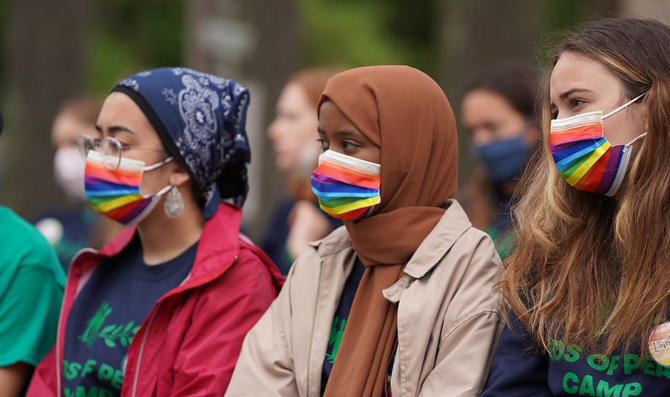
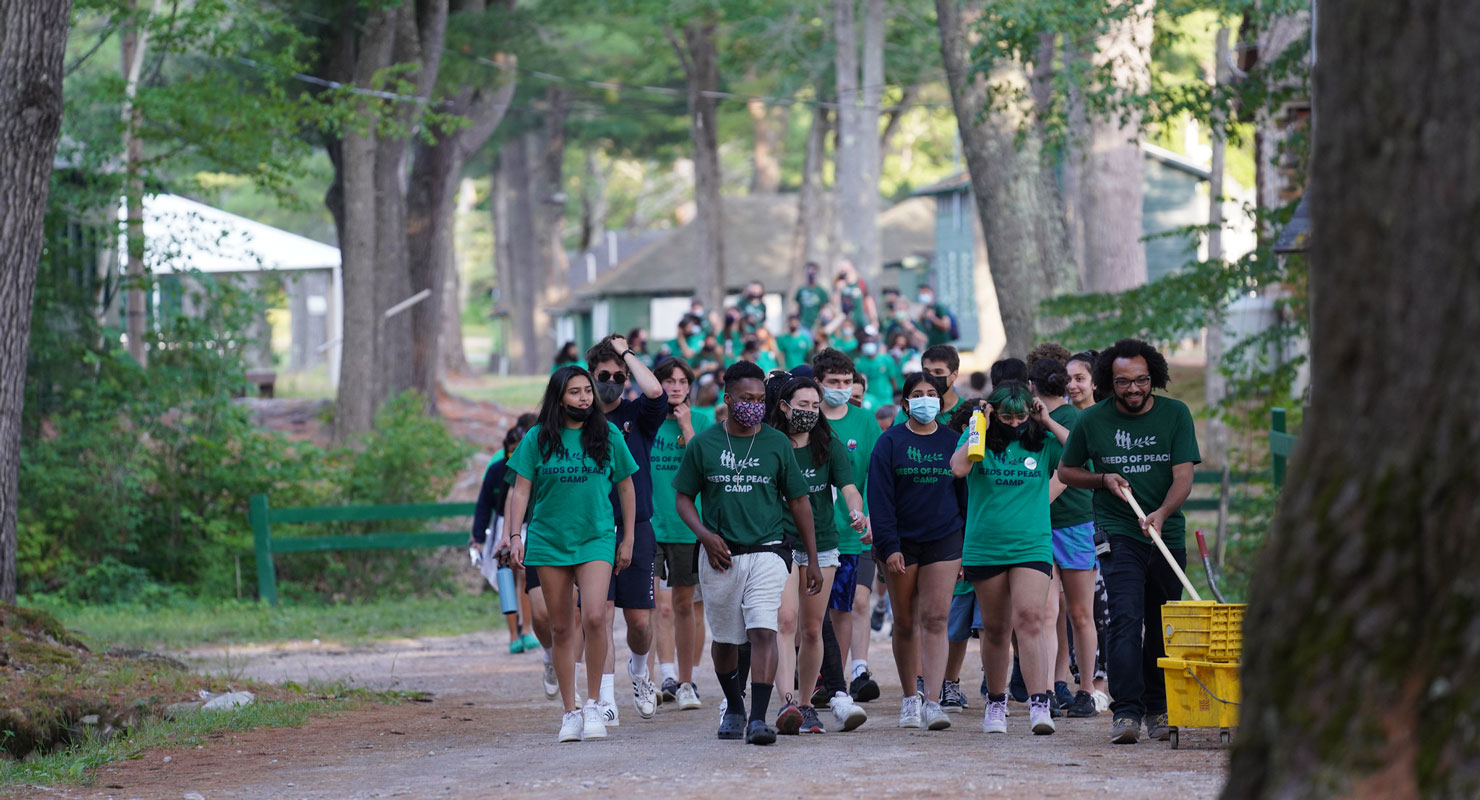
Working with local and national health experts, extensive protocols were put into place to keep campers and staff healthy all summer, including operating at a reduced capacity, limiting campers to only those from within the Northeast U.S., regular testing, eating all meals outside, keeping pods among dialogue and bunk groups, and of course, wearing masks. Not a single COVID case was reported during either of the two sessions.


Community Action as a core focus

Seeds of Peace Camp (Maine, August)

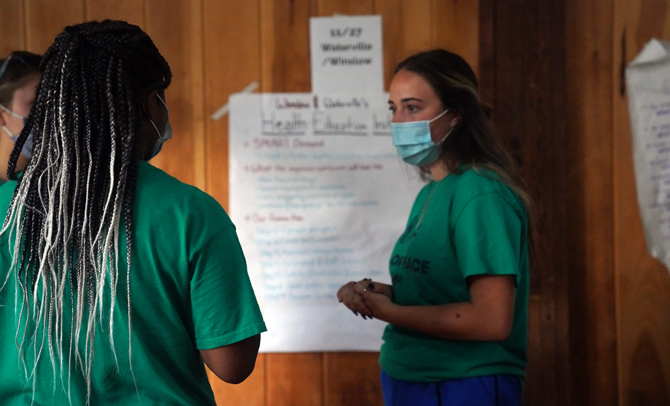
Dialogue, community-building, leadership development, and action-taking are the four pillars of the Seeds of Peace Core Leadership Program, and those elements were emphasized daily at Camp with the introduction of the new Community Action program. In Community Action, youth gathered in groups from their hometown to identify and address issues in their communities and beyond. While dialogue and relationship-building are first steps in creating solidarity, the Community Action initiative underscores Seeds of Peace’s belief in the importance of action-taking to bring about real change.


This is how we do it

Seeds of Peace Camp (Maine, July)

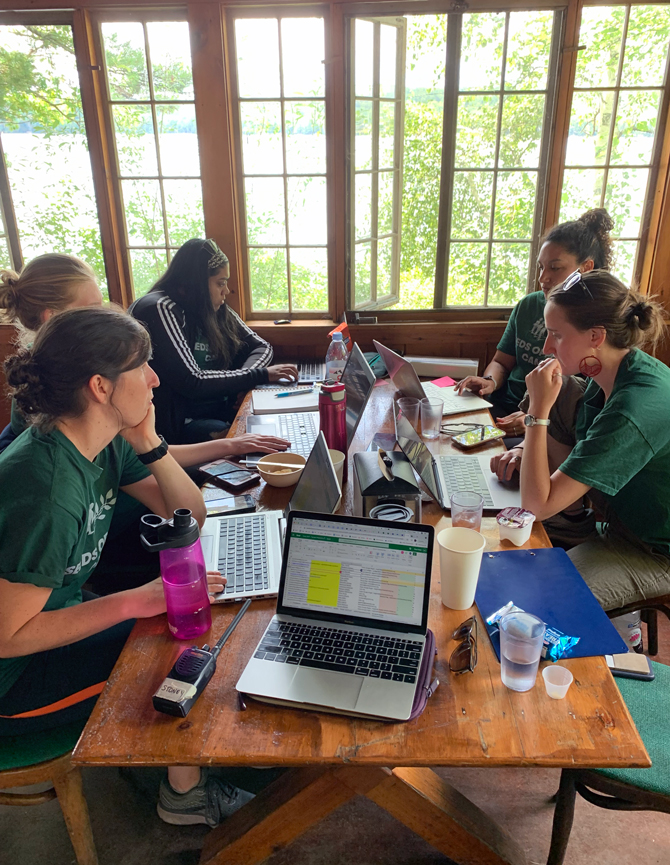
It took an enormous commitment from staff—many of whom were on site the entire summer—to bring together the 2021 Camp. “I love this photo because it’s in many ways the behind the scenes of Camp—staff members worked tirelessly day in and day out to ensure everything ran smoothly, while also supporting each other and enjoying views of the lake.”
— Eliza O’Neil, Co-Director of US Programs


All together now

Seeds of Peace Camp (Maine, July & August)

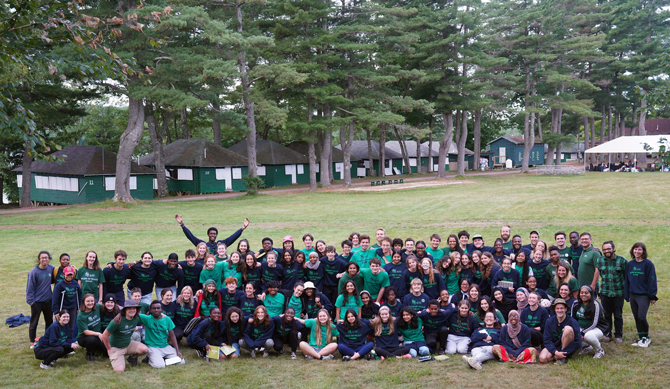
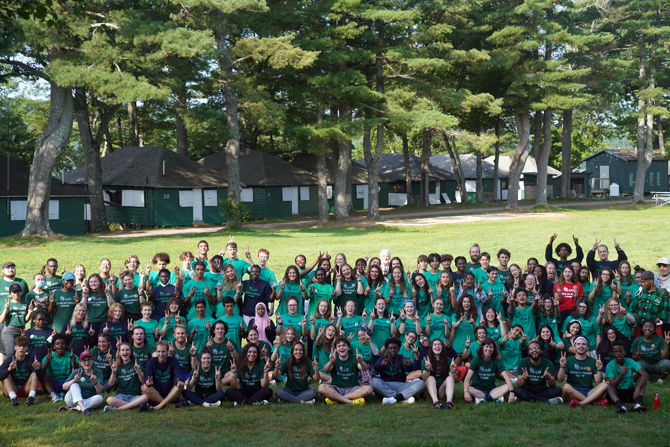
“It may seem like a cop out, but my favorite pictures are of the entire Camp together. This was the first time I had to figure out a good way to get everyone in the shot, so it was my biggest challenge this summer. But I also like the idea that no one is left out (except me in the first session). The second session, I was able to get somebody to snap the shot after I got it set up. I like these pictures because the Camp is in the background, the morning sun is on campers’ faces, and they were taken at the end of the session when we felt like a community and everyone could be next to whomever they wanted (as opposed to being organized by bunks or dialogue groups, as we were for much of Camp due to COVID safety protocols). Here, at the end of each session of Camp, we are comfortable standing alongside anyone in the Camp community.”
— Bobbie Gottschalk, Seeds of Peace Co-Founder, Camp photographer


Written on stone

Seeds of Peace Camp (Maine, August)

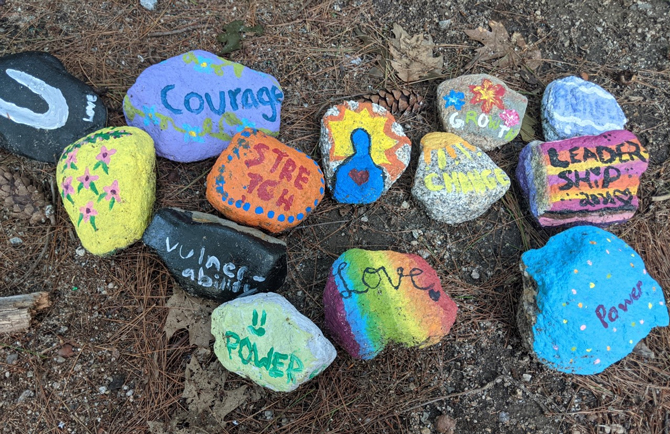
“The incredible counselors and campers of Bunk 18 painted these powerful words on rocks at the end of the summer as a reminder of the values they each shared at Camp in the summer of 2021. We see here: “courage, stretch, growth, change, leadership, power (x2!), love, vulnerability, respect.” Throughout Camp, our staff and campers displayed all of these values—and more. Together, our community navigated the many challenges of COVID-19 and spent our time at Camp building collective understanding and power in working against systematic injustice with creativity, joy, and courage. These rocks remain at Camp throughout the winter, and we can’t wait for our 2022 Seeds to see them when they arrive in the Summer and join the legacy left by all our campers and staff throughout the years.”
— Sarah Stone, Camp Director & Multinational Education Consultant


Saying so long

Seeds of Peace Camp (Maine, August)

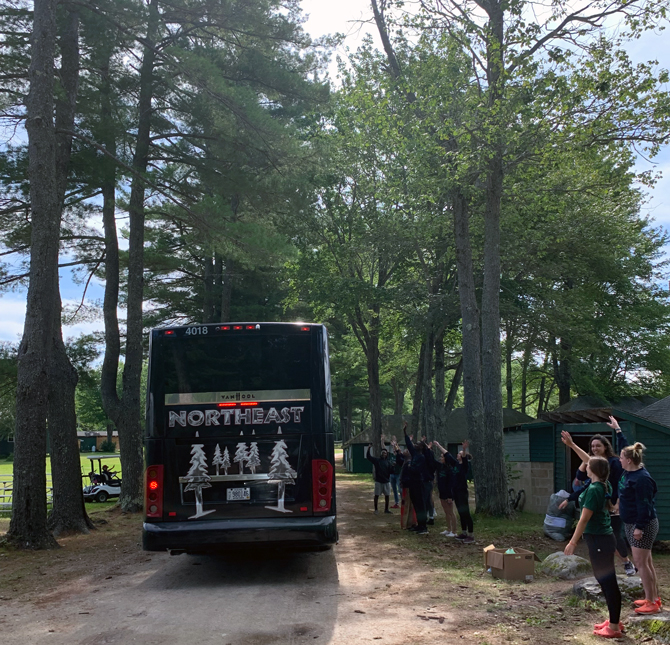
“This was the last bus pulling away from Camp at the end of Session 1. Departure day is both sad and a giant exhale for staff who put so much into making Camp happen.”
— Eliza O’Neil, Co-Director of US Programs


A Camp in Pakistan’s mountains

Youth Leadership and Dialogue Camp (Pakistan, July)

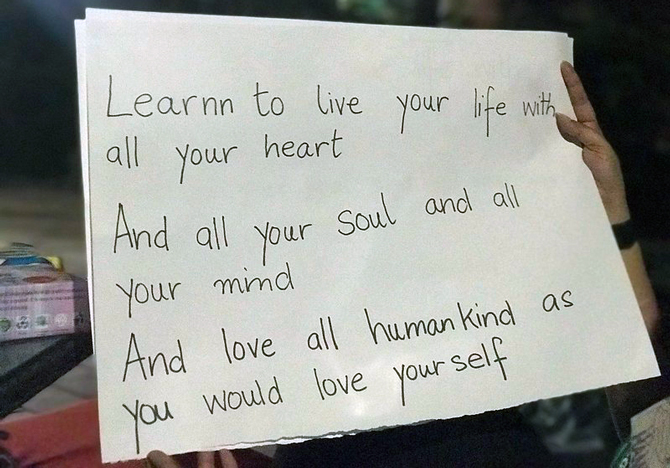
Young leaders traveled as far as 1,800 km to attend the first Pakistan Youth Leadership and Dialogue Camp, a weeklong, in-person experience led largely by older Seeds who incorporated many of the traditions from the Seeds of Peace Camp in Maine. “It was beautiful to see the message that one of the fellows of the Core Leadership Program wrote. It was pure, authentic, simple and encouraging of being an ‘EMPATHETIC HUMAN’. I recently stumbled upon this picture again, and I smiled.”
— Hana Tariq, Pakistan Program Coordinator


Investing in communities through GATHER Hubs

GATHER Hub (East Jerusalem, December)

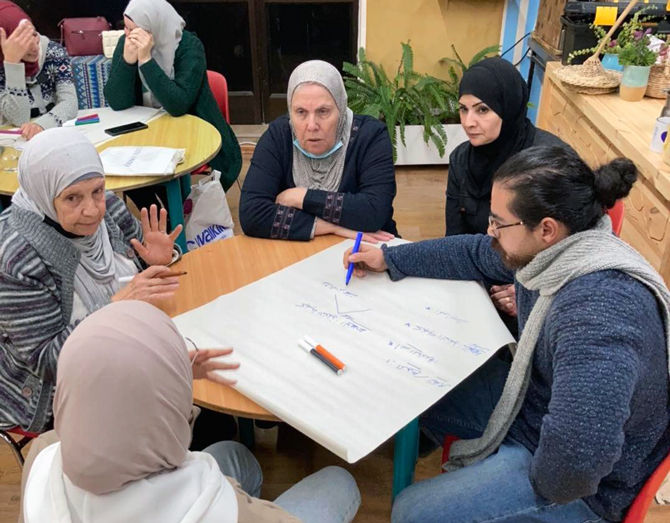
“This photo shows the founding members of the Sinsila Center in East Jerusalem, an eco-sustainability center that invited GATHER to build our first ever Hub—a community building strategy based on dialogue, education and local change. We have had Hub members from all over Jerusalem and of all ages. Like Um Ashraf, the woman at the center of the photo, who is 73 and from Lifta, an occupied and demolished Palestinian village whose remains tell a story of a once-thriving life of the indigenous Palestinian people who now live as refugees on their own land.”
— Ashraf Ghandour, Director GATHER Middle East Programs


2019 Israeli Seeds become Teen Leaders

Teen Leaders Seminar (Israel, August)

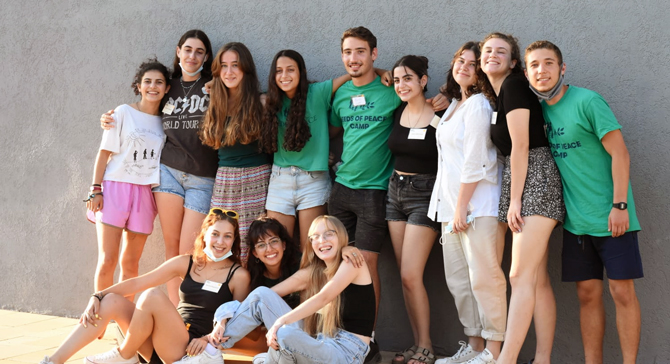
“The Israeli Teen Leaders, who attended Camp in the summer of 2019, came back to a reality that none of us could imagine. This picture is from their meeting in-person for the first time after a year of COVID outbreaks, many Zoom activities, and a war. Despite everything in their world that could make them hopeless, they chose to take action and help our team in Israel build back, enroll, and work with a new generation—our first graduates of the Core Leadership Program. We are so grateful to have those amazing young people with us, and so excited for the next big things they’ll do with their power, willingness, and hope.”
— Jonathan Kabiri and Shahar Shillo, Israeli Programming Team (photo by Jonathan Hefetz)


Spreading impact

Samvaad Project (India, April)

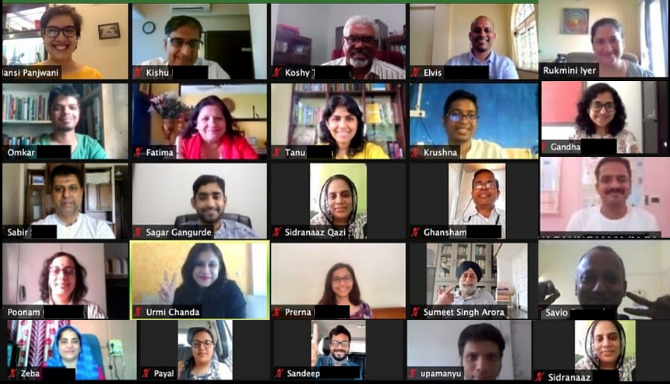
The Samvaad Project sought to train more than 30 professors in interfaith dialogue facilitation, making it the first of its kind in India. Over the course of nine months, the program, staff, and participants had to overcome numerous personal and programmatic obstacles, including having to shift an in-person retreat to virtual platforms after a second wave of COVID-19 swept India. Nevertheless, many of the participants continue to hold interfaith dialogue meetings for their students and communities, long after completing their certification requirements. It officially culminated in December with the National Interfaith Summit.


Interconnected in India

Interfaith Camp (India, December)

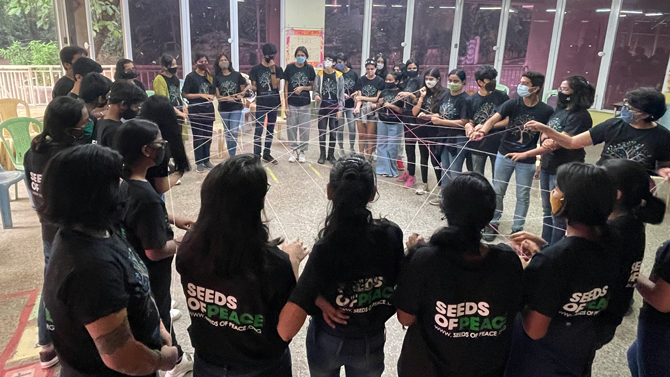
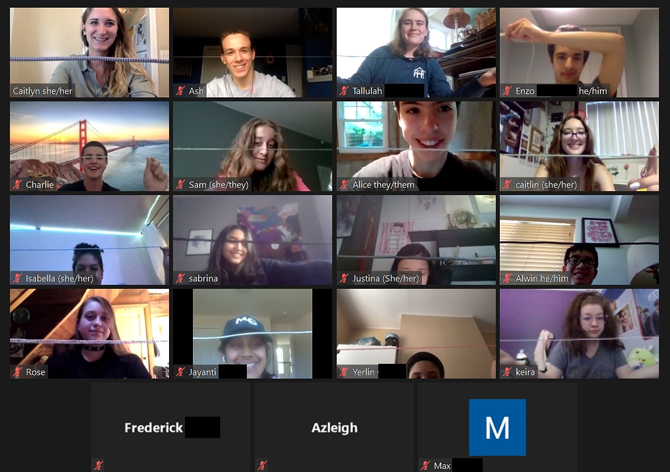
The Interfaith Harmony Camp has become a staple of the India Seeds of Peace program, and with extensive COVID safety measures in place, an in-person gathering in December capped India’s 2021 youth programs with an exciting, meaningful note. “This group shot shows all participants and us facilitators interconnected with a long string for a gratitude activity that felt rather special to me. This deliberate act of joining was very symbolic of what Seeds of Peace is essentially about: bringing people together.”
— Urmi Chanda, Senior Programs Coordinator, India


Resiliency and resolve in Jerusalem

Interfaith Dialogue Senior Program (Jerusalem, November)

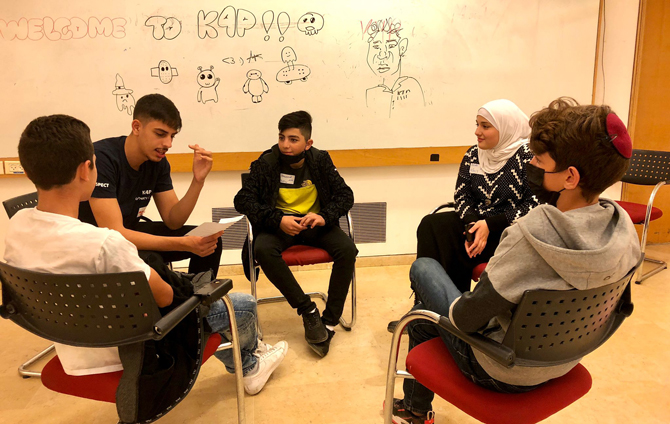
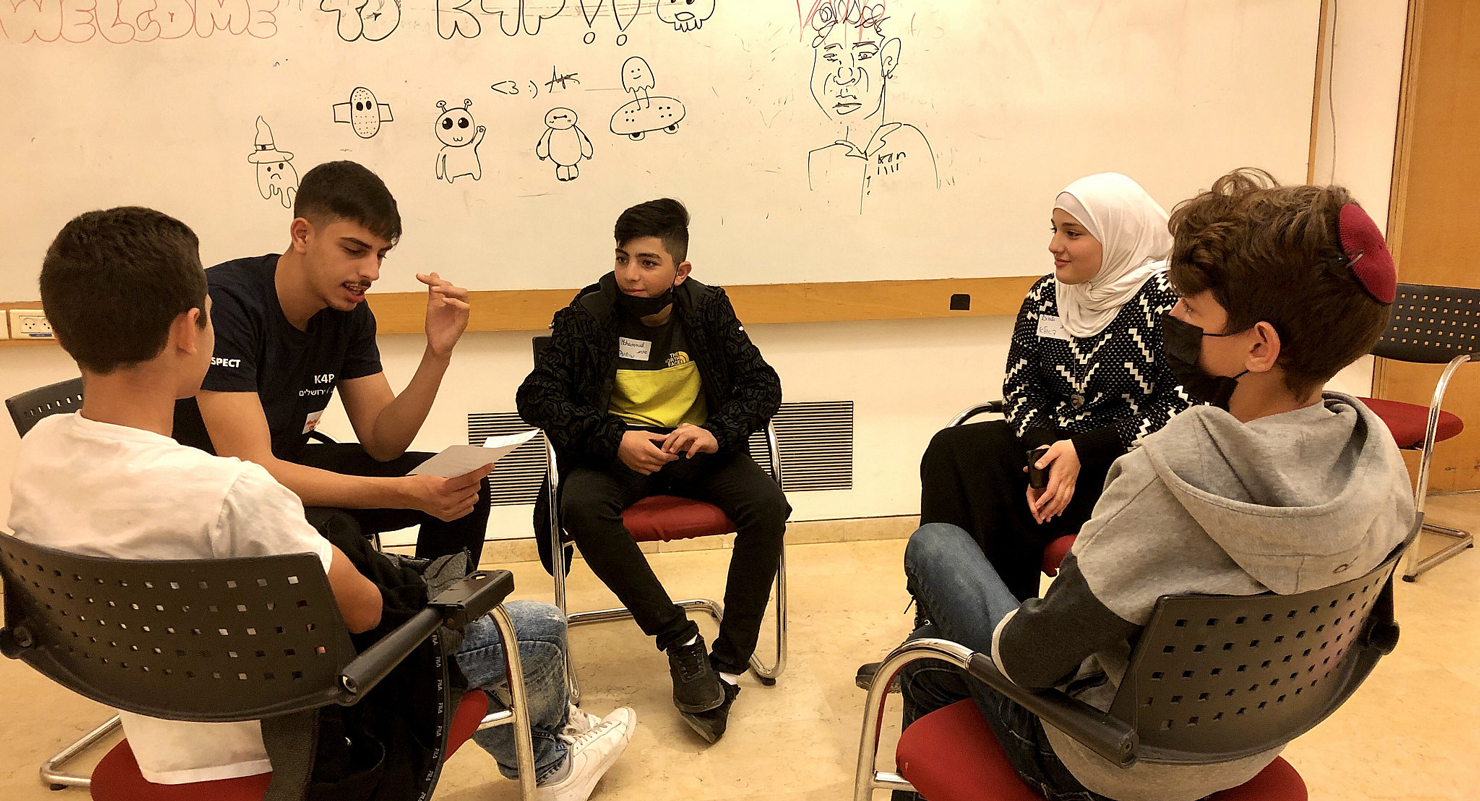
As the world’s attention was drawn last spring to Palestinian families facing unjust evictions from their homes in Sheik Jarrah neighborhood of East Jerusalem, Israeli and Palestinian youth continued to gather for Kids4Peace-Jerusalem meetings just blocks away. But when deadly fighting broke out between Israel and Hamas in May, K4P halted their meetings—in part for the safety of participants, and in part to re-evaluate the very nature and purpose of their work. After many meaningful discussions, staff and participants decided to resume meetings as soon as it was safe to do so, with a renewed commitment to listen, to learn from one another, and to find a better way forward—together. “I choose this photo as it shows youth who are both old and new youth to Kids4Peace, and who are of different religions, sharing about what Jerusalem means to them in a conversation led by our youth murshideen Murad.”
— Ittay Flescher, Director, Kids4Peace Jerusalem


A first for Palestinians

Tree-planting (Palestine, October)

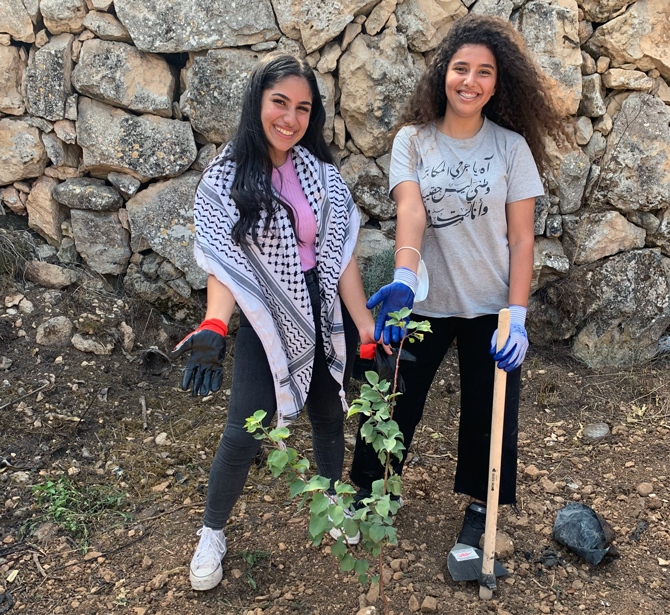
The launch of Bassmeh, the Palestinian Core Leadership Program, last fall was a historic moment for Seeds of Peace: For the first time, the organization provided a consistent space solely for youth from across historical Palestine to come together, learn from each other’s different realities, and make plans for creating the future they all deserve. In October, the “Planting Palestine” program allowed youth to work with farmers to replant trees on land facing ongoing threats from Israeli settlements. “I chose this picture for many reasons: One is that both those girls come from two very distant cities—Jerusalem and Saknin. Since the start of the Bassmeh program I have witnessed how their friendship grew, without this program I think, Yara from Sakhnin would have never imagined she would have a great friend all the way from Jerusalem. Another reason is because it was beautiful to see both working together in planting trees. Initially they were very hesitant and wanted a guy to come and help them, but then they decided to challenge themselves and do it on their own. Together, they planted four trees that day.”
— Mirna Ansari, Senior Manager, Palestinian Programs


Spreading wings in Cincinnati

Kids4Peace (Fall)

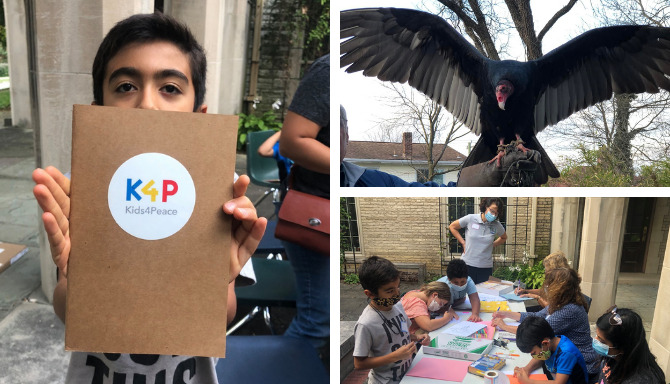
“Kids4Peace Cincinnati piloted a new program for elementary students in grades 1-4 this fall. Every Wednesday they came together to play a game, hear a story, and brainstorm ways to make the world a little bit better place (left and bottom right). And in the fall of 2021, Kids4Peace Cincinnati hosted a program to learn about local vultures and what everyday people can do to help preserve their environment. We all play a role in creating a peaceful environment, even this turkey vulture.”
— Adam Hayden, Senior Coordinator, US Programs West


In-Person, In Dialogue

Core leadership program (Israel)

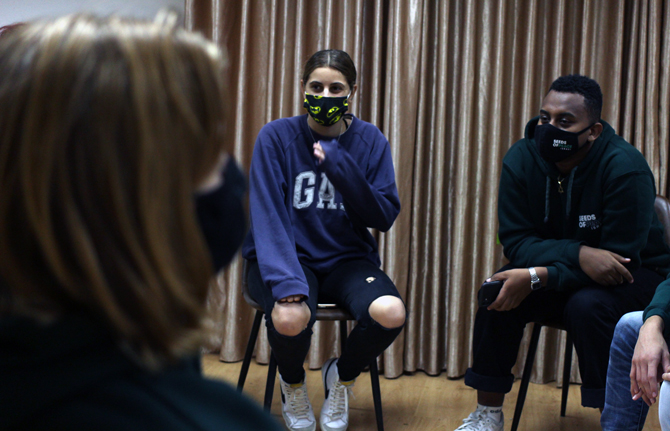
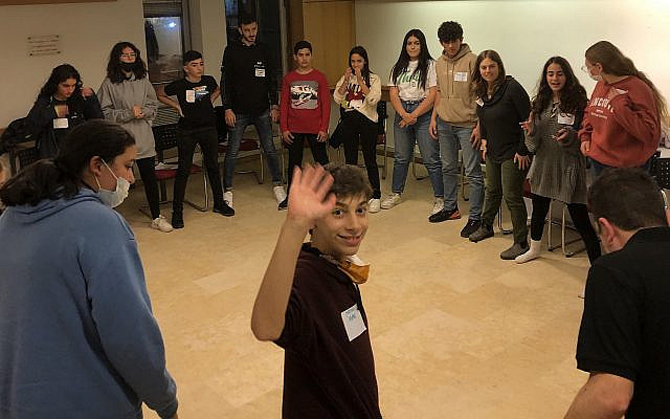
“Our Israeli Core Leadership Program participants are finally sitting in a circle and talking! We’ve waited a long time to get back to this important work of dialogue. What we most love about this one is that you could see they both are very engaged in a conversation that is happening, but through the body language (and even beyond that masks) you could see their different reactions to what they’re hearing, being attentive, engaged and curious. (And, possibly mad, or amused).”
— Jonathan Kabiri and Shahar Shillo, Israeli Programming Team (photo by Yaara Better Pocker)


Diversity & respect

Interfaith Camp (India, December)

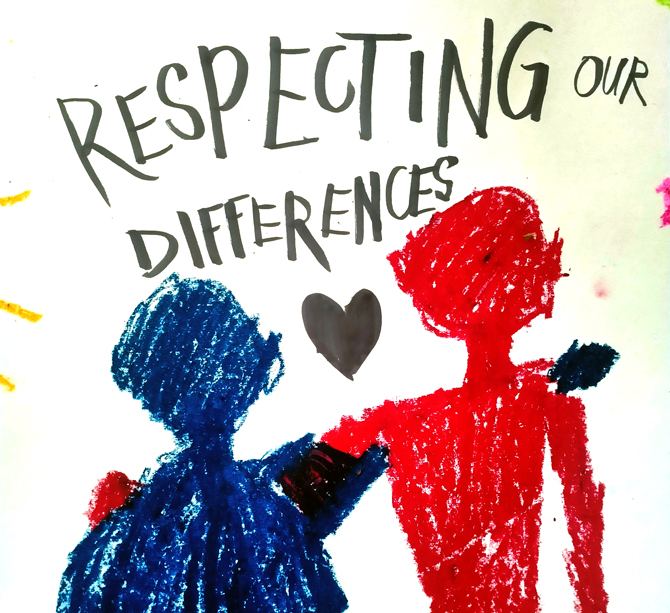
“This crayon illustration was made by one of our Interfaith Camp participants during an art activity that encouraged them to first depict differences in society, and then solutions. This lovely drawing in primary colors caught my eye in a way only simple, strong things can, with its fundamental message of ‘unity in diversity’. Seeing the drawing felt like we had accomplished what we had set out to do at the camp.”
— Urmi Chanda, Senior Programs Coordinator, India


Connecting leaders, coast-to-coast

Virtual Leadership Programs (United States, July)

From Atlanta to Seattle, Los Angeles to New York City, dozens of youth from across the U.S. logged in day after day for virtual programs this summer and fall that included the Core Leadership Program and numerous skill-building workshops. “As part of the Civic Engagement program with youth logging in from all across the U.S., we talked about how we are all in individual places, on individual screens, but collectively we were working together to make our communities and our world more just and inclusive.”
— Hannah Hochkeppel, Co-Director of US Programs


Young leaders RISE across Jordan

RISE Core Leadership Program (Jordan, September)

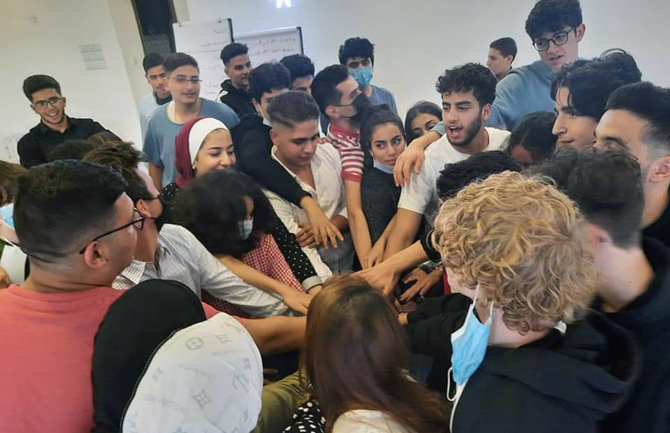
The Jordanian Core Leadership Program brought together more than 30 youth from across the country—including areas and schools completely new to Seeds of Peace—for a yearlong initiative. “I love these photos from our Islands of Sanity seminar because they represent the celebration of many months of getting this team assembled and coming to life. Also, because I believe that among this uncertainty and insanity that we live in, this group represents a promise that the sanctuary of now and tomorrow is being constructed by these young women and men.”
— Farah Bdour, Director of Jordanian Programs

Utah virtuoso’s “Concert for Peace” in Salt Lake City to benefit Seeds of Peace

SALT LAKE CITY | Gerald Elias, associate concertmaster of the Utah Symphony, and local pianist Marjorie Janove will present their third concert to benefit Seeds of Peace, an international organization that seeks to empower the children of war to break the cycle of violence.

The Salt Lake City “Concert for Peace,” which follows the national benefit gala recently held in New York City, will be Saturday, May 31, at 7 p.m., at The Cathedral Church of St. Mark-Episcopal Diocese, 231 E. 100 S. Tickets are $25 for the concert and $35 for both the concert and post-concert reception. Food will be provided by Mazza, which specializes in Middle Eastern cuisine. For more information, or to make advance reservations, call 801-328-5043, or e-mail lbarlow@saltlakechamber.org. Tickets may also be purchased at the door.

Seeds of Peace offers one-on-one interaction for teenagers from 22 war-ravaged nations at an idyllic lakeside camp in Otisfield, Maine and runs follow up programs through its Center for Coexistence in Jerusalem. Through the creation of open dialogues, team building, group projects and activities and conflict-resolution sessions, the teens—or “seeds of peace”—begin the difficult process of developing the mutual trust, respect and empathy needed to break the cycles of hatred and violence. The organization’s goal is to humanize “the enemy” by breaking down barriers and by building bridges, all in a neutral, safe and supportive environment.

“This year the message of peace is more relevant than ever,” notes Elias, adding that his visit to the Maine camp and observance of the emotional and passionate “coexistence” sessions was a life-changing experience.

Although Seeds of Peace founder John Wallach passed away last year, the organization has been busier than ever. Over the past 12 months 450 teens, representing 22 nations, graduated from Seeds of Peace camps; over 150 Israeli and Palestinian alumni held a reunion through the Seeds of Peace Center for Coexistence in Jerusalem and ran leadership programs and coexistence dialogue groups; over 100 Seeds of Peace students were on scholarships at U.S. universities; and an Afghanistan program was initiated.

Current Seeds of Peace President Aaron David Miller writes, “No matter how compelling the terms of any agreement or treaty, peace will not be secured without an effort to break down barriers of suspicion and mistrust and create normal relations between people. Indeed, if peacemaking remains the purview of the diplomats alone, it will not succeed.”

Last year’s Salt Lake City Seeds of Peace Concert, played before a capacity audience at Gardner Hall, raised $11,000 in two hours. The 2002 event featured music by Tartini, Gershwin, Chopin, Deberiot and Strauss. This year’s concert, part of a larger community outreach effort, will surprise music lovers, as the evening’s program will not be announced in advance. “We are calling this a command performance,” notes Lizzie Barlow, one of the event coordinators.

Commenting on why he and Janove have decided to keep the program a secret, Elias explains, “We want the audience to be even more excited about the music when they hear some of their old favorites—and some soon-to-be favorites—pop out of our hats.”

Two representatives from the national organization of Seeds of Peace, Amy Baroch, senior event coordinator, and George Atallah, development associate, will attend the concert and will accompany two Seeds of Peace alumni. They are Malvina Goldfeld, a 21-year-old Israeli who is a sophomore at Princeton, and Mohammed Matar, a 17-year-old Palestinian from Gaza who, through a scholarship, is finishing his senior year at Deerfield Academy in Massachusetts.

“This year our goal is to be able to send six teenagers to the Seeds of Peace camp, which costs $2,500 per student,” notes Barlow, adding that the national organization is funded through individual donors, foundation and federal grants, and corporate giving. “We hope to raise $16,000 through this event, with $9,000 of that donated outside of ticket sales.”

Deseret News music critic Ed Reichel has called Elias “an exceptionally talented and sublime musician” and Janove “a marvelous pianist and first-class accompanist.”

To schedule an interview, contact Ann Bardsley at 801-466-1127 or at annjb@xmission.com. Photos available upon request.

Seeds of Peace was founded in 1993 by award-winning author and journalist John Wallach. Foreign Editor of the Hearst Newspapers for 25 years, Wallach covered many regions of war and terrorism, including the Middle East. After the 1993 attack on the World Trade Center, Wallach decided to reach out to the children of war and terror to find and nurture hope. Wallach created the organization to provide an opportunity for these children to plant the seeds for a more secure future. In its first year, the Seeds of Peace International Camp brought 45 youngsters from Israel, Palestine and Egypt to live together side by side.

Now, more than a decade later, almost 2,000 teenagers from the Middle East, the Balkans, Cyprus, Greece, Turkey, India and Pakistan and the United States have graduated from the Seeds of Peace International Camp. In 2002, 12 Afghan youths attended the program. Seeds of Peace has created a variety of follow-up initiatives worldwide, including the Center for Coexistence in Jerusalem, which offers year-round activities for Seeds of Peace alumni to sustain their relationships and commitment to coexistence.

Seeds of Peace has achieved broad-based international recognition as a “best methods” conflict resolution program and has been featured on 60 Minutes, Nightline, Good Morning America, The Today Show and on CNN, PBS and NPR. Seeds of Peace received the UNESCO Peace Prize for the Promotion of Tolerance and Nonviolence in 2000.

Gerald Elias, associate concertmaster of the Utah Symphony since 1988, first violinist of the Abramyan String Quartet and a faculty member of the University of Utah, has performed in Europe, Japan, Australia, and New Zealand as well as in the United States. He has composed many works including “Conversations With Essie,” which was performed at the 2002 Moab Music Festival. He has been commissioned by the Utah Symphony to compose a piece for its chamber orchestra series in 2004. Elias is also the author of the mystery novel Devil’s Trill.

Marjorie Janove is an active soloist, recitalist and chamber musician. She has appeared with the Utah Symphony, NOVA Chamber Music Series, Temple Square Concert Series, the Vivaldi Candlelight Concert Series, the Maurice Abravanel Distinguished Composer Series and the Madeline Festival of the Arts and Humanities Series. She completed a Doctorate of Musical Arts Degree with distinction in piano performance at Indiana University, where she studied with Karen Shaw and Menachem Pressler and where she taught as an associate instructor.

ADDRESS: 231 E 100 Street, Salt Lake City, Utah 84111
DATE: May 31, 2003
TIME: 7:00 p.m.
LOCATION: The Cathedral Church of St. Mark-Episcopal Diocese
CONTACT: lbarlow@saltlakechamber.org

Seeds of Peace UK screens ‘SEEDS’ documentary, holds panel discussion

LONDON | On December 2, Seeds of Peace UK and the International Community Committee Film Club at the American School in London (ASL) screened the film “SEEDS”. The showing was followed by a panel of three Seeds, Patrick Cirenza (ASL ’11, Camp ’07, ’09), Sarah Khatib, (Jordanian, Camp ’00-’02) and Vivek Jois (ASL ’11, Camp ’09).

Following the powerful film, the Seeds who spoke of how Camp had changed their lives. As Patrick said, “Seeds of Peace is truly unique. I don’t know of a single other place in the world where teenagers of so many nationalities can have such a free exchange of ideas and culture. I believe to my core that Seeds of Peace changed me, changed the others who went to Camp, and is going to change the world.”

Vivek Jois spoke about his background: “As a British citizen, of Indian origin and educated at an American international school, Seeds of Peace provided the perfect way to express my internationalism. I feel indebted to Seeds of Peace because I truly believe that there is no other cause as big, no other experience as difficult, and no other place that can make people follow the true calling of their hearts over their blind loyalties.”

Remarks by Seeds

Patrick Cirenza

Patrick attended the Seeds of Peace Camp in 2009 and is currently enrolled at the American School in London.

When I knew I was going to Seeds of Peace I decided I was going to very prepared for the dialogue sessions. I read numerous books, read my news from Al-Jazeera English, and even learned a few phrases in Hebrew and Arabic.

I thought I was ready.

I wasn’t.

On the first day of orientation Tim Wilson, one of the founders of the Camp, talked to the American delegation in one of his famously to-the-point speeches.

He looked us all in the eye and said, “You know nothing, but you sure as hell will learn quick.”

Shaken, but resolved I began Camp.

My Israeli-Palestinian dialogue sessions are some of my most vivid memories of Camp. The first week was uncomfortable, to say the least. Trying to get a room full of unacquainted teenagers to discuss their personal beliefs and experiences in any situation is near impossible. Decades of conflict certainly didn’t help. I still wonder to this day how the facilitators got us talking. But when we did, the fireworks began to go off. Once they began, there was no stopping them.

Everything I had so carefully learned over the past couple months went straight out the window. All I could do was sit there and listen as they argued. I simply wasn’t able to relate to anything they talked about. I was completely out of my depth.

A girl from Sderot, “I didn’t go to school for two months because Kassam rockets were hitting my school and my bus route.”

I remember sitting there thinking, closest experience I have to that is a snow day.

A Palestinian boy said, “I was sitting in my basement with my family when my house was bulldozed on top of us.”

My jaw just dropped. My mind was blank.

The story I will remember the most, the one I will probably never forget is that of Janan. She was an older girl in the dialogue and usually quite quiet but responded to the question “What does the Occupation mean to you?”

She began her story by looking at the floor “I was sitting in class one day chatting with my best friend when an Israeli soldier burst into the room and opened fire. My best friend was hit and she died in my arms. There had been an IDF raid on school, which was suspected of hiding a cache of weapons. There were no weapons.”

Then she looked the Israelis right in the eye and said “this is what the Occupation means to me.”

While her story is tragic what was even more so was the manner in which she told it. She was numb, devoid of emotion. The conflict was a part of her life. She was born in it and, as she told me later with much conviction, she was going to die in it.

Stories like hers were just a currency at Seeds of Peace to exchange in dialogue in order to prove who had suffered more.

But it wasn’t always tense at Camp. Cultural boundaries were often stripped down in oddest of fashions, often in manners that would never occur in a dialogue room.

We attended a baseball game; as resident American I was expected to explain the rules to this truly bizarre game. After about 15 minutes of trying to expound the virtues of baseball and comparing it to every other sport on the planet. Israelis, Palestinians, Indians, and Pakistanis were united in telling me just how stupid they thought it was.

I made the mistake of insulting hummous one meal. Israeli and Palestinian alike leapt to defend the cause of one of their favorite foods. I never did it again.

I remember one American girl burst into tears when an innocently curious Pakistani boy asked, “Aren’t all Americans supposed to be fat?” a sentiment to which many other non-Americans seemed to concur with.

Seeds of Peace is a truly unique in that sense. I don’t know of a single other place in the world where teenagers of so many nationalities can have such a free exchange of ideas and culture. I know I walked out of that camp both vowing that I would return and with an entirely new view of my life and the world.

Since Seeds of Peace, I have taken up Arabic, attempted to start a youth interfaith council and raised money for organization by doing everything from growing my beard to racing in a triathlon.

The only reason I am sitting before you today is because I believe to my core that Seeds of Peace changed me, changed the others who went to Camp, and is going to change the world.

Vivek Jois

Vivek attended the Seeds of Peace Camp in 2009 and is currently enrolled at the American School in London.

I’m going to start today by telling you a little more about myself. I was born in London, a British citizen by birth. When I was 4, my parents, both admirers of the American education system, decided to send me to The American School in London, and I’ve remained here for the last 13 years.

To me, London is something special—it’s what I like to call, “the gateway of the world.” We’ve got America to the left, and the Middle East and Asia to the right.

I’ve watched the world change over the past 16 years of my life, and I’ve watched the international affairs brew, from the Kargil War between India and Pakistan to the Second Intifada, to the United States’ invasion of Iraq.

I’ve been the perfect outsider, as one might say: I’ve seen different societies interact with each other, in sometimes both positive and negative ways. But it wasn’t until this past summer that I asked myself the question: Who Am I? Because, clearly, I’m British by birth, American by education, and Indian by heritage. There’s no way I’m escaping my tri-national background—it follows me around everywhere.

But the real question to be asked here is, “Does it matter?”

The answer, realistically, in any case, is no. I, not being a citizen of the US, was a part of the American Delegation this summer, and it didn’t matter. Sure, I have an American accent so you might think I would fit in with everyone else in the delegation, but really, that’s not the case. The general concept of a delegation is one based on regional connections—which are why you have the Israeli, Palestinian, Indian, Pakistani, and other regional delegations at Camp.

But the American Delegation is not founded on regional ties—this year, we had one girl from an international school in Morocco, and Patrick and I from London. The American Delegation is founded based on common systematic thought—the Western upbringing, for students in westernized education systems, like all of you students here. In fact, it would be incredible if there were more Seeds from the UK—we could add so much more from our experience of being at the center of all the major world societies.

Let me just sum it up: anyone can apply for Seeds of Peace. It doesn’t matter who you are or where you come from when you arrive at Camp—all that matters is who you become after those three incredible weeks in Maine.

To go into my next point, I would just like to say how much I enjoyed Camp this summer. It was an enlightening experience, in which I got to spend three weeks in the middle of the scenic New England forest, isolated from the world outside. It definitely changed me—but when I returned, and soon as I left the gates of Camp, I had to face reality once again.

I received a lot of interrogation from my friends and teachers upon returning to London. All of them had tons of questions as to what I did, what I saw, what I learnt at Camp.

But what I found is that every few people I talked to asked me the same question, “Isn’t Seeds of Peace a Jewish organization?” That is, to say, is Seeds of Peace intended towards students of a Jewish background?

I personally feel that this stigma is incorrect. Yes, half of the American Delegation happened to be from a Jewish background, and the Israeli Delegation was the biggest at Camp, but what does that say about the organization’s tendency towards one group or another? Nothing. The conflict facing Israel is so current that it is only natural that people who feel a tie to one of the countries involved would want to do this in search of the truth in the matters pertaining to the “other side.”

Let me assure you, that no matter how many Seeds were from a Jewish background, there was equal representation from other delegations and points of view across the globe.

We had students from Palestinian backgrounds in the American Delegation, as well as others like myself from different and mixed cultural compositions.

I would like to conclude today by telling you about one day at Camp. It was during our daily two-hour dialogue session, and I was in a dialogue group of Middle Eastern kids. Our facilitators split us into two groups at random, not based on where we’re from or whatever. We then went to separate parts of the room. One facilitator came over to my group, and we were told to assume that we have a dying mother in hospital, and in order to survive, she needs the juice of a certain orange. Okay, easy enough, no one had difficulty imagining that.

Then, we were told that this certain orange was in the hands of the other group, across the room. What went through my mind in that instant was: Oh no. The other side needs the orange juice too. This is going to be difficult. Then we were each paired up with one person from the other group, and were told to negotiate the orange for ourselves.

So I sat down opposite Laila, the girl I was paired up with, knowing this was going to be hard if she needed that orange juice for her own reasons, as I had been told. But as we talked about it, she informed me about what her group had been told to assume: they needed the rind of the orange.

It was a key moment in my experience, because it highlighted the point of the Seeds of Peace: if you don’t talk to your supposed enemy, you make assumptions about their demands and needs, much like I assumed that Laila needed the orange’s juice as well. But it is only through talking to the other side, talking to the person who has been made your enemy by society, that you finally gain an understanding of what they have been told, and can thus make an honest decision on the peaceable outcome of a situation. This is the only way that our ultimate goal can be achieved.

The orange is what generations on either side of a conflict have called their Promised Land; when in fact, they have not realized yet that they can coexist if they were to just understand people from the other side—the people that their society terms as “the enemy.”

This is fully what the Seeds of Peace has taught me, and I hope, with the induction of many more future Seeds, we will be able to continue this process for the goodwill of our global community.

Sarah Khatib

Sarah attended the Seeds of Peace Camp in 2000-2002 as a member of the Jordanian Delegation. She is currently completing a Masters of Law at SOAS.

It is easy to manipulate nations into hating their enemies. It not at all easy to give the enemy a face, but this is what Seeds of Peace did for me and many others, and it continues to do so till this very day. The term “enemy” was not only toned down into “the other side,” but for me now the enemy has a face and a name; be it Elad, Rita, Hagar, Khen or Rony and whoever else I have met at Camp.

Seeds of Peace is a revolution against this manipulation. It is an international revolution for which I can find no counterpart. Tell me where else in the world could I have gone at the age of thirteen not only to familiarize myself with Israelis, Americans, and Greeks, etc., but give them a face after unmasking them every day at Camp.

In my personal statement for my master’s application I wrote “in the summers of 2000, 2001, 2002 I was one of the participants sharing space and dining with Israelis, Palestinians, Cypriot and Turkish teenagers, some of whom became my close friends. During camp time, we all took part in co–existence sessions. We all, at a very early age, sat down and talked about real life conflict issues and tried—hard—to reach common grounds, something only ten years prior to that my father was doing at Wadi Araba where the Israeli–Jordanian peace talks were concluded.” I do not think that any of us who participated in Seeds of Peace would have become the individuals we are now and who we will be tomorrow if the transitional force brought about by Seeds of Peace was absent.

Even at the peak of conflicts, I learned to narrow down my anger and frustration. During the horrific events in Gaza last year, it was common to hear people saying “the Israelis are ruthless, they have no hearts.” I was saying, but the Israeli government is ruthless and irrational, thinking that this is the way to deal with the conflict. It is not by any means easy to talk about peace in a time of war, of course it seems easier and inevitable for me to give up on my convictions; then I look at my Camp pictures and say “what a minute, but peace did happen, it happens every summer in Maine.” I have seen it with my own eyes, I felt it, and I lived it.

Ten years later, I need to admit that some things do as a matter of fact change. In one of my classes the tutor asked “what is the difference between a dispute and a conflict”? I said well it’s quite clear, your course is titled “dispute resolution and conflict management,” and therefore, disputes can be resolved, where conflicts can only be managed. The tutor nodded and smiled as if I made a point that was too clear, but was one that she failed to notice. It was then and there that I realized how far I have come from my time at Camp; now a bit more cynical but with a sense of realism. I know that I have not given up on my principles, I merely modified them.

Seeds of Peace rooted in me this notion of “selflessness”. We all develop our own narratives, and one of my own narratives is the idea of “transferability,” as in how transferable are the things that I learn? I think to myself why do not the parties of the conflict submit to arbitration or go to court to have their differences dealt with by a neutral third party? I know such ideas some ridiculous to many, but this is how I want to apply my area of specialization to conflicts; this is the selflessness that Seeds of Peace taught me, how could what I learn and posses help others? I really believe that at some point I will be able to pay Seeds of Peace back, if not in a strict sense then to assist in the concrete realization of our hopes and aspirations.

For so many years I was hoping that I would get the chance to talk about my experience at Camp and with Seeds of Peace. Now that I have this chance, I thought for a long time about the things I could talk about, but all my lawyering skills cannot come into play. Seeds of Peace raised me up; it taught me to differentiate between the right and wrong, between the moral and the immoral, between the norm and the exception, regardless of how blurred the lines between such can be. This is a virtue that I value, for it is one that makes Seeds all over the world stand out in their communities and countries, and it is one that makes as all as Seeds stand out in the world.

Seeds of Peace praised by U.S. Congress

Resolution 288 calls program a “model of hope that living together in peace and security is possible”

WASHINGTON | The U.S. House of Representatives unanimously passed the bipartisan resolution by a vote of 415-0 on November 19, 2003. The House Concurrent Resolution honors Seeds of Peace for its promotion of understanding, reconciliation, acceptance, coexistence, and peace among youth from the Middle East and other regions of conflict, and it validates the organization’s year-round programming that has successfully taught teenagers the tools to make peace for the last ten years.

House Concurrent Resolution 288, introduced by Representative Tom Allen (D-ME), states, “it is especially important to reaffirm that youth must be involved in long-term, visionary solutions to conflicts perpetuated by cycles of violence.” It also states that Seeds of Peace is a “model of hope that living together in peace and security is possible.”

The resolution was co-sponsored by Representatives Steve Chabot (R-OH), Joe Knollenberg (R-MI), Mike Michaud (D-ME) and 46 other bipartisan co-sponsors.

“John Wallach reported on war but dreamed of peace,” said Representative Allen. “For ten years, Seeds of Peace camp has realized John’s vision of a refuge in the Maine woods ‘to provide an opportunity for the children of war to plant the seeds for a more secure future.’ Israeli and Arab teenagers live, work and play together in peace and understanding, along with teens from other troubled nations around the globe. Today, the U.S. Congress pays tribute to John’s enterprise in hope and offers its encouragement and support to the program, as it continues under the leadership of its new president, Aaron Miller.”

“This resolution honors not only Seeds of Peace and the great vision of John Wallach, but it pays tribute to the courage and resilience of the more than 2,000 young leaders who have been through the program in the last decade. It is critically important that these young people know that the U.S. Congress values and supports the difficult and bold journey toward coexistence on which they have embarked,” said Aaron David Miller, President of Seeds of Peace and a former State Department adviser to six Secretaries of State on Arab-Israeli negotiations.

John Wallach, an award-winning author and journalist, founded Seeds of Peace in 1993. Since then, Seeds of Peace has graduated over 2,000 teenagers representing 22 nations from its internationally recognized conflict resolution and coexistence program. Through these programs, at the Camp in Maine and at its Center for Coexistence in Jerusalem, participants develop empathy, respect, communication/negotiation skills, confidence, and hope—the building blocks for peaceful coexistence. A jointly published newspaper, a list-serve, educational conferences and seminars provide year-round follow-up programming.

The full text of House Concurrent Resolution 288 follows.

Honoring Seeds of Peace for its promotion of understanding, reconciliation, acceptance, coexistence, and peace among youth from the Middle East and other regions of conflict. (Engrossed as Agreed to or Passed by House)

108th Congress 1st Session
IN THE SENATE OF THE UNITED STATES
November 20, 2003
House Concurrent Resolution 288

Whereas Seeds of Peace, founded by John Wallach in 1993, is a program that brings together young people from regions of conflict to study and learn about coexistence and conflict resolution;

Whereas although the original focus of Seeds of Peace was to bring Israeli, Palestinian, Jordanian, and Egyptian youth together, the program has expanded over the past decade to involve youths from other regions of conflict, including from Greece, Turkey and divided Cyprus, the Balkans, India, Pakistan, and Afghanistan;

Whereas these young people study and learn primarily at a summer camp operated by Seeds of Peace in Otisfield, Maine, and also through its regional programs such as the Jerusalem Center for Coexistence;

Whereas Seeds of Peace works to dispel fear, mistrust, and prejudice, which are root causes of violence and conflict, and to build a new generation of leaders who are committed to achieving peace;

Whereas Seeds of Peace reveals the human face of those whom youth have been taught to hate, by engaging campers in both guided coexistence sessions and ordinary summer camp activities such as living together in cabins, sharing meals, canoeing, swimming, playing sports, and creative exploration through the arts and computers;

Whereas the Arab-Israeli conflict is currently at a critical juncture, and sustained progress towards peace depends on the emergence of a new generation of leaders who will choose dialogue, friendship, and openness over violence and hatred;

Whereas Seeds of Peace provides year-round opportunities for former participants to build on the relationships they have forged at camp, so that the learning processes begun at camp can continue back in the participants’ home countries, where they are most needed;

Whereas Seeds of Peace is strongly supported by participating governments and many world leaders; Whereas previous Federal funding for Seeds of Peace demonstrates its recognized importance in promoting United States foreign policy goals;

and Whereas it is especially important to reaffirm that youth must be involved in long-term, visionary solutions to conflicts perpetuated by cycles of violence:

Now, therefore, be it Resolved by the House of Representatives (the Senate concurring), That Congress

(1) honors the accomplishments of Seeds of Peace for promoting understanding, reconciliation, acceptance, coexistence, and peace among youth from the Middle East and other regions of conflict around the world; and

(2) offers Seeds of Peace as a model of hope that living together in peace and security is possible.

Passed the House of Representatives November 19, 2003.

World-renowned designer Marithe+François Girbaud becomes official sponsor of Seeds of Peace

(Français) / (Italiano)


MILAN & PARIS | Marithé+François Girbaud has denounced war. Far from an opportunistic move, this decision forms part of a long-term strategy designed to address adults who are aware of the world around them and concerned about the future of our planet.

Today, Marithé+François is talking about rebuilding, opening up, sharing, exchanging, using a communication strategy that appeals to reason and to the children of tomorrow—children who will grow up in a world that is an increasingly

OPEN SPACE.

The strategy applies to all the company’s communications: medias, outdoors, other marketing tools, in-store and online.

Seeds of Peace is proud to announce a partnership with Marithé+François Girbaud, the world-renowned French designer brand. Starting in February 2007, Marithé+François Girbaud will launch an advertising campaign that will feature Seeds of Peace. The million-dollar campaign will run in print magazines such as Vogue, Elle, Marie-Claire, Glamour, and Vanity Fair, and will be seen by an estimated 9 million readers in France, Italy, Germany, UK, and Japan.

In addition, the campaign will be featured on billboards in high-traffic locations in the heart of European and Asian capitals. This partnership was announced in press conferences in Paris and Milan in December 2006.

In addition, Marithé+François Girbaud will design a line of clothing especially for SoP. These clothes will be available for sale exclusively on the Seeds of Peace website, with 100% of proceeds benefiting Seeds of Peace. This advertising campaign marks the beginning of a long-term partnership between Seeds of Peace and Marithé+François Girbaud.

Summer 2007 photoshoot : a dozen teenagers originating, either by birth or through their families, from places like Israel, Lebanon, Pakistan, Sri Lanka, Rwanda, the Ivory Coast, and Tibet came together at a studio in Aubervilliers, Paris to bring the brand to life the clothing of tomorrow, the clothing they want to wear today and in their near future as young adults. These young people are the hope for different tomorrows and they owe it to themselves to represent the future with beauty. They are sowing the seeds of peace under the lens of Jackie Nickerson*.

To strengthen the brand’s message and to give it even more depth, the company has partnered with the non-profit organization “Seeds of Peace” (SoP).

SoP, founded in 1993 by the American journalist, John Wallach, is supported by famous names such as Bill Clinton, Queen Noor of Jordan and Shimon Peres. The organisation has created a process to sow the seeds of peace in the hearts of teenagers who have lived in regions of conflict, particularly the Middle East, since their birth. The objective of SoP is to establish a dialogue and show that young people around the world share the same hopes, the same desire to achieve personal fulfillment and the determination to build the foundations for a peaceful future.

Marithe+François Girbaud has committed itselves to supporting these efforts, associating its communication with the work of SoP and putting their talents at the service of the organization by creating a range of new merchandising tools. SoP will be present at future events organised at the stores in New York, Paris and Tokyo and will form an integral part of future communication campaigns.

* An Anglo-American born in Boston, but who now lives in London, Jackie Nickerson spent 5 years in the world of fashion before deciding to work on her own projects (starting in 2002, with the publication of the book “Farm”, a collection of striking images of farmers in South Africa). She regularly works with the New York Times and now, for the third time, has partnered with Marithe+François Girbaud.

Seeds of Peace annonce un partenariat avec Marithé+François Girbaud

Marithé + François Girbaud a récemment dénoncé la guerre. Cette approche n’était pas opportuniste mais s’inscrivait dans une stratégie à long terme tournée vers l’adulte conscient de l’actualité et de l’avenir de la planète.

Aujourd’hui ils parlent de reconstruction, d’ouverture, de partage et d’échange avec une communication qui parle aux plus raisonnables, aux enfants de demain qui vont grandir dans un monde de plus en plus

“OPEN SPACE”

Cette stratégie s’inscrit dans la communication médias et hors médias, les magasins et sur internet. Shooting Eté 2007 : une dizaine de jeunes d’origines ou de nationalités israélienne, libanaise, pakistanaise, sri-lankaise, rwandaise, ivoirienne, tibétaine, etc… s’est réunie aux studios d’Aubervilliers pour donner vie au discours de la marque et mettre en scène les vêtements de demain, ceux qu’ils ont envie de porter aujourd’hui et dans leur futur proche d’adulte. Ils sont l’espoir pour avancer vers d’autres lendemains et se doivent de donner une belle représentation de l’avenir. Ils sèment les graines de la paix sous l’objectif de Jackie Nickerson*.

Pour renforcer et donner davantage de profondeur au discours de la marque un rapprochement avec l’Association « Seeds of Peace » (SoP) s’est imposé.

Cette organisation créée en 1993 par le journaliste américain John Wallach, soutenue par des personnalités comme Bill Clinton, Noor de Jordanie ou Shimon Perès a mis en place un processus pour insuffler des graines de paix dans le cœur d’adolescents vivant dans des pays essentiellement du Moyen Orient en conflit depuis leur naissance. Etablir un dialogue et démontrer que les jeunes de tous les pays sont nourris par les mêmes aspirations avec une volonté de s’épanouir et de construire les fondations d’une vie à venir dans la paix, tel est l’objectif de SoP.

Marithé + François Girbaud s’est engagé à soutenir cette démarche, à associer à leur communication SoP, à mettre leur talent au service de l’association en créant les outils de merchandising. SoP sera présent sur des événements organisés dans les points de vente de New-York, Paris et Tokyo et s’intégrera naturellement dans les campagnes futures.

* Jackie Nickerson, une anglo/américaine née à Boston mais habitant à Londres. 5 ans d’expérience dans l’univers de la mode pour ensuite travailler sur ses propres projets (en 2002 sort le livre « Farm » qui montre des agriculteurs d’Afrique du Sud dans toute leur beauté). Elle collabore régulièrement avec le New York Times et pour la 3ème fois avec Marithé et François Girbaud.

Seeds of Peace annonce un partenariat avec Marithé+François Girbaud, la marque de vêtements mondialement connue.

En Février 2007, Marithé+François Girbaud lancera une campagne publicitaire sur laquelle figurera le logo de Seeds of Peace. Cette campagne, qui représente près d’un million de dollars d’investissement, paraîtra dans des magazines tels que Vogue, Elle, Marie-Claire, Glamour et Vanity Fair, et sera vue par environ 9 million de lecteurs en France, en Italie, en Allemagne, en Grande Bretagne et au Japon.

La campagne publicitaire figurera également sous forme de panneaux d’affichage dans des lieux très fréquentés au coeur des grandes capitales d’Europe et d’Asie. Ce partenariat a été annoncé lors de conferences de presse à Milan et Paris en Décembre 2006. Ci-dessous, le communique de presse, ainsi que quelques articles déjà parus. De plus, Marithé+François Girbaud créera une ligne de vêtements spécialement concue pour Seeds of Peace. Cette gamme sera vendue en exclusivité sur notre site internet, avec 100% des ventes revenant à Seeds of Peace. Cette campagne marque le début d’un partenariat à long terme entre Seeds of Peace et Marithé+François Girbaud.

Dossier de Presse, Conference de Presse des 18 et 19 Dec 2006 »
 

Marketing multietnico per M+FG

La comunicazione di Marithé+François Girbaud si schiera contro i pregiudizi. La nuova campagna che debutterà a fine gennaio in tutta Europa per un investimento pari a 600 mila euro, è stata realizzata in collaborazione con Seeds of Peace. L’associazione Semi di pace nata nel 1993 ha lo scopo di far crescere le nuove generazioni nel rispetto reciproco e della tolleranza, organizzando campi estivi a cui partecipano giovani di paesi a rischio di guerra come Palestina, Libano, Israele, Pakistan, Sri Lanka, Rwanda, Costa D’Avorio.

La pubblicita ha per soggetto ragazzi di diverse nazionalità che corrono in mezzo si campi come a rappresentare i frutti di un seme cresciuto senza pregiudizi, spiega lo stilista François Girbaud noto anche per la campagna delle modelle che evocano il dipinto dell‘Ultima cena di Leonardo. Spot condannato che però ha chiuso la faccenda giudiziaria vincendo il ricorso in Cassazione.

In futuro, spiega il direttore marketing Muriel De Lamarzelle, vogliamo veicolare la strategia di comunicazione e marketing in più direzioni per colpire diversi target: la comunità del fashion, gli opinion maker del settore del lusso e del design. Inoltre sempre a partire dalla fine di gennaio, è al vaglio l’ipotesi di realizzare un cd con 15 canzoni in partnership con la case discografica Emi. Una raccolta che contiene musica proveniente da culture di diversi paesi e che riflette la filosofia multietnica e cosmopolita della marca. Tra le altre attività prosegue la collaborazione con il Rallye des Gazelles, dedicato alle donne. M+FG è partner fornendo l’abbigliamento. Il Rally è in evento in cui il brand francese partecipa da sei anni e in futuro la volontà è di accrescere gli investimenti.

Remarks by James Baker at the Seeds of Peace Forum on Conflict & Diplomacy

WALDORF-ASTORIA, NEW YORK | As Aaron [Miller] has said, he and I (and others) spent many years working together on Mid-East peace.

I’m delighted, Aaron, that you’ve found a home where you can put your very able and talented experience and passion for peace to such good use. The efforts of Seeds of Peace support a goal I know we all share—a world that is safer because it is more peaceful.

That mission recalls the words of Elie Wiesel, the Hungarian writer and Holocaust survivor. “Mankind,” he wrote, “must remember that peace is not God’s gift to his creatures; peace is our gift to each other.” I have been asked to speak to you today about negotiations. And to begin at the beginning, let me say a word or two about what I think it takes to be a good negotiator.

Over the decades, experience has taught me that successful negotiations more often come to those who are well-honed through years of hard work at developing this special craft. That is important because, as you would expect, bad negotiators produce bad negotiations.

As I moved from the world of law and business to the world of public service, I was struck not so much by their differences as by their similarities. The politics of success in the boardroom and the courtroom, and the politics of success in government, whether domestically or internationally, may not be exactly the same. But, it is still politics.

My old friend, George Bush, President No. 41 as we call him, taught me that there are two kinds of politicians. One, he said, is like a Dalmatian who grows up in the fire house. From the time he’s a puppy, every time the bell rings, he runs. But that President Bush 41 and I were the other kind. Both of us served in the military, then worked for a living. He founded a successful oil company before he ran for Congress in the 1960s. I worked as a lawyer before joining the executive branch of government in 1975.

When I speak to young people who are interested in politics, I encourage them to do what 41 and I did: First, get a life! Get a job. Start a family. One reason for this advice is personal. I think you’ll be a happier and more productive human being if you put family and profession ahead of politics. But another reason (with many, many honorable exceptions) is that our country is better governed, I think, by people who have earned a paycheck in the private sector.

In my case, everything I did in public life was based in part on the experiences I got while serving for 18 years as a business lawyer in my hometown of Houston, Texas. In all my government posts (whether dealing with my fellow executive branch officers, with members of Congress, or with foreign diplomats and heads of government) I always enjoyed negotiating, maybe because I had spent so many years doing just that for my law firm’s clients. Along the way, I have found that there are a half-dozen building blocks that, when properly applied through solid preparation and hard work, can be used to develop good negotiations—whether you’re negotiating for a client in the private sector or for your country, whether you’re negotiating a merger of two companies, or negotiating peace.

First and foremost among those building blocks is the ability to understand an opponent’s position. I would have to say that if there was one key to whatever success I’ve enjoyed in negotiating in the public and private sectors, it has been an ability to crawl into the other guy’s shoes. If you understand your opponent, you have a better chance of reaching a successful conclusion. That means paying attention to how they view issues and appreciating the political constraints they face.

This approach was important when, as Secretary of State to the first President Bush, we confronted the unexpected collapse of the Soviet Empire. No great power wants to relinquish its supremacy. No leaders like to see themselves humiliated on the world stage. We therefore did all we could to avoid “triumphalism”—public crowing over the defeat of communism and the implosion of the Soviet Union. I believe that our attention to Moscow’s sensitivities was a major reason the Cold War ended with a whimper, not a bang.

That period in American diplomacy also illustrates a second building block of good negotiations—building trust through personal relationships. I am talking about the type of trust that transcends written documents and treaties. Of course, you never sacrifice principles or your country’s national interest in order to acquire a trusting relationship with your interlocutor. But, building trust at the personal level greatly enhances the chances of successful negotiations.

For example, over the years, I developed a close affinity with the Minister of Foreign Affairs of the Soviet Union, Eduard Shevardnadze. During moments together in foreign capitals or on a Wyoming ranch, we nurtured a unique relationship that helped us steer the Cold War to a peaceful conclusion. Though he was an adversary, he also became a close friend. I found I could trust him and we were able to do things that benefited both our countries. When both sides trust each other, even the most contentious talks can succeed. The negotiators can relax and explore the territory outside their formal negotiating positions. They can talk about their assumptions, strategies, and even fears. This doesn’t guarantee success, but it sure improves the odds. And it leaves both parties in a better position to try again later if they are not initially successful.

But sometimes, building trust needs a little help, or a kick-start. As a business lawyer, I learned that the best way to think about a big negotiation was as a series of small negotiations. It was always important to start with an issue that could be resolved quickly, reasonably, and amicably. Finding a common point of agreement—even a minor one, like the shape of the negotiating table—can help set the tone of the relationship. It also helps develop a dialogue, which is one of the most important aspects of negotiations.

Ambassador Max Kampelman, one of our arms-control negotiators, had it right when he said that “A dialogue is more than two monologues.” The longer you can keep the sides talking with one another—instead of delivering sermons at one another—the better are the chances that a middle ground can be reached. I like to call this third building block of negotiating “parallel reciprocal confidence building.” It is a method of confidence building that keeps the parties talking. It shows both sides they can negotiate.

In 1991, when I was trying to get Israel and her Arab neighbors to meet in Madrid for peace talks, I would ask the two sides to consider modest confidence-building measures. At the time, direct talks between the two sides had been almost taboo. Building trust was a difficult challenge. But once the two sides learned to take small steps in unison, they moved to larger and larger ones. And that confidence building led to the first ever face-to-face negotiations in Madrid between long-time adversaries.

Another building block I learned through personal experience is what I call “principled pragmatism”—the art of the possible without the sacrifice of principle. Negotiation, almost by definition, is the act of compromise. But no compromise should be taken to the extreme of sacrificing core principles. In fact, I would argue that success in politics requires principled pragmatism.

From 1981 to 1985, I served as President Reagan’s White House chief of staff. These were the years of tax reduction, economic deregulation, rebuilding our defense capabilities and Social Security reform. Working with Congress to achieve these goals was part of my job description. In this regard, compromises were needed and compromises were made, often over the objections of some of the President’s more ideological supporters. But those compromises were made by the Gipper himself, who told me many times, “Jim, I would rather get a substantial part of what I want than to go over the cliff with my flag flying.” It is a lesson I applied again and again in my public career: “Don’t let the perfect become the enemy of the good.”

The fifth building block for good negotiations is timing. It is the diplomatic art of recognizing when to press a point and when to withdraw. Like a good poker player, you have to know when to hold them and know when to fold them. In 1991, the international developments provided good timing for creating better relationships between the Jewish and Arab worlds. Remember, the collapse of communism was proceeding across the globe. That phenomenon, coupled with the defeat of Iraq in the first Gulf War, created a new geostrategic dynamic. The timing was right to try to bring Israel and her Arab neighbors to the bargaining table for the first time ever. On the other hand, bad timing can undermine negotiations.

During the past 12 years, two potentially important moments in negotiations between Israel and the Arabs failed because the timing was wrong. Our efforts in 1992 to get Arab leaders to meet with Israel’s Yitzhak Rabin in a Washington summit probably came too soon after the Madrid Conference, and too late in President Bush’s term. Similarly, the 2000 Camp David talks between President Clinton, Israeli Prime Minister Ehud Barak and Palestinian Leader Yasser Arafat came too late in the president’s term, and at a time when Barak and Arafat were not strong enough politically at home.

The final building block of successful negotiations is a deep respect for politics. We all know that the Prussian military philosopher Clausewitz said war is the continuation of politics by other means. I would argue (and I did in the book I wrote about my years as Secretary of State) that diplomacy is the continuation of “politics”—whether in revolution, war, or peace. In a broader sense, governance itself is a continuation of politics. That’s why it doesn’t make sense to say you admire the American system of government but detest the politics. They are inextricably linked, like the roots and branches of a tree.

But by “politics” here, I refer to two things. One is the noble art and science of winning election to public office. It’s hard to argue with J. William Fulbright, who stated the obvious: “To be a statesman, you must first get elected.” “Politics” in the second sense is what occurs between elections, the process of turning ideas into policies. In other words, “governing.” It is only through politics (in this second sense) that we can transform political philosophy into policy. But an elected official can transform his ideas into policy only to the extent that he has power. And power in our system ultimately derives from public support—as expressed in the last election, and as it will be expressed again in the next one, and as it is reflected in the meantime by shifts in public opinion. A public official who loses public confidence also loses power. A public official who husbands that resource and uses it wisely can change the direction of history.

My point is that “politics” enters into every policy decision that a president or other public official makes. And that is both necessary and good. In building my team at the State Department, I looked for certain characteristics—loyalty, leadership, and a willingness to work as a team.

Aaron, I’m proud to say, fit the bill on all counts.

I also looked for people with good political sense. Why? Because, quite simply, politics drives diplomacy, not vice versa. The difference between success and failure is often measured by the ability to understand how political constraints shape the outcome of any negotiation. When negotiating on behalf of the United States, one must never forget that most foreign leaders are themselves politicians. They view their problems, and their opportunities, through political eyes. To persuade them, as I mentioned earlier, it is often helpful to put oneself in their shoes—to determine how to help them explain, justify, or even rationalize positions back home. Foreign political leaders respect American diplomats who can work the domestic side of U.S. politics in order to deliver on international commitments. This approach helped us build the Gulf War coalition that ejected Saddam Hussein from Kuwait in 1991. Effective U.S. leadership depended on our ability to persuade others to join with us. That required us to appreciate what objectives, arguments, and trade-offs were important to our would-be partners.

So these are six building blocks that can lead to successful negotiations:

  • Understanding an opponent’s position.
  • Gaining trust through personal relationships.
  • Reciprocal confidence building.
  • Taking a pragmatic approach that does not sacrifice principles.
  • Being aware of timing.
  • Maintaining a deep respect for the politics of the situation.

Of course, the building blocks are only as good as the negotiating tools used to put them in place.

Quickly, I would like to discuss three tools that have served me well.

The first is, perhaps, the Golden Rule of negotiating: Never lie. Misunderstandings and miscommunications are inevitable. But they can be overcome with solid dialogue. Lies, however, break trust between the sides, and trust is vital to negotiations.

The second is the ground rule that “nothing is agreed upon until everything is agreed upon.” This is a simple negotiating rule that prevents both sides from claiming that one or more disputed items were resolved and trying to pocket them, even though the entire problem was not resolved. This rule is essential to avoid misunderstandings.

The third is to keep a written record of all discussions. This prevents parties from having to rely on their memories, which can fail after long hours of talks.

In the United States, we are fortunate that our forefathers’ hard work has left us in the best negotiating position—one of strength. That strength must be appreciated and guarded if this country wants to remain the world’s leader. One element of our strength is our unequaled military capability, which gives us the capacity to responsibly project power anywhere in the world.

Another is economic might. Historically, I believe that is an element that American diplomats too eagerly compromise. As one of two people privileged to serve as Secretary of the State and Secretary of the Treasury, I have a special perspective on this. American policy makers in the past have sometimes bargained away economic chits for foreign-policy gains. Such actions betray a lack of understanding that our country’s political, diplomatic and military strengths are indelibly linked to its economic vitality.

Another element of the strength of the United States is the stability of our political system. We see evidence of this in times of crisis, when people put their money in dollar-denominated assets.

A final secret of America’s success, I think, is the way our Founders institutionalized the political process. This is ironic, in a way, because they expressed a strong fear of what they referred to as “factions.” But they also deliberately designed our government as a competing set of institutions—executive, legislative, and judicial. The genius of this system is that the working out of policies requires a great deal of cooperation, compromise, public support, and leadership. That, in turn, requires constant negotiation.

The system is not perfect, and yes, democracy is messy. But, as Churchill said, it’s still better than all the alternatives. The international system is not so well-ordered, institutionally, but as I learned when I served as Secretary of State, it too is driven by politics. The bottom line is the same. Both at home and abroad, our peace, prosperity, and liberty are created, preserved, and defined by the art of politics. And I count myself very blessed for having had the opportunity to practice that art on behalf of this wonderful country of ours.

Seeds raise funds for Pakistan flood aid

Pakistan Flood Relief

LAHORE | According to Prime Minister Yousaf Raza Gillani, the recent floods are the “worst natural calamity of Pakistan’s history.”

More than 20 million people—a ninth of the country’s population—have been affected. One third of the country has been submerged. The UN estimates that the number of people affected exceeds the combined total in three recent mega-disasters: the 2004 Indian Ocean Tsunami, and the Earthquakes that hit Kashmir in 2005 and Haiti in 2010.

In response to this disaster, Pakistani Seeds asked fellow Seeds from around the world to join them in helping those affected by the floods.

Their message: ‘One life lost is way too many. This is the lesson we learned during those three weeks in Maine. With many lives already lost and millions more at risk, we urge you all to help us fuel a coordinated effort to do the best we can to support those in need.’

Seeds in Pakistan have already raised raise 100,000 PKR (about $1,160) so far towards the Campaign, made the news in Pakistan, and are mobilizing the Seeds of Peace community to direct support to both immediate relief needs and a long-term rebuilding project.

100% of donations sent via Seeds of Peace will support flood relief in Pakistan.

Our goal is to provide both short and long term help during this crisis. We will be working closely with NGOs working in affected areas to provide direct support in three ways:

  • Repairing and rebuilding homes that were damaged by the floods. On average, it costs just $235-$2,300 to repair a home.
  • Providing clean water by constructing tube wells that can provide water for more than ten years, and arranging for water purifiers (which can cost as little as $3.50 each).
  • Re-establishing education by rebuilding a school, providing supplies for teachers and students.

The campaign to raise funds for these efforts ended in November. Thank you to everyone who supported this Seed-led effort to support those affected by the floods.

In a tense Jerusalem, an inside look at the city’s youth movement for peace | The Times of Israel

On an organization that equips young Israelis and Palestinians to build trust and confront a generational conflict together

By Avi Meyerstein

By the time I got to the large community building just steps from Jerusalem’s Old City walls on a cool December evening last year, I had been waiting to see Kids4Peace, a program of Seeds of Peace since 2020, in action for a very long time. A couple years earlier, I had been impressed when their group joined a delegation from the Alliance for Middle East Peace (ALLMEP) in Washington to meet with lawmakers and diplomats, all of whom were spellbound by these kids.

At the time, peace talks had collapsed amid a series of stabbing attacks, many by young people (in some cases, in the very neighborhoods where these kids lived). Yet these Israelis and Palestinians talked about how they met regularly in Jerusalem to learn about each other, discuss the most difficult of issues, and build the most unlikely of friendships.

Their words in those meetings mattered. Based in part on their presentation, US officials made special efforts to ensure that the Quartet’s 2016 report concluded by calling for more investment in exactly these kinds of people-to-people encounters to “strengthen the foundations for peace and countering extremism.”

Though it was by now years later, tensions in Jerusalem — just minutes away from me in Sheikh Jarrakh — were palpable once again. As I approached the building where Kids4Peace meets, I wondered what impact the storm outside might have on the middle school and high school students gathering tonight. What does a program engaging Israeli and Palestinian, Arab, Jewish, and Muslim youth in Jerusalem look like when some of their peers are facing off on the streets?

Around the corner, a world apart

That evening, two groups were meeting. On one side of the hall was a group of kids from 6th and 7th grades. Across the way were 8th and 9th graders. In the hallway between them stood a small table with light snacks and drinks. The focus of the evening sounded ambitious for any group this age: teaching them how to debate respectfully.

The atmosphere was relaxed and cozy. As the kids began to trickle in, they’d get a high five, a hug, or a “how’s it going” from one of the young adult counselors. True to their age, they all reacted to these greetings differently. Some offered a nonchalant shrug or a quiet look around the room. Others returned a wide smile or an enthusiastic gesture. Some came in twos or threes from a carpool; others came on their own.

Less obvious but equally important: Some had come from just around the corner while others had to travel an hour or two through the stress and uncertainty of military checkpoints. Some of the Jewish boys wore a kippah on their heads while one of the Muslim girls wore a hijab. The statistics — and anyone who lives here — could tell you that if not for the trailblazing work of this program, it’s unlikely these kids would ever have a chance to meet.

The evening launched with icebreakers. The younger kids began a game, where each person had a word taped to their backs to identify who or what they were. Everyone else would walk around the room and give them clues to help them guess their identity. As the kids stumbled around in search of clues, giggles and laughter bounced off the walls.


Middle school and high school students from across Jerusalem’s communities at a regular Kids4Peace meet-up. Courtesy of Kids4Peace.

On the surface, I simply couldn’t help but smile. These kids were having a blast. They navigated the room and interacted without regard to who they were, where they came from, or how the society outside would label them. People outside would be in shock or outrage to see this, but in here it was just plain fun.

It seemed to me the game was full of meaning, too. It was a reminder about the identities we carry inside versus the ones we wear on the outside, not to mention how we sometimes need a community to help us figure out who we really are. What community we choose can make a big difference in who we become. These kids had found a community like none other.

Tel Aviv vs. Ramallah

As the game continued among the younger group, I ducked out and crossed the hall, quietly opening the door to the senior program in progress. The eighth and ninth graders here were sitting on chairs in a big circle around the room with two facing each other in the center, one marked “agree” and the other “disagree.” When I walked in, the room was full of lively conversation. Something was under intense debate.

It quickly became clear what the raucous excitement was all about: Barcelona or Real Madrid? The kids in the center were debating each other, and everyone around the room was listening and cheering them on. When someone in the larger circle thought they could do better, they would tap a shoulder to take one of the places at the center. And that was just the start. The next hot topic: Instagram vs. TikTok. And then: Tel Aviv vs. Ramallah.

As needed, Yarden and Mohammed, the Israeli and Palestinian counselors, provided help with real-time translation into Hebrew and Arabic. And soon they introduced new rules: No shouting. No interrupting the other person. Before you respond, first you have to repeat what your debate partner just said. And always refer to your opponent respectfully as Mr. or Ms.

More topics followed in debates for-or-against: Everyone should be vegetarian! Mixed-gender schools are better! Parents should be able to read everything on their kids’ phones!

Watching from the sidelines, it was clear what was happening. First, the kids were re-aligning themselves, not along national or religious lines but based on their ideas. Second, they were learning tools for engaging in respectful debate. And third, they had a chance to reflect on how it felt to play different roles and engage with each other in different ways.

After the activity, the counselors led a de-brief, posing questions for discussion. How did it feel to sit on the chairs in the middle? How did it feel to sit on the outside? What did it feel like to argue for something you don’t believe? How did the debate change after we added the rules? What would your life be like — what would the world be like — if everyone debated this way?

A little later, the kids took on more issues. They broke into small groups to consider various ethical dilemmas they might encounter in their teenage lives: Should you invite your whole class to a party? What do you do if you find money on the street? What to do if a student cheats on an important test? Again, a thoughtful conversation followed: How did it feel to disagree with people? Was it harder or easier to disagree with someone of your own or a different religion? Do you learn more from people with whom you agree or disagree?

These were just a couple segments of a lively two-hour evening program, which concluded with talk of Hanukkah and Christmas celebrations and everyone singing the Kids4Peace song. Before parting ways, the students exchanged more hugs and high-fives goodbye as they filtered out of the room.

When they return after winter break, the journey continues. With this early work under their belts, some of the issues will become a bit more challenging, focusing on conflicts, leadership, role models and, of course, national narratives.

What the kids say

Seeing the program in action, it speaks for itself. It’s obvious that these kids are getting not only a high-caliber evening activity but also best-in-class leadership development, an opportunity to meet extremely diverse peers, and a chance to work together to sift through issues that several generations of adults have not managed to solve.

Youth who have gone through Kids4Peace talk about a transformative experience. When he was a 9th grader, Jewish alum Evyatar explained that he joined the group to “learn about ‘the other side’ for myself,” and soon “it wasn’t ‘the other side’ to me anymore. Because of the Palestinian friends I’ve made through K4P, I don’t see it as an ‘us against them’ thing anymore.” He says it’s “really special that we can talk about hard topics… we can be such close friends and respect one another deeply even if we have different opinions and beliefs.”

Another alum, Kareem, a Palestinian Muslim, said when he was a 9th grader that the program enabled him and his Kids4Peace friends to hear and tell stories grounded in each other’s very different realities. “[T]elling your story shows them and gives them an experience that is stronger than their illogical misinterpretations.” Indeed, while some on the outside accuse these programs of ignoring the conflict, they are nearly the only places where people can share their realities with the other side and advocate for allies and change.

Impact rippling outward

What these young people do every week at Kids4Peace Jerusalem is often not easy or popular. Yet those who participate — and their parents — seem to have discovered its rewards and know what an opportunity it presents. They walk away with relationships and skills that are simply unheard of in today’s reality.

And if they have a little more hope than most, it’s not from naivete. Quite the contrary, it’s because they’re grounded in reality. Unlike most of their peers, they enter adulthood prepared for the toughest issues. They become adult community members having had this experience building trust and confronting a generational conflict together. They also become part of a growing network and community of graduates from many of the 150 organizations within the ALLMEP network.

Walking out into the cool Jerusalem air that evening, I couldn’t stop thinking about where these remarkable kids will be in just a few years and imagine: What could the next generation of voters and leaders look like if there was so much more of this? The implications could spread wide and far beyond this city. As the next year of programming soon gets underway, the power to step closer to that reality is once again in the hands of local parents and kids alike.

About the Author

Avi Meyerstein is the founder and president of the Alliance for Middle East Peace (ALLMEP), the coalition of 170 NGOs building people-to-people cooperation and partnerships between Israelis and Palestinians, Arabs and Jews in the Middle East. The views expressed are his own.

Read Avi’s blog post at The Times of Israel ››

Panel Discussion: Israel and Palestine — Voices for Peace

Seeds of Peace Executive Director Eva Armour facilitated a 90-minute panel discussion between activists, peacebuilders, and humanitarian leaders in partnership with the Institute for Middle East Options.

Eva was joined by Seeds of Peace’s Ittay Flescher (Director of our Kids4Peace Jerusalem Program), Huda Abuarqoob (formerly of Search for Common Ground Palestine and the Alliance for Middle East Peace), 2015 GATHER Fellow Sulaiman Khatib (Co-Founder of Combatants for Peace), and Rabbi Nava Hefetz (Les Guerrières de la Paix and Rabbis for Human Rights).

The Institute for Middle East Options’ mission is to foster a more peaceful, integrated, and thriving Middle East and North Africa through high-impact forums that advance dialogue, innovative networking programs that strengthen regional and global connections, and accessible educational resources that highlight the region’s richness, complexity, and potential.

Listen on Spotify

Watch on YouTube