


Session One / Session Two
Camp 2009 in Numbers
- 280 campers representing 8 nations
- 91 Courage Campaign messages sent to 2009 Seeds
- 30 hours of facilitated dialogue for every camper
- 58 times that “Everybody Like Hummus” was sung in the dining hall
- 43 regional projects that second-year campers planned to create the change they would like to see in their communities
- 13 Alumni Seeds who returned as Counselors, Facilitators, and Delegation Leaders
- 6 professional basketball players volunteering for the annual NBA “Play for Peace” Day
- 2 Color Games victories by the Green Team (First time ever)
- 1 Afghan Delegation representing their country for the first time since 2004
2009 Camp Reports
[Excerpt from a 2009 Camp Report.] Interfaith dialogue took place today. All campers were invited but not compelled to take part in an all-camp dialogue explaining and getting information about their respective religions from one another. No one spoke for an entire religion. Rather they were asked to preface their remarks with “This is what I believe,” as a Christian, Muslim, Jew, Hindu, agnostic or non-believer. Each question and answer was treated respectfully, although some campers were clearly shocked to learn what some people believe because it is so different from what they have been taught.For those who strictly adhere to their religious principles and practices, even someone who is not very strict in their religious practices is something new to consider. Written general questions, along with counselors monitoring four large groups in dialogue, ensured that the discussion would remain respectful and on-topic. Although religion is a highly-charged subject, the campers handled it without heated arguments.
SESSION ONE: MIDDLE EAST & SOUTH ASIA
Video | Session One
Orientation Week 2009 | June 15-21
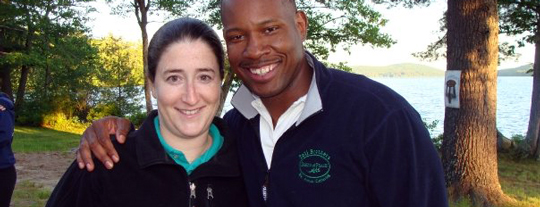
A week before the campers are due to arrive, the entire Camp staff comes to Maine for an orientation and group-building experience. As usual, it is not quite summer weather, but it is fun anyway. We are all anticipating the amazing summer we will have with the campers from the Middle East, South Asia and the United States.
Seeds of Peace is not a typical American summer camp, although that is exactly what it looks like to the untrained eye. We are preparing to bring together teenagers from two conflict areas of the world who, during the normal course of their lives, would never have the opportunity to meet each other in a peaceful, safe setting. Most of the teens have never travelled thousands of miles from home and certainly have no basis for sharing their sleeping and eating quarters with their enemies. As staff members, it is our job to help the campers overcome the strangeness of the Seeds of Peace experience and join us as one community for a month in the woods of Maine.
One of the ways we help the new campers adjust to Seeds of Peace is to include former campers on the Camp staff. Former campers reading this may recognize the names of their buddies who will be working at Camp this time: Amit, Ghassan, Lama, Bashar, Leena, Omar, Leo, Amanda, Jay, Loizos, Sofi, Micah, and Radhika.
Another way we help the campers feel more comfortable is to conduct our sports and arts activities in an inclusive way, rather than in a strictly competitive way. The process of getting people to support each other is more important to us than focusing on the most skilled and talented campers. During orientation, the counselor staff is taught how to be inclusive, no matter how competitive they usually are in similar situations. We also do not shy away from discussing difficult topics, including religion, politics, emotional problems, and sexual orientation, because those subjects will definitely be present in the Camp when the campers are with us. What we emphasize is the manner in which these topics should be discussed—with respect.
During this one-week orientation, we also try out the food, take swim tests in the icy water, prepare the 53 Camp buildings, test all the equipment and fix whatever is broken. We also provide background information about each country and conflict. We even go through sessions of dialogue and “what if” scenarios with the counselors to help them prepare for difficult situations in the bunks and on the playing fields.
For the first time in four summers, we will have a delegation from Afghanistan joining us, along its neighbors, India and Pakistan. They will endure a difficult journey and will have the greatest adjustment challenges of all the delegations coming, but we are ready to support them.
Most importantly, we try to unify the staff, many of whom are new this summer and come from wildly divergent backgrounds. Situated on Pleasant Lake, with a half-mile of shoreline, our Camp will soon be filled with 200 people who will become part of the Seeds of Peace family. Most of them will arrive scared and wary of what might happen to them during their stay. It is very important for the staff to be comfortable as a group before they have to address the concerns of the campers. Happily, this is happening. In three days, our 17th summer will begin!
Day 1 | June 23
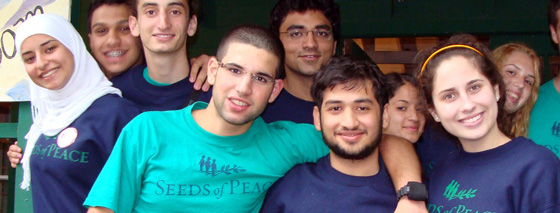
Today was the first full day of Camp, although for the Pakistanis and Afghans, who travelled together, days and nights have temporarily lost their meaning. Just for the record, the Afghans spent more time getting to Maine than any other delegation ever has before. These two delegations had several “bonding experiences” in a couple of airports before they eventually pulled into Camp on a bus from Boston at 4:30 a.m. Most of them joined their fellow Middle Eastern and American campers for pre-breakfast Line-Up anyway. They are hardy and determined.
This is a day spent taking care of business: swim tests, medical check-ups, calling home, getting their Seeds of Peace T-shirts and sweatshirts, buying phone cards and learning the Seeds of Peace song. Later they had a private chat with Assistant Camp Director Wil Smith and were introduced to their facilitators for daily dialogue sessions.
It was a day when some were feeling jet-lagged and others quite spirited. All the Peer Support (PS) campers (the ones who were invited back to Camp for the second time) were full of excitement and anticipation. They have memories they hope to relive and the anticipation of creating new memories. The PS program has been a part of Camp since 1994. It is essentially a way to carry forward the spirit of previous Camp sessions. It is also an opportunity for us to teach more sophisticated leadership training, since they are two years older than the first-year campers.
Our excellent chef, Earl, is back again, cooking up healthy food, which is nonetheless strange for many of the campers. It will never taste like home, though.
Tonight, the campers went to sleep early, after a cozy hour with their bunkmates and counselors.
Day 2 | June 24
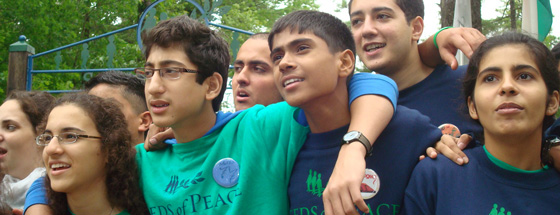
The flag-raising ceremony, held at the Camp gate, is actually the formal opening of the session. Outside the gate, there are flags for each delegation represented at Camp. During the ceremony, we raise the flags on high poles arranged in a semi-circle, while each corresponding delegation sings its national anthem. Every delegation applauds for the other national groups. Between the singing, one camper from every delegation addresses the crowd of campers, counselors, delegation leaders, facilitators, other Camp staff, visitors and reporters. At the end, we all sing the Seeds of Peace song together, raise the Seeds of Peace flag and then walk through the gate together, leaving our respected and recognized national flags outside Camp.
Richard Berman, chairman of the Seeds of Peace Board of Directors, addressed the campers first. He told them that John Wallach’s “better idea” was to bring leaders of the next generation together at a young age in a safe, supportive and nurturing environment—the way you would treat seeds—so they will learn to value diversity and understand themselves.
Tamish, a first-time Afghan camper, noted that Afghans feel like they have been given the chance to begin a new life, free from war—a life of peace. All the other campers who spoke were back at Camp a second time as Peer Supports.
Monica, from Egypt, said that the Seeds of Peace Camp is not always “rainbows and butterflies,” but many good things happen here, like the night she found Israeli and Palestinian girls washing their clothes together in her bunk.
Rishi, from India, spoke about the need to listen to each other’s stories and feel free to tell one’s own. He said that the Seeds of Peace story is a convergence of everyone’s stories and that is what makes it genuine. The stories help us form bonds across boundaries. Rishi also quoted the first prime minister of India, saying, “The only alternative to coexistence is co-destruction.”
Amit, from Israel, said that his mother’s admonition only made sense to him after he came to our Camp for the first time. She told him, “Don’t let who you are prevent you from becoming who you want to be.” He believes that everyone at Camp has leadership ability inside them, ready to be brought out and strengthened by Seeds of Peace. He has also learned that accepting himself as a person with flaws helps him accept others in spite of their flaws.
Hashem, from Jordan, said that Seeds of Peace is a place where enemies become friends. He has a deep commitment to negotiation rather than war and hopes for a peaceful region as advocated by King Abdullah.
Nur, from Pakistan, recognized that coming to Camp was a real act of courage for most campers, and that is what makes them extraordinary. She spoke about the gratification of waking up each morning with a purpose—to make John Wallach’s dream a reality. She talked about good leadership based on compassion rather than merely passion. “Go alone,” she said, “and you’ll go fast. Go with everyone and you’ll go farther.”
Marian, a from Palestine, said that Seeds of Peace leaves traces of impact on our hearts. She hopes that these marks on our hearts will be permanently engraved. She welcomed all the new campers with “open arms.”
Hannah, an American, said that the role of Americans is sometimes hard to define. But, she has found meaning in many small things she has learned, which have added up to a very large meaning for her.
The remainder of the day included the first 110-minute dialogue groups for everyone and other Camp activities, like canoeing and music. Some of the highlights included a successful swim lesson for three Afghan girls and knee-boarding lessons for boys from South Asia and the Middle East. We ended the day with the Counselor Show, an enjoyable way to reveal to the campers what they can expect to do and learn at Camp.
Day 3 | June 25
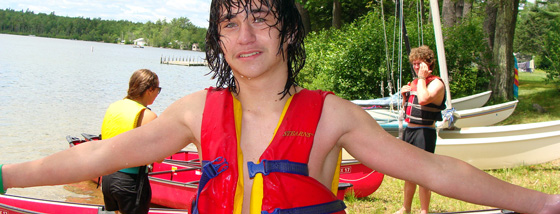
For the first time in several days, the sun came out. It was out in the morning, again at noon and also at dinner time. What joy! At last the campers saw our Camp in Technicolor, instead of various shades of gray. Their shoes dried out and they could swim and go boating on the lake in comfort. Many went out in canoes for the first time, learning many lessons the hard way. Canoes require balance and cooperation. When there is no balance and a lack of cooperation, watch out, because you will tip over or end up in places you might not want to be. New campers are given instruction, on land and in the water, but it takes time to master the art of paddling a canoe.
In the morning we have “special activities” which are devised by our very talented counselors. They vary from finger knitting to staying fit to sailing to kneeboarding to making masks or studying nature in our wooded spot. Today, the nature study group made different kinds of tea out of plants growing at Camp and then played a game similar to hide-and-seek among the trees.
At mid-day Line-Up, Seeds of Peace was honored to be awarded a generous grant from the Million Dollar Round Table Foundation. The check was presented by their grant sponsor and longtime friend of Seeds of Peace, W. Thomas Spencer, Jr., who spoke to the entire Camp about how important peace is to prosperity in general and to businesses all over the world.
In the afternoon, the entire Camp normally has sports and art activities, such as dance, Frisbee, American football, swimming or group challenge. The group challenge activities support the goals of the dialogue groups—building trust and compassion, listening skills and leadership. Generally, the groups are given a challenging objective, with some restrictions, which forces the group to be creative together. The competitive instinct tends to overtake any inhibitions they have normally. After a while, they solve the challenge and then realize that they just worked cooperatively to solve a problem with their enemies! Of course there is a big difference between the way Peer Support campers conduct themselves and the way the new campers act in these situations. The new campers don’t really trust each other yet. The second-year campers have already built up trust and they focus entirely on the objective being accomplished in a supportive and balanced way.
Tonight we had an all-Camp activity which has been a favorite for many years—the egg drop contest. Campers are organized into their dining table groups and are given materials to create a protective environment for a raw egg, which will be dropped from varying heights to see if the protective gear will keep it whole. They work very hard to do the impossible, using foam and pipe cleaners, etc., but in the end, most of the eggs don’t survive. Only the most well-designed protective gear saves the last egg.
Tonight a crescent moon is illuminating a clear sky.
Day 4 | June 26
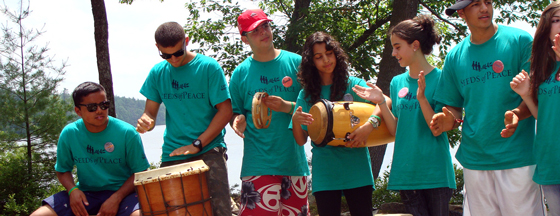
Fridays are slightly different at Camp because we suspend dialogue sessions that day and observe both Muslim and Jewish prayer services. On the other two Fridays, people of all religions will be invited to observe the worship services, but for the first Friday of each session of Camp we limit attendance to worshippers. During the services we expect everyone else at Camp to stay in their bunks and be quiet, so as not to disturb the peacefulness of the worship.
The Peer Support campers, having been to Camp before, like to play good-natured tricks on us. Today, one of the boys, Amit, pretended to have a birthday and all the other Peer Support campers went along with it. They sang to him and cheered when he chose them to go first to breakfast, lunch and dinner. By the time dinner was served, the fraud had been discovered, so they missed out on the anticipated birthday cake. But, they almost had us!
Sailing and swimming were popular today. Music is always a welcome activity. Like many other activities at Camp, we use music to bring people together and to improve communication. A group of boys from the Middle East first listened to the sounds of nature all around us, like the babbling brook and different birds. Then they differentiated those sounds, which are not intentional, with musical sounds, which are creative and evocative. In a short amount of time, two groups of boys took up instruments and created music which sounded melancholy and another piece that sounded like an opening door.
On our fourth day, we see that some of the campers are having an easier time than others, settling into the Camp environment and feeling okay about being so far from home. Often we see that the children who have had the most deprived and frightening childhoods are the first to adapt and soak up the opportunities for self-expression here. Tomorrow, they will all have the chance to meet with their delegation leaders who accompanied them from home. The delegation leaders are educators who go through a program similar to the campers, but with an adult twist.
Fortunately, a storm which travelled over the East Coast missed us entirely today. We prepared for it and then it didn’t happen. We were not disappointed though, after all the storms we had last summer.
Day 5 | June 27
“Steal the Bacon” sounds like a peculiar game to play at a camp mostly populated by people who do not touch pork, but it is just a pretense for having fun trying to out-smart the other people on the opposite side of the court. It is a game of skill, speed and wit. Our counselors make it even more fun than normal by asking people to play it while doing other things, such as acting like a dinosaur or making a two-person wheel-barrow. There is no way to get bored at this activity.
The warm sunny day was delivered with a cool breeze, making it perfect for sports and any kind of outdoor challenge. Soccer (or football), rugby and Frisbee are very popular these days. Any type of game which involves teamwork helps encourage people from both sides of their conflict to experience working together to achieve a goal. Even canoeing provides that opportunity because each paddler must coordinate with the other one to get from one place to another.
Today we had delegation meetings for the first time. For an hour, the adult delegation leaders met with the campers they brought with them from their own countries. They were able to speak freely in their native languages. Most often these meetings are a way for the delegation leaders to offer support and encouragement.
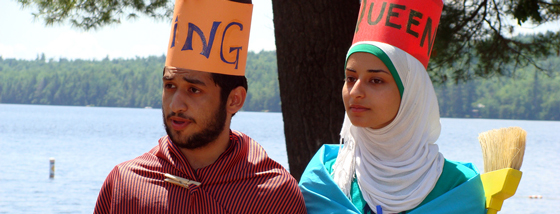
We also had “royal visitors” who led the campers in a reverse scavenger hunt tonight. The “king” met with the boys bunks and the “queen” met with the girls bunks. The royal persons had to decide if the bunks had brought the right objects with them to meet the requirements of the scavenger hunt, a reverse of the normal scavenger hunt.
Day 6 | June 28
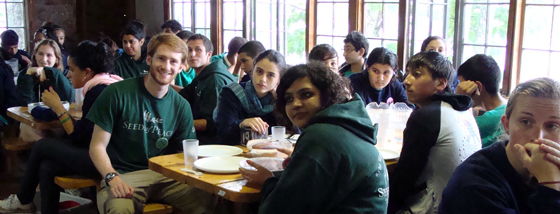
We have been hoping that we wouldn’t have a rainy summer like last year, but so far, we are experiencing some long rainy periods. A rainy season has been predicted, but we still have our hopes up for sunshine and dry breezes. Although the rain has an impact on scheduling, the campers don’t seem to mind and the program proceeds as usual. Today, we even brought umbrellas to Line-Up.
Tim Wilson, our long-time Camp director, came over to speak with the campers about taking their dialogue group discussions seriously. He told them to speak about what is on their minds and not hold back. We have passed the point where the campers don’t know each other very well, but we have not reached the point of honesty. Mutual trust is the eventual goal; however, we have a lot more ground to cover before we will get there, if we do. We are finding that the delegations have been coached not only in terms of historical facts and talking points, but also in terms of psychological “hot buttons.” Perhaps now that dialogue programs have become more common in regions of conflict, people come to Camp with sharper skills than they used to. They seem to be determined to hold their ground, as if this was a debate, rather than a dialogue.
Dialogue sessions are 110 minutes long each day, so the rest of the day has to provide other opportunities to get to know one another and cooperate with and appreciate people who are different. We use group singing almost daily, which in past years has helped us unite the campers into a supportive community. I Guess You’re Just What I Needed and two other songs, written by an older Seed and counselor, Ahmad, are very popular. One song is about everybody liking hummus, and the other is about a shy boy who doesn’t know how to speak to the girl of his dreams.
We have found that we need to allow the teens to blow off steam, especially at night. So we often have an exciting activity in the evening involving all 145 campers. Tonight’s activity was billed as the World Cup of Ga-Ga. This sport is played in the Big Hall, where all the benches are placed on their sides to form a huge circle. The whole Camp gets inside the circle and throws the ball low between the teams, trying to hit the other players in the legs so they will be “out.” We had four teams: Germany, Spain, Brazil and Italy. One has to be very fast and strategic to win this game. At the end, there were two boys left, one being an experienced Palestinian Peer Support camper and the other a new Afghan camper. They were both obviously very good. Although the Palestinian scored the winning point for Italy, all the Afghans from all the teams ran over to congratulate their “national hero.”
Now the steady patter of the rain on the roof is helping everyone drift off to sleep.
Day 7 | June 29
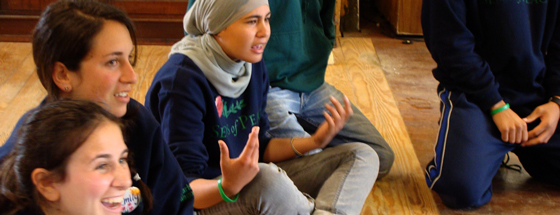
After a rainy night, we awoke to more rain, so we met in the dining hall for Line-Up. The adult delegation leaders told us about their interfaith day, yesterday, when they all went to a mosque, a synagogue, a Protestant church and a Hindu worship center. They were taught about the basic tenets of each faith and the ways prayer is conducted. Providing the 14 delegation leaders with a challenging program parallel to the campers helps everyone sympathize with each other. In fact, the delegation leaders should get everyone’s sympathy as they set out tomorrow for a wilderness overnight trip to the coast of Maine. They will sleep in tents and paddle boats in the ocean, which is very cold. They will also be cooking and living in a primitive way, which will be their ultimate bonding experience.
Although the ground is saturated with water and puddling on the fields, we are attempting to do everything possible to maintain the normal schedule for the campers. So they sloshed through American football, rugby, Frisbee, canoeing, etc., but didn’t attempt to swim. It was too cold for that. Art, drama and dance are welcome activity choices, not only to keep warm and dry, but also to listen to music at the same time. Music really cheers everyone up.
Pop music was the theme for this night’s activity, lip syncing. Each counselor was given CDs to choose a song from, so that their bunks could work on lip syncing and performing to a popular song. Peer Supports, dressed as celebrities, acted as judges as the different bunks competed for the “best.” This is always pretty funny because some people seem to blossom on stage and show us talent we never suspected.
Day 8 | June 30
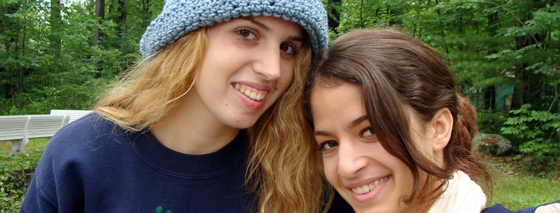
Fashion has become important here at Camp, as the rain has taken its toll on our sneakers and dress shoes, made our pants wet from the knees down and destroyed our socks. Most of the campers do not have rain gear at all, so anyone with rain boots or a waterproof coat is held in awe. Americans are used to having rain almost any season, but for the people from South Asia and the Middle East, cold and rainy times occur during the winter only. Still, nothing stops these campers from getting the most out of Camp.
The boys dance class was a classic. About half the group was very hesitant about trying to dance, although the music and dance moves were very manly. The dance instructors had all they could do to keep the boys from bolting every time the dance routine got complicated. But, in the end, most of the group stuck with it and actually performed for the whole Camp at pre-dinner Line-Up. The art class produced hot air balloons and launched them on the field and at Line-Up. The balloons were made from colored tissue paper so they didn’t survive more than one take-off. It was a very cool project for the campers to work on together.
One of the dialogue groups proved that actions speaks louder than words. The facilitators asked Israelis to leave their regular dialogue hut for a few minutes. Then they invited the Israelis back inside and told the Palestinians to go outside. After several minutes they were brought back inside too. They were asked to talk about what if felt like to be on the outside. And they were asked to decide to whom the dialogue hut belonged. They answered by pulling their chairs closer together and didn’t sit on opposite sides of the room anymore.
Tonight the group activity was a total Camp trivia game. Questions about geography, world-class sports and TV shows were followed by questions about Seeds of Peace history and facts about personalities at Camp. Almost all the information had been imparted to them over the course of the first week by various speakers. Tomorrow we will find out who was actually listening. Someone on our staff has sailed around the world and another person actually got married at Line-Up. Someone lived in Leslie’s house before she did and someone visiting Camp last summer lost a diamond earring worth $10,000. We are still looking for it!
Our catamaran sailboats are delightful to use or even just to see on the lake. Several campers were able to take them out on the lake today.
Day 9 | July 1
We awoke to a foggy day. We couldn’t see as far as the other side of the lake, let alone to the mountains. But, it wasn’t raining, so who cares if it was foggy? Besides, some of us always feel a bit foggy in the morning. But not Wil. He got up in front of the campers, asked the Peer Supports to come up there with him, and proceeded to give everyone a talk about getting through the hard discussions in dialogue. He said that the PSs didn’t get invited back to Camp because they were perfect. They got invited back to Camp because they had made it past the tough, challenging times at Camp and at home, with widening compassion and understanding for the people on the other side of the conflicts. They were brought back to Camp to help the new campers do the same. He assured the campers that if they allow themselves to grow in this way, “everything will be all right.”
The basketball, soccer and softball teams practiced today. On Friday, our Sports Day, they will be challenged by visiting teams from other camps. Israelis, Palestinians, Egyptians, Jordanians, Afghans, Indians, Pakistanis and Americans all pull together for the sake of winning.
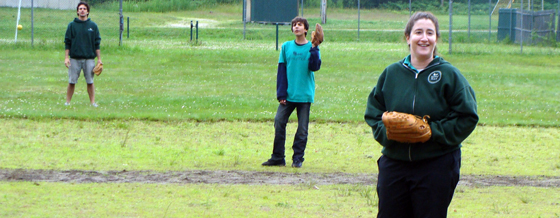
A softball game got especially lively this afternoon, when Leslie, our Camp director, and Wil, our assistant Camp director, jumped in to play. Leslie has a powerful pitching arm and Wil can hit and run with the best of them.
The a capella chorus is being trained by Micah Hendler, a Seed turned counselor. At evening Line-Up, the chorus sang a mixture of Where is the Love? and some serious rap music. The campers gave them a standing ovation and it wasn’t because they wanted to get to dinner. They loved it!
Tonight, the campers had a digital scavenger hunt. Each bunk had one camera and they ran all over Camp taking pictures of things on a list. Some got creative out of desperation. For example, one group couldn’t find any ducks, so they asked Bobbie to pretend to be a duck in her yellow hooded jacket. We aren’t sure if that will suffice, but who can find a real duck in the dark anyway?
Day 10 | July 2
Again the rain in Maine stayed mainly in Maine, but we didn’t let it slow us down too much. We have an indoor sports center which is getting a workout and our Big and Small Halls are the settings for many activities. Music, art and dancing are generally done indoors, although the art group was seen gathering pine cones and small branches for making natural picture frames. One group is in the process of building another climbing wall, but that has to stop when the rain comes down hard. Since there hasn’t been lightning until tonight, we have been able to continue the boating. But only the most dedicated learners are able to swim this week.
Our Line-Up was held indoors twice today. From a practical perspective, the Line-Ups are about making sure everyone is here and okay, but we also use that time to tell stories, show off what various groups have learned, give out scores or announce winners, make announcements, or just have fun together. Today, an art class had spent time designing fashions, so they paraded around in their creations. This might be a signal that people are growing tired of wearing the same kind of clothes every day. That green T-shirt and navy blue sweatshirt can grow on you, though. In the morning, the delegation leaders told the campers about their overnight camping trip to the coast of Maine, where they worked so well together that they felt like they were all on the same “side.”
This afternoon, Monsters, Inc. saved the day, as all 145 campers took sleeping bags to stretch out on up to the Big Hall for a rainy day movie.
Tonight, some educators and authors from Maine and Massachusetts gathered with our delegation leaders at Camp to share ideas and get acquainted. Everyone in this group had a unique story to tell about why they are interested in peace education.
While this was going on, the campers had dialogue sessions and then the boys went to the Big Hall for a spirited game of Ga-Ga and the girls went to the Small Hall for what they thought was a work project. The girls were pleasantly surprised when they realized they would have a night of dancing instead. Sarah, the head counselor, told them at first in her teacherly manner that she was disappointed in their behavior and so as a punishment, they were going to … (lights out, music on) … dance!
Day 11 | July 3

Sunshine, Sports Day and laundry day! At our Camp, that’s a winning combination. The sunshine stayed with us all day and allowed us to play on some of the fields. Camp Micah brought over their teams to challenge us in softball, basketball and soccer. The girls soccer team played inside our field house this morning, but the boys played outside on a muddy field in the afternoon. Between games, the opposing teams had lunch together and had the opportunity to observe the Muslim prayer service. After the games ended, our whole Camp jumped into the lake for the first time in several days.
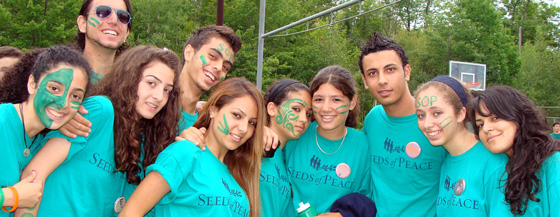
We have a number of songs and cheers that get passed down from one generation of campers to another every year. There is a cheer which evidently has little meaning, but it sounds good. It is called “Mish Ma’oool” (“Unbelievable” in Arabic). You could hear that cheer and plenty of drumming all over Camp today as the campers enthusiastically cheered their fellow campers, from all the countries represented here. It is customary for everyone to paint each others’ faces with green paint and use empty water containers for drums.
The main thing we try to emphasize in sports, as in everything else, is respect for all the people playing the game. As Wil says, it isn’t life or death. “And it isn’t about winning or losing … it’s about winning!” And we did that in three out of four games, and tying for the fourth one. We have some extraordinary athletes at Camp and they will do almost anything to win, including working together with “enemies” to achieve that.
Tonight after dinner, there was a Shabbat service and then a quiet night with bunkmates. Rumbling thunder off in the distance reminds us that we aren’t out of the woods yet with regard to the band of storms sweeping along the East Coast. But, the day we just had was simply glorious. A little more rain can’t spoil that!
Day 12 | July 4
The Fourth of July began with a demonstration of what the Peer Supports had prepared for the little parade that takes place every year in Otisfield, a small town where our Camp is located. Our older campers and the delegation leaders were the only people we sent to the parade. An estimated “crowd” of 100 people watched it. It is an understatement to describe this parade as low-key. Nevertheless, the original music and dancing was spectacular and would have dazzled any size crowd anywhere. Most of us were humming the tune all day long. The rest of Camp had a normal schedule with special activities like creative writing, fitness and cooking.
A cook-out turned into a cook-in when a perfectly awesome sunny day was obliterated by dark clouds, thunder, lightning and hard rain. The lake is already very high, so the rushing water from the mountain streams started to back up when it flowed toward the lake. But, late in the afternoon, we were graced with a magnificent rainbow.
The delegations all had their separate meetings today. This week the meetings focused on the way dialogue sessions and Camp life are going for the campers. This is the point in the process when most of the campers who have been engaged in arguments in an effort to convince people on the other side of their conflict that the truth is on their side, realize that this kind of discussion serves no purpose. Each side has its own facts and stories. Now they think it is time to acknowledge these things and move more in the direction of finding solutions.
In the evening, we gathered in the Big Hall to watch a short video about John Wallach. Leslie, Wil and Bobbie spoke about John’s ideas, dreams and charismatic personality. After the film, two of the Peer Support campers talked about how they met at Camp at a “Café Night” and became very good friends, two years ago. The Peer Support campers then led the whole Camp to the dining hall, which they had decorated and set up for conversations in small groups or pairs. Campers were able to either stay with one new acquaintance or mingle with several, according to their own preferences.
Day 13 | July 5
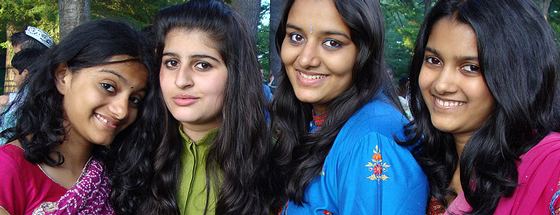
A crisp sunny day prevailed as memories of yesterday’s deluge faded, along with the memories of many rainy days. This has been a day and night so glorious that writing about it can not do it justice. This is a time when Camp community is most enjoyable. Everyone is used to the food and the routines. Everyone fits in, somehow, and most people are stretching themselves to try new things like the high ropes on the group challenge course. It is amazing to watch how paired “enemies” help each other cross on the high ropes and then hug each other when they lower themselves to the ground. Sometimes, one of them gets scared partway across the ropes and the other camper will go all the way back to lead the frightened one to the final position.
Mariam Bazeed, a former camper and counselor, and Micah Hendler, a counselor who was also a camper, sang a beautiful duet at morning Line-Up, setting the tone for the day. “I am sitting here wanting memories to teach me to see the beauty of the world through my own eyes.” The words of the song inspired Wil to urge campers to look at what is happening here at Camp and make up their own minds about what the people on the other side are like, instead of relying on the opinions of others.
A Catholic priest came to Camp and held mass for everyone who wanted to attend. We also had a Hindu service today. There were many sports in the afternoon, including softball, soccer, basketball and street hockey. After the entire Camp had general swim, all the campers were instructed to put on the national garments that they had brought with them from home. As they came out of their bunks and headed to Line-Up, the colors and embroidery were a dazzling sight. Some of them were very elaborate. The cameras were out in force, as all of us tried to capture this feast for the eyes.
An international dinner was prepared by the delegation leaders for all of us. It was delicious and different to have native foods and recipes at Camp. After the outdoor meal we also had some music from all the countries represented at Camp. Then it was time to change back into green T-shirts.
Tonight, the campers were given a list of questions and were divided into dyads with people they didn’t know yet. Using the list of questions, they found out about each other’s home life and culture. The campers were so ready for this that it was hard to get them to stop and go to bed.
Meanwhile, the Peer Support campers were activating their community projects at Camp. They divided into three groups. One is all about recycling and composting. Another is designing a way for the Middle East and South/Central Asian campers to learn about the two conflicts. The third is planning to make a sculpture out of the materials to be recycled, mainly plastic cups.
Day 14 | July 6
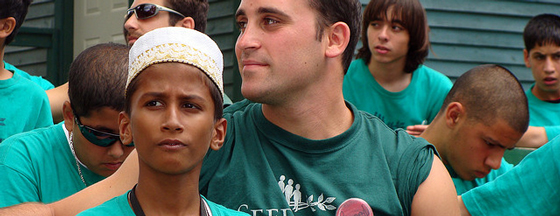
One of the girls bunks sang a song to Leslie, our Camp director, begging for a “sleep late” morning, as many people were trying to emerge from their personal morning fog. Wil, our assistant Camp director, reminded the campers that he was the person who is responsible for waking them up with a 7 am. bell, so they should have been singing to him instead of Leslie. Sleeping late is not an option, however, until later on. At this point, we have so much to crowd into our daily schedule that losing an hour would really cheat the campers out of the variety of activities they need. Also, we like to make sure that they all have the opportunity to try new things. Today, a group of South Asian boys were heading out for their first canoe ride. They had all levels of swimming ability among them. One small boy was really nervous. But the counselors took him in their canoe and gradually, he built up some confidence, as they paddled all around the lake.
Many people visit us because they have had some connection with our Camp. Today, a former head counselor, Nina, and former Board members, Fred and Helaine Gould, and their families, came for short visits. Fred said that John Wallach was a rare individual, who was important to the world, not just to his family and friends. Also, A.C., a former camper and art counselor, set up his easel and painted the “road less-travelled by” in the middle of Camp. Many former counselors and campers stream into Camp all summer, just to confirm their love for this place.
Tonight was Pirate Night. The counselors dressed up as pirates and hid all over Camp. Small groups of campers searched for the pirates, who were carrying a bag of “gold.” The objective was to gather as many pieces of gold as possible. But, they had to perform mostly funny tasks before the pirates would hand over their treasure. The campers who collected the most gold as a team were the winners. So, just imagine campers running all over Camp shouting every time they spotted a pirate and then having a great time trying to get the gold. This not only lets off some steam, but it is an enjoyable way to build cooperation and support the competitive spirit. Now the game is over and everyone is sound asleep, hoping to not hear the first wake-up bell at 7 a.m.
Day 15 | July 7
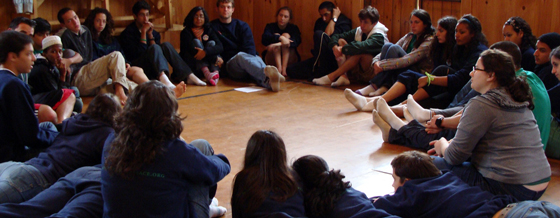
Interfaith dialogue took place today. All campers were invited but not compelled to take part in an all-Camp dialogue about their respective religions. No one spoke for an entire religion. Rather, they were asked to preface their remarks with “This is what I believe” as a Christian, Muslim, Jew, Hindu, agnostic or non-believer. Each question and answer was treated respectfully, although some campers were clearly shocked to learn what some people believe because it is so different from what they have been taught. For those who strictly adhere to their religious principles and practices, even someone who is not very strict in their religious practice is something new to consider. Written general questions, along with counselors monitoring four large groups in dialogue, ensured that the discussion would remain respectful and on-topic. Although religion is a highly charged subject, the campers handled it without heated arguments.
In sharp contrast, the evening schedule was a minor league baseball game played by the Portland Sea Dogs. This the is only time the campers leave Camp to see something especially American. Normally a rather low-key event, our campers add so much energy and noise with their cheering, you would think that they know what they are cheering about. But they don’t. They have learned how to sing Take Me Out to the Ball Game in case the rain doesn’t prevent a seventh inning. But the real noise comes from some mostly nonsensical cheers that have been passed down from one generation of campers to the next. And they bring along drums from Egypt and other parts of Africa. By far the most important aspects of this trip are socializing and the ballpark food, particularly the Sea Dog biscuits (ice cream sandwiched between two big chocolate chip cookies).
Back at Camp, the rain was pouring down and the temperature was 55 °F (12 °C). Seemingly, global warming has yet to surface in the state of Maine.
Day 16 | July 8
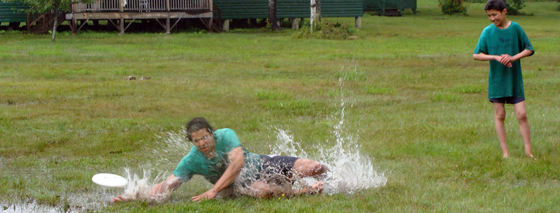
“Take 10 seconds to express your feelings about the weather,” said Wil. Since we were all wet and cold, most people had really bad things to say. It sounded like one giant moan. Then we moved on to the business of the day. The good news is that sunshine is in the forecast for the next few days. Bobbie told the campers about the hundreds of former campers who are following their progress on Facebook and in these daily Camp reports, all of whom say they are so envious of the campers who are at Camp right now. So no matter what the weather is, everyone should participate and get the most out of this experience. Apparently, several campers took her seriously by going out in canoes for the first time or playing “underwater Frisbee” in the water-soaked field.
Taking an informal poll of the facilitators today, it seems as though the campers have reached the point of not seeing people from the other side of their conflict as a unit. They are considering each person individually and recognizing that they sometimes have a common enemy—people who are against trying to establish peace. This is a far cry from where the campers began their dialogue sessions. It will help them work together to build a better life. All session long, the Peer Supports have been trying to find a way to move a rock which is in a dangerous place relative to the climbing wall. After breaking a shovel trying to move the rock, they found a way to do it. Cooperation and a lot of effort made it possible.
The campers have been rehearsing for tomorrow night’s Talent Show. This is when we find out how much talent we have assembled in this place. We are bound to be blown away by the quality of their performances. Some of the delegations prepared dances and songs before coming to Camp. Other people are putting acts together today. It is like a celebration of their achievements and gives us all a chance to show our appreciation for each of them. We had a taste of what is in store for us tomorrow night when the drama group performed original skits for us today. Meanwhile, in the background, certain counselors are secretly preparing for Color Games. Shhhhh! Don’t tell anyone!
Day 17 | July 9
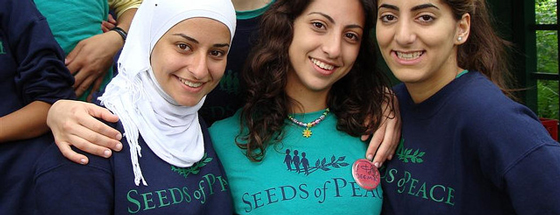
This is one of our favorite nights in our Camp program. The campers present us with a talent show which always amazes us. Some perform dances from their own culture and some perform dances from another. Where else would you see an Afghan girl switch from African dances to Afghan dances? Think about the courage it took for her to come to Camp, to try all the new sports, learn to swim and canoe, play street hockey and do the climbing wall, among other many other new things. Then, imagine her getting up in front of the whole Camp and dancing an African dance with others who had just learned those unique dance movements. Wow! Does that happen anywhere else?
We like to honor John Wallach by singing a song he liked to perform at the end of each talent show, Last Night I Had the Strangest Dream. Jesse Erwin sang is beautifully for us. Then, all of a sudden, the counselors burst into the big hall screaming, and pretty soon it was obvious that Color Games had started! Wil explained that for the next three days, they will be in a fierce competition with people who are either on the Blue or Green Team. Blue or Green will be their main identity for this short period of time. At the fire pit, they learned which color team they would be part of and had their first team meeting. They are very excited! Tomorrow they will wake up and have the all-Camp rope pull before breakfast. Legend has it that the team that wins the rope pull is the team that loses the whole Color Games in the end. But that is just a rumor, generated to help the losing team remain confident.
The Peer Supports prepared presentations about the Middle East and South Asian conflicts to present to the campers in dialogue groups, groups which are normally focused on just one of these conflicts. Everyone paid very close attention and appreciated knowing more about the other conflict represented at Camp. People from both sides of the conflict presented their own perspectives.
Most of the campers, facilitators and counselors got their pictures taken today so they will remember their bunks, tables and dialogue groups.
Day 18 | July 10
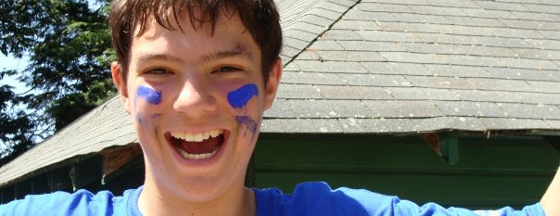
Before breakfast, the Blue Team won the boys and girls rope pulls, but the Green Team won the full-Camp rope pull. This was a great way to start. The sunny and slightly cool weather was conducive to high energy levels. Perfecto! We couldn’t ask for better weather, as a matter of fact.
The morning competitions were between bunks which rotated around from street hockey to basketball, ping-pong, soccer and volleyball. New cheers were introduced by both teams after lunch. Even the White Team (the White Team members are the score-keepers and officials of Color Games) may have had an original cheer. One of the best sights was watching an Afghan girl score several goals on the street hockey court. Street hockey is one of the sports which is unfamiliar to just about everyone, before Camp. So, they start on a level playing field in more ways than one.
In the afternoon, we stopped to allow Muslims to pray and then resumed Color Games. The competition was in Ga-Ga, drama, soccer, American football and basketball. Tonight there were a couple of all-star games. The score tonight was Green 520 and Blue 575. After dinner, we paused for Shabbat services for Jewish campers.
Color Games has been likened to a “rite of passage” for Seeds to become Seeds. It is a test of endurance, character and commitment. The cumulative scores are hard-won and include all areas of Camp life. At the end of the three days of competition, they know what each of them is made of. Yet the competitive factor didn’t separate any friendships. You can still see people in blue and green shirts socializing together.
Later in the evening, there was a concert at a theater nearby to benefit Seeds of Peace. Palestinian and Israeli Seeds turned counselors Amit and Ghassan, along with Bobbie, made a short presentation to the audience and then everyone was treated to Turkish, Armenian, Greek, Arabic and Klezmer music, performed mostly by professors at Bates College. Only the delegation leaders and our presenters attended from Camp, but the appreciation of the music of many cultures made this a delightful thing to do at the end of the session.
Day 19 | July 11
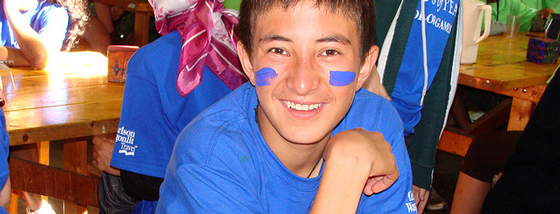
Color Games continued all day, starting with the 7 a.m. Race for Peace on the dirt road that goes all around Camp. We have some very impressive athletes at Camp, as usual. There was a photo finish for the girls and the boys made wonderful time. When we began the day, the Blue Team was ahead, but by noon the Green Team had caught up and surpassed Blue by 50 points. By this evening, Green was ahead by 100 points.
In the morning they had many kinds of relay races in the lake. There were also several all-star games all day, including soccer, basketball, street hockey, softball, volleyball, Frisbee and Steal the Bacon. The fields were not quite as dry as we would like, but we were able to use them at least.
Drama, music, art, dance and cake decorating were also hotly contested. Having experienced a very reluctant boys dance class earlier this summer, it was amazing to see some of those same boys putting together their own dance performance in about 20 minutes. They were not reluctant or embarrassed this time.
Tonight, the teams had to compete in a variety show which included singing, dancing, skits, instrumental performance and an original team song. There was no lack of talent. In fact, each team took their challenges seriously and produced some very fine work. The skits are always about Camp life, so imitations of Leslie, Wil, little Sam, counselors or Bobbie are par for the course. The Blue Team imitated the “Blue Man Group” in one of their acts. The Green Team had a very talented music composer who was able to organize several instrumental players who have never played as a group before.
And finally, after the team songs were performed, we all joined together for one of the most beautiful sounds we know, the singing of the Seeds of Peace song.
Day 20 | July 12
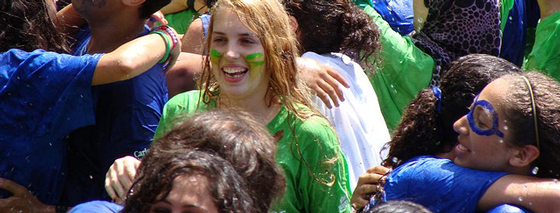
The Peace Canoe Race, done in old Indian war canoes, went smoothly, considering that very few of the campers had any prior knowledge of canoeing when they arrived at Camp three weeks ago. These big wooden canoes are very steady and much less likely to tip over. All the boaters wear life jackets and are closely monitored by counselors in motor boats. Once the peace canoe reaches its destination, which is Wil Smith standing in the water with a wetsuit on, a runner sprints to the bell we use for everything and rings it. Each boat’s entry is timed from start to the sound of the bell. All this happens before breakfast. They definitely work up an appetite!
The campers were not given their scores from the Variety Show before they launched into the final phase of Color Games. They didn’t know that their scores were even after the Green Team won the Message to Hajime all-Camp relay race, involving 106 different activities before the actual message has to be recited from memory by one camper from each team. After the messages were completed, the campers were brought to the boys swim area, where they learned the winner of Color Games. All the coaches and supporting staff were thanked and the campers were given their due praise. The Green Team entered the lake with all their clothes on and then the Blue Team followed suit. They all splashed and hugged each other for a while and then formed a circle to sing the Seeds of Peace song. A lot of wet people went back to their bunks to change into the normal green T-shirt and the Camp was reunited. But now the Camp is united on a deeper level than it was prior to Color Games.
This afternoon we had a double rest hour. We needed it! Then we gave all the campers their memory books so they can take the time to write messages to each other which they will cherish when they return home. They will be trading books and writing lots of kind or funny words to each other before they have to part on Tuesday.
Tonight we held a very moving memorial service for Asel Asleh and the seven other Seeds who passed away over the years. Asel is the only one who was killed in the conflict and he was very important to us. Several Seeds participated by reading passages of letters he wrote. He was a prolific writer. Amit, Bobbie and Wil spoke about their memories of Asel, who was a very active Seed for four years. He first attended Camp in 1997 and was only 17 when he was killed, while demonstrating peacefully, wearing his green Seeds of Peace T-shirt. After this service, everyone had their last bunk night. Behind the scenes tonight, Radhika and Bobbie were selecting photos for the CDs we plan to give the campers tomorrow. Surveys were being printed and directories were being stapled. We are all preparing for the end of Session One, which is both heartbreaking and uplifting at the same time.
Day 21 | July 13
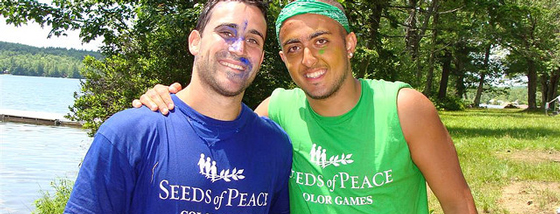
The last day of Camp is very emotional, from every perspective. On the one hand, most campers are happy to be going home. But on the other hand, they want to stay here in this peaceful, supportive community a little longer. The signing albums were out in full force, as each camper tried to capture the positive relationships formed in just three weeks. And, of course, we were just emerging from the collective ordeal of Color Games. Still, it is important to deal with the emotions to the extent we can.
First, we had an all-Camp clean-up so we are leaving the place in the condition it was in when we arrived. Then we gathered in the Big Hall where Bobbie provided a space for sharing thoughts and feelings with the whole community, using the model of a Quaker silent meeting. Everyone was silent for the first 15 minutes as we intuitively felt the presence of the others. Then, people began speaking from their hearts about the meaning of Seeds of Peace in their lives. An hour later, we were all quite moved by what people had shared in this meeting. The bell rang softly. Then we walked to our next activities.
Later we had delegation meetings, final dialogue groups, time for packing and two more Line-Ups. After dinner, everyone met to hear about “life after Camp.” Our Global Programs Director Paul Mailhot and the Peer Supports explained what the follow-up programs in their countries will be this year. We also talked about SeedsBook and The Olive Branch and other ways they will be able to stay in touch.
A 45-minute slide show depicting the past three weeks at Camp was very much enjoyed by the campers and staff. Radhika and Bobbie had been taking many pictures. Choosing among them was a major task. With so many positive interactions going on in such a lovely setting, it is difficult to not take good pictures. We also had the Color Games coaches speak to the campers about their impressions of what just happened in Color Games. Then, the campers headed to their bunks, but they asked for no “lights out” tonight.
Days 22-24 | July 14-16
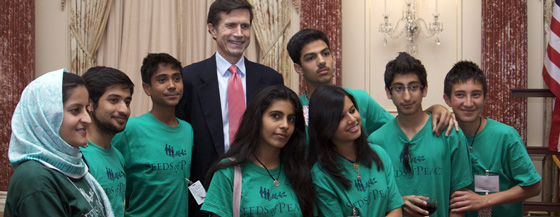
Very early in the morning, the Peer Supports created their “prank,” which in recent sessions has changed from being a joke to being more of a theme gleaned from memories they shared. Several times during the session, a favorite folk song was performed. So all across the front benches where the Peer Support campers sit at Line-Up, they wrote the words to the song, “I am sitting here wanting memories to teach me to see the beauty in the world through my own eyes.”
Not much later in the morning, the bell rang so we could all say goodbye to the first batch of campers. Given the nature of our Camp, the goodbye scene can be excruciating for everyone involved.
Even a bystander would crumble at the sight of all these wonderful teenagers saying goodbye to their dear friends, not knowing if they will ever meet again. In most cases, the Internet will help keep them connected. But for some, this is not an option.
Having lived together for three weeks, in close quarters and under some considerable stress, they now trust and care about one another. So there are a lot of tears and hugs. It is a challenge to load them on the buses. With each successive bus, fewer people are left behind to say goodbye. And by the time the last bus leaves, the staff is exhausted by the emotions of the day.
The Indian, Pakistani and Afghan delegations stopped in Washington, DC, before departing for home. For two days they together visited their respective embassies, as well as the State Department, where Ramish from Afghanistan spoke eloquently on behalf of all the Seeds. They had the chance to speak with the diplomats both formally and informally. One morning, a small group went to Capital Hill to speak with the legislative aid for Rep. Jim McDermott. The final night, they had a boat ride on the Potomac, a unique experience for all of them. Their travel will be long and taxing. But they are all very glad to have made this journey.
SESSION TWO: MIDDLE EAST & MAINE
Second Session Arrival Day | July 20
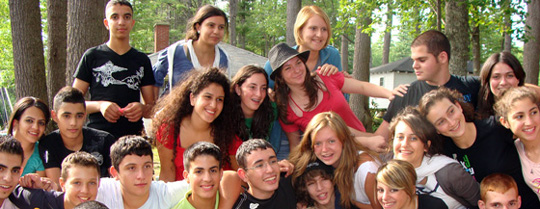
The second session of Camp will be different from the first session because the populations are not the same. This session does not have campers from South Asia. It has Middle East delegations (Israelis, Palestinians, Egyptians and Jordanians) and a large delegation from Maine.
The Maine Seed Program is comprised of selected individuals from all over the state. Many are originally from African countries suffering from war. Some come from the more rural northern part of the state and others come from Portland, Lewiston or Augusta. They have had considerable bad feelings about police actions in Portland especially, but there is tension elsewhere as well. The Maine campers will have quite a lot to discuss and overcome.
By 9:30 p.m. we had a full Camp, as two buses of Palestinians, Jordanians and Egyptians rolled in. Earlier in the day, the Maine campers, Americans and Israelis arrived. While we were waiting for the later buses, everyone went out on the fields to play soccer, softball and Frisbee. They were welcomed with boisterous music, food and Bobbie’s talk about equality, and had a chance to experience the peace and the beauty of the lake.
We are still holding out hope that campers from Gaza will join us this session. They are close to being able to come. If this does happen, there will be no more than five and perhaps only three, but their presence at Camp will make a big difference in the dialogue sessions.
Day 1 | July 21
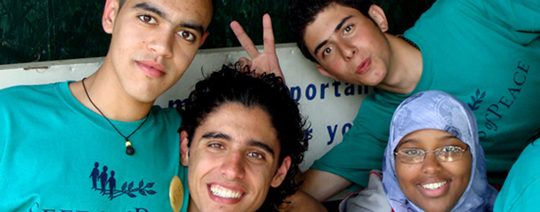
The first real day of Camp is all about “housekeeping.” Campers are seen by our doctor and nurse, so they are known to the medical staff from the start. All medications are kept locked in the infirmary and dispensed to the individuals who need them on a regular schedule. Items like Ipods, cell phones, money, passports, airline tickets and jewelry are collected for safe-keeping. We want their full attention to be on the monumental task before them for the next three weeks. Even email is suspended, except for incoming messages from friends and family. The campers call home once or twice a week. Their first call was made today. So, it is not like being at home where phone calls interrupt life all the time. It might take them a while to get used to not having music in their ears while they are walking along, but soon they will become accustomed to the change. And we hope they will enjoy listening to the sounds of nature, live music of their own making, and looking straight into the eyes of their new friends.
The Seeds of Peace Camp song was taught to the campers in time for the flag raising ceremony tomorrow. The Peer Supports have thought about what they want to say to the new campers at this ceremony. Neighbors and friends have been invited. Let’s hope it doesn’t rain like it has today.
Six of the bunks have already made up cheers and songs to unify their groups. The Peer Supports have come up with a short cheer to be used whenever “PS” is mentioned. Traditional table cheers are being passed on to the new campers. This is all about weaving the community together, one unit at a time, and adding this group to the more than 4,000 campers who have gone before them.
Day 2 | July 22
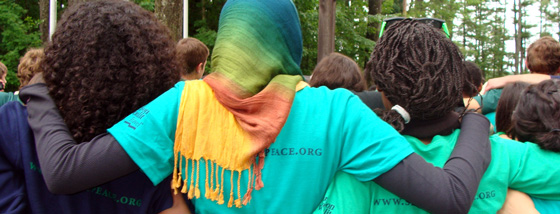
It rained hard all night, but the morning brought first a tiny bit of sunshine and then, while the whole Camp was finishing the flag raising ceremony at our front gate, the sun broke through and celebrated with us. Peer Supports spoke beautifully to the new campers about their Camp experiences and about the political challenges ahead. Jonathan (Maine Seeds), Najat (Israeli), Noor (Egyptian), Nora (Palestinian), Leen (Jordanian) and Lexi (American) all spoke from their hearts.
Leslie welcomed our visitors, Richard Berman (Chairman of the Board) spoke about the importance of making the effort to meet the challenges of the Camp program, and Tim talked about the need to have a Maine Seeds program and gave credit to the people who created and helped sustain Seeds of Peace all this time.
Tomorrow will begin the special activities. These are created by the counselors to augment the regular Camp program. One is going to be called, “The Meaning of Life.” The group will begin with some movement and meditation beside the lake and then will go interview various people at Camp to find out what is most important to them in their lives. They will meet five times, and so far, they have appointments with Leslie, Bob on our kitchen staff, and Bobbie.
We want to acknowledge that for the first time, we have a delegation leader (Palestinian) who was a camper in 1997. It was great to welcome Kheirallah back to Camp in his new role.
Days 3-4 | July 23-24
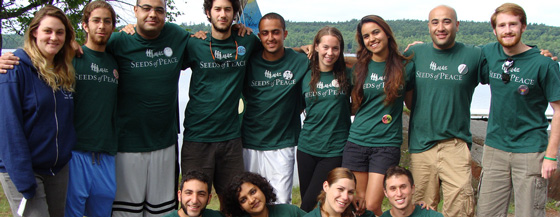
We have reached the point in our development as an organization at which many of our staff members in the regions of conflict are Seeds themselves. This is also true for the Camp staff. Several counselors—the staff living in the bunks with the campers and teaching them sports, the arts and other skills—as well as dialogue group facilitators are Seeds who have been trained by professionals in their fields. The combination of professional training and the experience of being a camper makes each one of them especially well qualified to work at Camp. This year, we have added a delegation leader who was a camper in 1997. He is a pharmacist at home in Jerusalem and has been a facilitator on the ground there. He is uniquely qualified to accompany the new campers to Maine and guide them through the process.
They say that into every life a little rain must fall, but here in Maine we might want to alter that statement to “into every day a lot of rain must fall.” Our bunks or cabins are all situated close to the lake. As the rain pours down, it collects in the streams which run into the lake, making the sound of rushing water quite common. We either have to come up with creative indoor activities or carefree outdoor activities. These past few days we have done both. Mud sliding is the most fun, according to the counselors and campers. There seems to be no way to dampen the spirits of the Camp with poor weather. If they are Mainers, they are used to it. And if they are from the Middle East, they find it adventurous.
Day 5 | July 25
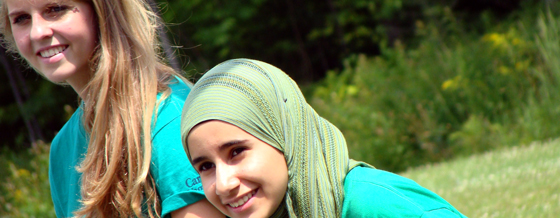
Campers get a taste of Americana when the nearby town of Casco holds a three-day fair called Casco Days to raise funds for local fire and emergency services. All the standard attractions, like a parade, a Ferris Wheel, cotton candy, fried dough, games and stuffed animals make the fair a fun place to visit for a couple of hours. Each year, the Peer Supports create a marching tune and dance for the parade and compete against other camps in this area. This year we were awarded second place. We send the campers during the times they do not have dialogue groups.
So campers had the chance to try out sailing, softball and Steal the Bacon. They have also begun to find the group challenge activities and the dialogues getting harder each day. All the late-arriving campers are now fully integrated in Camp life. After meals, the table cheers resound though the forest and across the lake. It sounds good to those of us who recognize that energy is being put into uniting this small community.
Day 6 | July 26
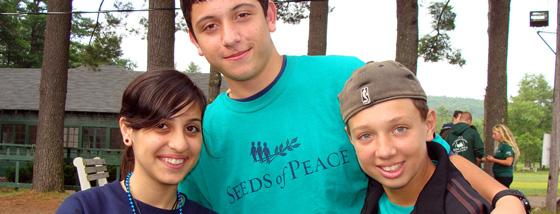
Anyone following these Camp Reports this summer is well-aware of the rain that has blessed us most days. Today was no exception. We have decided that it will require a “level three” swimming grade to participate in land sports this summer. All of them entail sliding into deep puddles or ponds in the fields. Playing in the mud has become an all-day special activity because that is what everything turns into, after a few minutes. Today we had lots of thunder too. During the thunder, we have to stay inside so we had an extended rest hour(s). These turn into unscheduled talks, which often form the bases of strong relationships. Many of the counselors who were campers when they were younger tell us that these times were some of the most important for them.
Tonight the campers had the egg-drop activity described in a first session report, but this time, we did not hand out insulation materials. Last time they protected the eggs so well, we thought the contest would never end!
While the campers were busy with the egg-drop, several professional basketball players arrived at Camp. Campers will meet these players, including Barbara Turner from the WNBA, tomorrow and will hold basketball clinics with them. The other players include Brian Scalibrini, Gerald Henderson, Wayne Ellington, Jordan Farmar and Tyreke Evans. This will be a pleasant distraction from the stressful discussions they are having in their dialogue groups. The timing is just right.
Day 7 | July 27
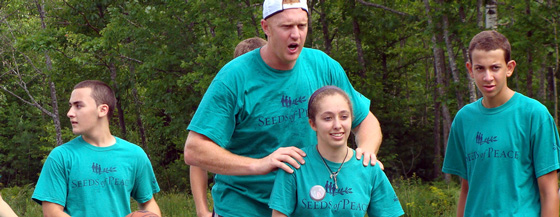
Half of our campers were getting basketball training from the NBA players visiting Seeds of Peace today, while the other half were doing the “heavy lifting” in dialogue groups. Then they switched places. Both activities involve paying very close attention to the other people in the room or game. Missing a signal on the court could cost the team a point. Missing a signal in dialogue could cause a misunderstanding between new friends. At this stage of the Camp process, no one wants to risk losing a newly-formed friendship with someone from the other side of the conflict. Yet their friendships will remain shallow if they do not open their hearts and minds to each other. Some are ready to do this while others are not.
Several Peer Supports gave up their rest hour to share in dialogue with the NBA players. They spoke about leadership styles and the parallels between sports competition and real life. They talked about influence and power, as well as the need to attract young people to programs which bring them together, rather than drive them apart.
Before dinner, one of the counselors brought out the words and music to a song composed by a counselor when they were campers. It begins with, “We are not afraid to look you in the eye, we are not afraid to see the other side.” The lyrics coincide with this period at Camp when reaching across the traditional barriers to human relationships requires a lot of courage. Then we all shared a cook-out with the NBA players before going up to the basketball courts for some Knockout and four-on-four games. The NBA players “got down” with the campers, and everyone agreed it had been a great day.
Day 8 | July 28
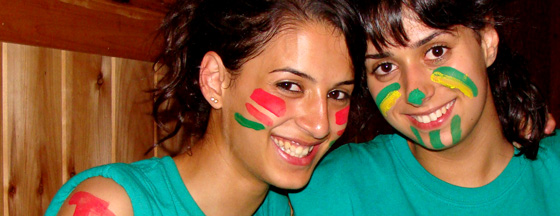
The spirit of Camp is quite high now. Maybe it was the NBA day. Maybe it is because of the sun. Or maybe people are just really engaging in the programs. But, there is a recognizable difference in the spirit of the campers between two days ago and today. Each session of the 40 which have preceded this one had its own pace and character. Tonight we held the World Cup of Ga-Ga in the Big Hall. The spirit of competition was so strong that you might have thought it was Color Games already. France, Argentina, Brazil and Spain competed for the title. (Just for the record, Spain won.)
Group challenge augments the dialogue meetings. It is made up of graduated low-level and high-level ropes course elements, set in the woods at the far end of Camp. The dialogue groups go through a series of challenges, some blind-folded, some soundless, almost all requiring cooperation and teamwork. Very skillful counselors guide the campers through these exercises, which are new to everyone. Afterward, the group of campers discusses what was discovered about themselves.
There were try-outs for the teams which will play against another camp on Friday’s Sports Day. We will field girls softball and soccer, as well as boys soccer and basketball. Judging from the competitive nature of Ga-Ga tonight, the other camps’ teams may have a rough time fathoming the fact that only a week ago, these Seeds of Peace campers didn’t like or trust each other. Now, they will defend their team members from “the other side” to the limit!
Day 9 | July 29
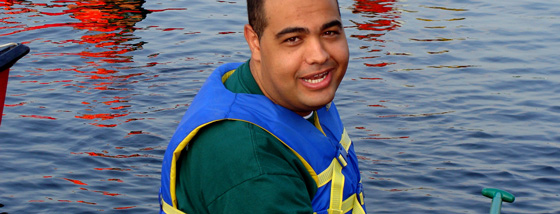
The serious nature of the work at Camp is always laced with intentional fun shared by the group. Watching the entire Camp enjoy a joke can be inspirational. Laughter is uniquely human and can be healing. Since the beginning of Camp, whenever the counselor Rebecca would begin to speak publicly, the other counselors would applaud and cheer. She can no more than begin to frame her words when she is overcome by “support.” For her birthday, she was encouraged to make a speech and then had to endure the applause of the entire Camp. In the end, everyone was laughing, especially Rebecca.
Group challenge continued with activities on low elements, advancing toward campers being able to make their way across the high wires of the state-of-the-art ropes course we have at Camp. Today they helped each other balance on low wires, learned how to do trust falls and climbed between rope swings without losing control. All of this is new to most campers, so they are stretching their abilities and level of confidence with each progressive accomplishment.
We had a hot summer day, just perfect for lake activities until dinner time, when the thunder storms rolled in. Still, we have been able to do all the planned activities. Tonight the whole Camp was in the Big Hall, having a trivia competition between the bunks. They had to answer questions about geography, history, details about Camp personalities, etc. It’s all good.
Day 10 | July 30
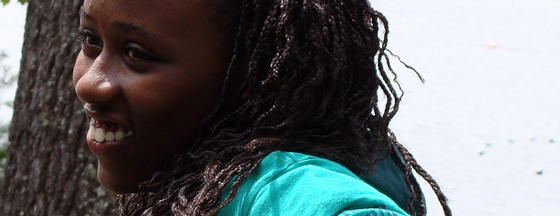
This was PS Day. The Peer Supports inserted themselves into areas of Camp that needed extra help, like the kitchen. They also organized the campers to help improve the Peace Garden so there would be more seating areas for chats. And they planted more flowers there. In the Art Shack, they got the campers excited about painting pictures to decorate the inside walls of the dialogue huts. All of this was very much appreciated.
The Peer Supports also took over the head counselor’s job of doing bunk inspections and giving out scores. The girls gave their own bunk a low 3.5 but the boys gave their own bunk a 10 out of 10. They delivered the scores with humor and good reasons for their scoring. Finally, they revealed that they had climbed in the window of Assistant Director Wil Smith’s cabin and decided to give him a score of 9 because his radio was still on. Wil said his radio was on to discourage animals from coming inside, like bats. We didn’t know that bats are averse to jazz and mellow rock, but you learn something new every day!
Dialogue groups seem to be on course. The difficult discussions are happening, something you could sense if you were to walk down what we call “Dialogue Alley.” There are about five small buildings where the dialogue groups meet. They are all in a row transversing the middle of Camp. When people are inside, they only hear each other and some muffled noise from the other activities going on outside. People walking by only hear muffled sounds of the dialogue, but cannot listen to the discussion. Everything said in the dialogue groups is supposed to stay within the groups. This provides a good measure of protection for everyone.
Day 11 | July 31
When the sun was shining this morning, we should have known better than to think it would last all day, as we organized our laundry for the Friday pick-up. But, some of us did dare to think that perhaps we would be lucky enough to have sun for the four sports matches and a cook-out with two other visiting camps. This was not to be!
Nevertheless, we painted ourselves in green patterns and cheered on our teams with drums and chants, probably never heard before by the visiting American campers. It was also visiting day for the families of the Maine campers, so all-in-all, it was a camp director’s nightmare when the sky opened up and drenched everyone and everything, forcing us all inside the Fieldhouse and then the Dining Hall for lunch. Our camp directors took it in stride, however: Leslie and Wil turned it into fun.
Before the rain, the girls soccer team and the boys basketball team swept the other teams off the floor. The girls beat their opponents 10-0. The boys also won 6-1. Naturally, our campers were delighted. Some of them felt so bad for the visitors, they formed a cheering section for the “other side.” Afterward, we took joint team photos in the pouring rain and brought everyone together for singing and cheering. After that, the cook-out became a cook-in. With the rain still pouring steadily, we decided to forgo any further games. After lunch, everyone was invited to observe the Muslim prayer service in the Big Hall.
In the afternoon, we had lip-sync contests between the bunks. They pretended to be the celebrity figures in the musical recordings, dancing and singing in a group. After dinner, we had a nice, long Bunk Night.
Day 12 | August 1
Dialogue groups continued to wrestle with tough issues. Racial and religious discrimination as well as recent violence at home were topics on the table for discussion. Blaming, justification and victimhood are all part part of the old script. It is up to the campers to create their own scripts and their own possible solutions, worked on together with people who are no longer considered implacable enemies, but are yet to become trusted friends. It isn’t easy.
On the lighter side, the male counselors created a mustache contest and some other people entered the competition as well, including female counselors, campers, and even the nurse. Mustache creations ranged from very large to very small, in all shapes and colors. Then we took a vote on who had the best ones.
Day 13 | August 2
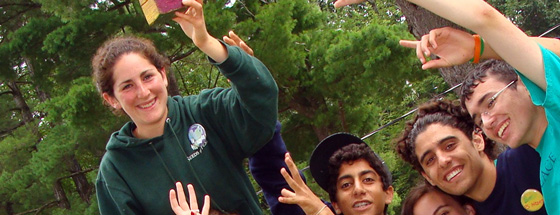
We began the day with all-Camp picture-taking. This meant that Radhika and Bobbie, armed with cameras, took pictures of all the delegations, bunks, table groups, dialogue groups, facilitators and counselors. It is always fascinating to watch how the different groups arrange themselves for photographs. One never knows how long a photo will be kept and valued. But it is very likely that these photos will be cherished for many years to come.
In the afternoon, a local priest came to Camp to lead a mass for the Catholics and provide a chance for others to observe the mass. This week, all the religious observances have been open for observers, including Jewish, Muslim, and Protestant. The campers also had a chance to meet just with their own delegations for an hour.
A lot of boating took place today. Sailing, water-skiing and canoeing campers populated the lake until dinnertime. The wind was stronger than normal, causing choppy water and some capsizing. However, everyone had a great time.
Tonight we showed campers the movie about Seeds of Peace Founder John Wallach. Leslie, Wil and Bobbie spoke about John from their own experiences. One person asked what John might think of Camp as it is this summer. Bobbie said that John would be glowing with pride that so many wonderful Seeds were on the staff, that we had a full Camp from all the places we hoped would send campers, and would be very impressed by the professional way Camp is run. He never wanted Seeds of Peace to be ordinary. He always wanted us to do what seemed to most people to be impossible. To end the day, we had Café Night. All the campers were asked to spend the evening meeting people they haven’t had the chance to meet so far, in a café-like atmosphere set up by the Peer Supports, with cookies, brownies and milk.
Day 14 | August 3
We had such a beautiful sunny day! Walid, from the Middle East, remarked on how people in Maine spend an inordinate amount of time commenting on the weather. Perhaps it is because you will always gets a sympathetic response to that subject here in Maine. Or perhaps when you live in peace with your neighbors, you can talk about something you share, like the sky, the wind, the rain and the sun.
While the Peer Supports climbed a mountain and looked out over the ocean today, the rest of the campers had their usual activities and dialogue meetings. This morning at Line-Up, we were told that the breakfast would be a little late, so we should keep busy for a half hour. Did you ever look out over a sea of grumpy teenage faces in the morning? They weren’t too happy about the delayed breakfast. Crawling back into bed was not an option. So, four of our liveliest counselors came up with some participatory, funny songs and stories. It didn’t take long for the whole Camp to be laughing and enjoying the half hour of waiting time.
Then one of the delegation leaders told the true story of driving toward Camp on arrival day with all the Peer Supports standing up in the bus, crying and screaming, “Look there’s the lake!” “There’re the flags!” “There is the trooper!” “And listen: they are playing music for us!” They were sobbing so hard that the adult delegation leaders who were coming here for the first time and the new campers didn’t know if this was a good or bad thing. They became concerned that they were entering a scary place. All the smiles and hugs on the ground relieved them after the bus emptied out, however.
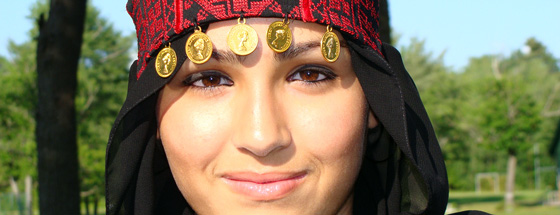
Tonight, we had the international dinner. Since everyone is encouraged to wear their national costumes, it is a very colorful affair. Many educators from all over New England came to see it and stayed for discussions with our delegation leaders. The entire dinner was prepared by the Middle East and American delegation leaders, our nurse, and two families of campers, one Somali and one Taiwanese. We finished off the meal with blueberry cobbler, a Maine delicacy. The whole Camp then participated in a dyad conversational exercise, as campers had one-on-one conversations using a prescribed list of questions to get them started. Then, we gratefully headed to bed, while the whole moon glowing over the lake topped off a very good day.
Day 15 | August 4
We had a make-up soccer game with one of the camps that had to leave last Friday in the pouring rain. This team was much more formidable than other camps’ teams have been. The players had a very intense match with lots of cheering on the sidelines. In the end, our team lost 2-1. With delegations from the Middle East and Maine campers from African countries, the level of soccer playing at Camp is exceptional. But the team from the other camp had players from Spain who could keep up with our players. We were good sports about losing and the teams traded T-shirts at the end.
In between the soccer game and the Sea Dogs baseball game in Portland, we had dialogue sessions and one-on-one conversations. Although we have a very tight schedule, and we keep track of where people are all the time, we try to allow some opportunities for personal conversations, particularly between people from opposite sides of their conflict.
The Sea Dogs game was played in the early evening in balmy, delightful weather, in sharp contrast to the first session of Camp when the game was rained out. Baseball food has a flavor all its own, but the signature item on this team’s cuisine is the “Sea Dog Biscuit.” Two big chocolate chip cookies with vanilla ice cream between them … really, what could be nicer? We came home late tonight so everyone is waking up one hour later than usual.
Day 16 | August 5
Today while we had general swim, the sky opened up and produced a heavy downpour while the whole Camp was swimming in the lake. Since everyone was all wet, and there was no thunder or lightning, the campers just swam in the rain. That must have been fun!
The Peer Support campers are building a low climbing wall for group challenge exercises. You can hear them hammering nails into boards and planks off in the woods. They have been working on this wall for several days and it is almost complete. The significance of working together for the sake of the Camp community is not lost on them, but the casual way they helped each other with this project might surprise some people back home. Tonight, the Peer Support girls will be having a quiet birthday party in the middle of the night for one of their bunkmates. It will be a surprise for her.
One of the most beloved Seeds of Peace camper/counselors, Ahmad, came back to visit today. He was the composer of two of the best songs at Camp, one being The Hummus Song and the other being Don’t Forget Me, No, No, No. Both of these songs are fun to sing and full of humor. His arrival had so much buzz that you would have thought a famous movie star was gracing Camp. He is sure to be very helpful at the Talent Show tomorrow night.
Behind the scenes, there is a small group of counselors preparing for something very special. Stay tuned.
Day 17 | August 6
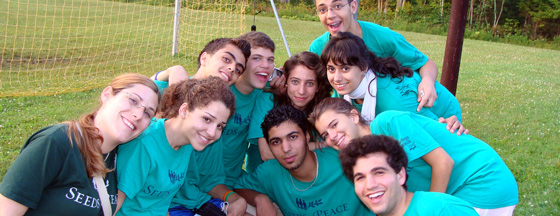
All day long, the counselors knew that Color Games would be starting tonight, but the campers didn’t have a clue about it. It is fun to surprise people. The campers were working hard on their talent show and finishing their dialogue groups, so their minds were not wandering, except for those who are beginning to think about leaving Camp in just a few days. Color Games helps the campers make the most of the remaining time they have at Camp. It is the final rite of passage to becoming a Seed. Over the next three days, they will be much too busy to even give one thought to leaving Camp. They will wake up early and stay up late each night, compete all day and only rest during rest hour. Color Games is a constant marathon, with only two short nights of sleep to break it up.
All the campers were carefully positioned on either the Green or Blue Team. Each team is balanced in every way possible. Each bunk has equal numbers on either side. All the delegations are evenly spaced on both teams and all sorts of talents have to be balanced as well. Equal numbers of girls and boys are on each team.
Prior to the beginning of Color Games, we had a mock visiting camp (made up of female counselors) challenge the girls softball team to a game, the final dialogue sessions, a cook-out and the Talent Show. The “Hummus Camp” took a beating from our girls team, but they did have the funniest T-shirts. Each player had a Middle Eastern food name printed on the back of very off-white T-shirts.
The Talent Show lived up to its name. Lots of wonderful talent was on display, but each performance was only three minutes long. The music and dancing were very well crafted and performed. This time, Micah Hendler had the honor of singing the song John Wallach loved to sing at the end of each Talent Show, Last Night I Had the Strangest Dream.
Day 18 | August 7
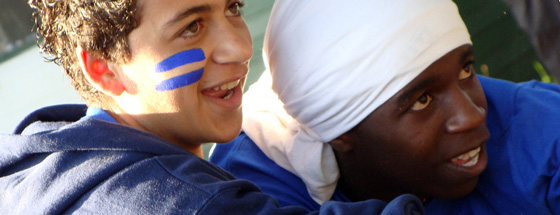
A sunny day greeted us, as well as a lot of cheering, as the Blue and Green Teams jumped out of their bunks, took care of their laundry in record time and then got ready for the giant rope pull. Photographers lined the road as the whole Camp took part in a contest to see which team could pull the rope to their side. First the girls did it and then the boys did it. Finally, both girls and boys from each team did it together. Blue won all three contests! This created a huge lead for the team and a big challenge for both the Green and Blue coaches. The Green coaches don’t want their campers to become discouraged and the Blue Team coaches warned their campers not to become too sure of themselves. Either way, these opposite attitudes could cause them to lose.
For most of the day, there was a bunk rotation of competition in basketball, soccer, Frisbee, table tennis, tennis, volleyball and street hockey. One boy, named Aboud, really stood out. In soccer, he scored a goal from three-quarters of the way down the field. Then in basketball, he made a basket from the opposite end of the court. His teammates were so happy that they just piled on top of him!
We have had so many visitors these days. Most of them are former campers, counselors or donors. Carlson Wagonlit Travel executives visited today. We also had a former counselor whose former campers are all counselors now. The counselors are a group of highly accomplished and innovative change-makers themselves. They are the unsung arm of Seeds of Peace, without whom the program would pale in comparison to what it has become.
Days 19-20 | August 8-9
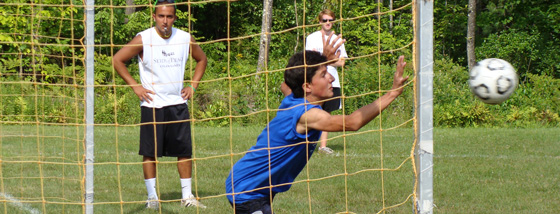
The second day of Color Games is even more demanding that the first. Not only do the campers compete in all-star games of every sport, but they also compete in art, dance, music, cooking and the ropes course. After each meal the cumulative scores are announced and a team member from each side is chosen to change the score board to reflect the new winnings. All throughout the second day, the Blue Team continued to dominate until by the end of the day, Blue held a 400-point lead. It looked so bad for the Green Team that the Blue Team made up a cheer that involved hugging the Green Team members.
Then came the Variety Show at night. Each team was expected to create a team song about Camp life, a comedy skit about being “ridiculous” at Camp, a drama, a dance number, a drama and an a capella performance. The Show was wonderful in every way, demonstrating how talented the campers and their coaches really are.
But, the third day was the final test. There is always something special before breakfast. On the second day it was a foot race around the Camp road. Today is was a race in the huge Indian war canoe we have (we call it a peace canoe). Several campers fit inside it and paddle for all they are worth to make the best time between the boys beach and a small beach up by the dining hall. Then a runner has to race to the morning bell and ring it.
The Message to Hajime takes all morning. There are 106 objectives that have to be met by individual members of each team, combined with a relay race. During this period, all of Camp is abuzz with runners and bike riders racing from one station to another. The culmination of this race is the message, which one member of each team has to memorize, and then the stop watch is punched. The winner takes all.
Down close to the lake, everyone gathered to hear the scores from the Variety Show and the Message to Hajime. Neither team knew who had won. When the winner was announced, the Green Team, which just yesterday had seemed like they would lose, ran into the lake, victorious after all. They were followed immediately by the second winner, the Blue Team. The community was then reunited with hugs, splashes and the Seeds of Peace song.
Days 21-22 | August 10-11
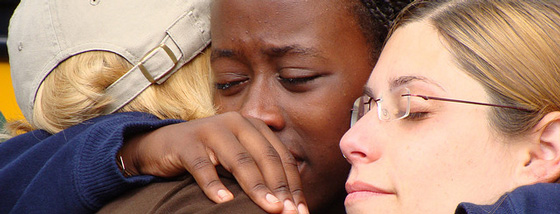
Last night we had a memorial service for Asel Asleh, the only Seed who has been killed in the Middle East conflict, as well as seven other Seeds who have died from other causes. Since his death in 2000, Asel has been memorialized at each session of Camp. We read some of the wonderful things he wrote to the Seeds of Peace community and thank him for inspiring the creation of SeedsNet, now known as SeedsBook.
In the morning, Bobbie invited the entire Camp to participate in a Quaker silent meeting. This format allows people to collect their thoughts and feelings at this sensitive time, when everyone is struggling with conflicting strong emotions. On the one hand, everyone is excited to be going home soon. But, on the other hand, separating from friends made at Camp is tortuous. For about 30 minutes, everyone remained silent together in the Big Hall. Then, one by one, several people spoke about the impact of their Camp experience. Afterward, half the Camp held dialogue sessions while the other half started packing for their trip home. In the afternoon, the schedule was reversed.
After dinner, several staff members talked with the campers about “life after Camp.” The campers were encouraged to participate in the follow-up programs in their home countries and in SeedsBook, our serious version of Facebook. Then everyone was treated to a 500-person slideshow taken by several photographers at Camp.
The Seeds of Peace Band, made up of six very talented counselors, played music for singing and dancing in the Big Hall. This was followed by the traditional speeches given by the Color Games coaches at the fire pit. At last, the time for sleeping had arrived, although few took advantage of it.
The Peer Support campers met with Bobbie for the traditional “turtle talk.” Each of them received a turtle pendant to remind them of their ties to Seeds of Peace and help them feel like they are carrying their second home, Seeds of Peace, around with them wherever they may go.
Early the next morning, the buses began to roll in and the delegations left amid tears, long hugs and promises to stay in touch. The follow-up programs, Facebook, SeedsBook, and other ways of connecting will keep most of these Seeds from drifting away from their Seeds of Peace community of support. Parents who came to pick up their American campers were also moved to tears as they watched their children try to cope with the enormous sadness of parting with people they love, maybe forever.
It was a wonderful two sessions. As usual, Seeds of Peace Camp was a group effort, led by Leslie Lewin and Wil Smith. The counselors were very balanced, talented, mature and flexible. They were also not averse to having fun and letting the rest of us in on the jokes. A wide thread of music wove its way throughout Camp, making musical connections all day long. We know this Camp isn’t like the real world. But that doesn’t mean it isn’t real. It did happen, just as we told you. It has happened 40 times before and it will happen again. Now there are 300 more young leaders who can tell everyone at home that peace is possible!